Before we get to the real problems with nuclear power, let's talk about public opinion*. A well publicized CBS News Poll tells us the following about whether people approve of building new nuclear power plants in the United States**:
2007 - 45% in favor, 47% against, 8% unsure
2008 - 57% in favor, 34% against, 9% unsure
2011 - 43% in favor, 50% against, 7% unsure
*Polling numbers here come from the invaluable PollingReport.com.
**It's also worth noting that people have strong opinions about where these new plants are built. When the same people were asked whether they approve of new nuclear power plants in their communities, responses are somewhat more reserved:
2007 - 36% in favor, 55% against, 5% unsure
2011 - 35% in favor, 62% against, 3% unsure
Don't read too much into the slight changes between 2007 and 2011 here, as margin of error is a bugbear in these opinion polls. NIMBY is alive and well, thank you very much. Just build that nuclear power plant over in the other part of town, thank you.
I include the 2007 numbers because they differ significantly from the more widely cited 2008 numbers. They are, in fact, much closer the the March, 2011 results.
It would be foolish, however, to just look at polls here, as there's a definite buzz around both traditional and social media about nuclear power, and a general sense that the tide is turning politically and socially against more nuclear power.
There is no indication, however, that any major "mainstream" politician is ready to take up the anti-nuclear power banner, in chief because that would mean angering a lot of energy industry big-wigs who have a lot of say in who gets to spend more money in the next campaign. That, of course, is a post all on its own, but it bears mentioning here.
Public opinion is our chief concern here. Obviously the fickle masses are easily moved by sensationalism, and there's little more sensationalist than a natural disaster followed by a nuclear meltdown. It's no wonder that Americans, in addition to hilariously buying up vast stores of potassium iodide, are feeling less sure about nuclear power.
But are they right-headed in this change of face? Are the dangers of nuclear power really all that different today than they were a month ago? Of course not. Nuclear meltdown has always, and will always be, a non-negligible risk of nuclear power. It may be exceedingly rare, but even one instance can be devastating. No matter how safe any particular reactor is, the worst-case scenario for nuclear power is disastrous. And that is what people are currently rallying behind.
That is takes an actual disaster to remind people of this fact is, of course, the silly part. We humans have notoriously short memories, and as big a deal as the current situation in Japan seems, it has already lost significant momentum (in the face of a new sensational story in Libya and, of course, the triumphs of Butler and Virginia Commonwealth in March Madness). It's only a matter of time before everyone settles down and forgets how scared they were of nuclear power in March of 2011.
I would argue, though, that it would be foolish to ignore this opportunity to talk about what nuclear power is and isn't. Now, I'm no expert, but I know enough about chemistry and physics, and have done enough background research of my own that I feel confident putting a few important considerations forward here. We've all seen, now, what ill can come of nuclear power gone wrong. What ill, then, can come of nuclear power gone right?
First of all, what is nuclear power gone right? There's little question that nuclear power is incredibly more efficient than our beloved combustible fossil fuels power. It takes, not surprisingly, much less uranium to boil water than it does burning oil, and carbon dioxide doesn't get pumped into the atmosphere along the way. This, however, is the first troubling thing about nuclear power: nuclear waste. As more and more of the world's energy comes from nuclear sources, more and more waste gets produced. What happens to this waste? We store it in vast pools, both because it's still dangerous (check the "legacy waste" section of this Wikipedia article for a heartwarming story about contamination of an aquifer in Ohio) and because we're dealing with half-lives ranging in the 10,000 to 1,000,000 year range.
Yeah.
So, about 10,000 years ago there were a total of, oh, roughly zero cities in the entire world, as human beings had not yet come up with the idea of "civilization." Let's not even talk about 1,000,000 years.
The thing is, no one is quite sure what to do with nuclear waste, exactly, and that's not really a concern for nuclear energy companies. Why think about the future when you can think about the present? Right now there is no question that we need power and we need it from a source other than fossil fuels. Nuclear power already has an infrastructure, it's efficient, and it's mostly safe most of the time (except when there's an earthquake, or there's a problem with the waste storage, or if someone manages to steal some of the uranium or plutonium being refined). And you know what, that's exactly right. For all intents and purposes, nuclear power is what we need to do because, frankly, we've neglected other, better options* for so long that it will take too long and cost too much to replace our massive energy needs with anything else.
*Namely solar. Wind energy has non-negligible and often-overlooked problems beyond how hideous it makes once beautiful hills. The chief among these is the outrageous cost of the lubricants necessary to make the things actually work. Not only are those lubricants expensive, and not only do turbines need lots of it, but usually lubricants are, you guessed it, oil based. Not that they have to be petroleum based, necessarily, but almost all industrial lubricants are.
Here's the real kicker though. Nuclear energy is not a long-term solution to our problems. I highly recommend the Azimuth Project for its collected wisdom (contributions come from a variety of scientists in a variety of fields) on general planet saving, but their piece on "Peak Uranium" is particularly important to our discussion here. The Internet is rife with argumentation about how much uranium there is available for future energy production. Claims range from 10 years to several billion, so obviously someone is lying for political gain.
The Azimuth article offers a simple thought-experiment, instead. Assume we replaced all other energy consumption and production with nuclear power. How long could our current stores of uranium support that level of energy use? Their answer: 10 years. 70 if you count all potential, but not yet mined, sources.
Now that's not saying that there's only 10 (or 70) years of uranium available. As we know, we're moving towards a hybrid energy world, where nuclear power plays a small role in the bigger. But it is informative, no? As we expand our reliance on nuclear power, we have to remember that it is not a renewable source of energy. Even if we find more than we currently have found (something many scientists believe is likely, as there have been few large-scale prospecting efforts), and even if we also tap all available thorium and plutonium sources, nuclear energy simply cannot last forever.
Now, recall that much nuclear waste will continue to be a problem for 10,000 years. Does 70 years worth of power - or even, if we're extra generous and double the uranium available and count thorium as a fuel source and ignore rising and increasingly industrialized and digitized populations, 400 years worth of power - justify 10,000 plus years worth of waste? Does it not seem that the history will deem us barbaric, wanton, and, above all, extremely stupid for making that trade?
As I mentioned above, this doesn't change that we are going to expand the use of nuclear power in both the United States and around the world, nor should it. We truthfully don't have many other options. And that's the point: let's not simply celebrate this "solution" to our energy problems. The nuclear age is a bitter failure on the part of human civilization to plan ahead, to think reasonably, and to act conscientiously towards its future generations.
In short, the immediate future of nuclear energy is bright, indeed, in spite of wavering public opinion. The distant future? That's another story.
Showing posts with label Science. Show all posts
Showing posts with label Science. Show all posts
Sunday, March 27, 2011


Friday, March 11, 2011
The Grade Band Paradox
Ok, so I'm inventing a term here. The term is the title: the "grade band paradox." It refers to an inherent problem in K-12 curricula that no one seems to acknowledge when they're doing research, making policy, or framing standards and tests. In reality, I'm sure I'm not the first to notice this, but it was particularly striking to me as I watched a presentation about ongoing work the National Research Council is doing along with achieve.org on new standards. One of the chief goals of these new standards is "grade bands." In short, the science education pooh-bahs think that there should be logical, rational, cohesive progress from grade to grade, with students from all over the place mirroring each other.
The problem is this*: we are always trying to create a cohesive, comprehensive K-12 curriculum. We want second grade to build on first, first to build on kindergarten, and the same up the chain. High school science classes should be able to rely - in theory - on the work done in the middle school.
*We're going to ignore, for now,** that different places - like Hawaii and New York - might have vastly different cultural and environmental needs in their curricula. A simple example is how much more vital it is to instill an understanding of coral life cycles at a young age in Hawaii, whereas the Hawaiian student will struggle to understand the equally important concepts of continental drift (for example) and the creation and erosion of mountains (like the Appalachians) and how that lends itself to mining.
**We're also going to ignore that individual students might differ from each other.
Wait, that's not the problem yet. That's just good curriculum design. After all, wouldn't we rather have a cohesive experience for our students? No, the problem comes from the continuous reinventing and tweaking that necessarily goes along with these efforts. Rarely does a given set of standards really last all that long. Or, even if the standards stay the same, the state-adopted standard-aligned curriculum changes. Or, even if that stays the same, schools change, teachers are hired and fired, students move around...
The result is that, despite good intentions and sound principles, no student actually receives a coherent K-12 experience. We decide so quickly that there are flaws and policy problems and teacher problems and learner problems and so on that we never actually give our comprehensive K-12 plans the thirteen years they need to run (not to mention the X years after that for the lessons to really take hold).
An example will serve to elucidate the problem:
Johnny is five years old, and will enter kindergarten this fall, in September of 2011. As he begins at his local public school, he'll be operating under the standards and procedures of No Child Left Behind.
Come 2013, the NRC framework and new standards have been published, and the Federal Government moves to adopt them. States slowly follow suit, meaning Johnny's elementary school makes the switch as he enters the fourth grade at the end of 2015.
After a couple of years, Johnny's home state is starting to recognize flaws in the current program, and so they do an internal revision and change testing procedures state wide. As a result, Johnny's state (and school district) adopt a new text book and new curriculum in 2018. Johnny enters seventh grade already having faced NCLB, the new standards, and a revision and curriculum change.
Of course, in 2018 a new President enters office with a new plan for education. He appoints a revolutionary new Secretary of Ed who makes sweeping changes to science curricula in particular, integrating more even more technology and engineering studies than were in the NRC standards of 2013. This process takes three years to come to fruition, and so as Johnny enters his junior year of high school in 2021, he confronts his fourth new integrated, cohesive K-12 system.
And so on. The point being, you can't really have a grade-by-grade curricular arc when the arc changes every three to five years. Kids in America are in school for 13 years, and radical education policy changes - or even small tweaks - lead to a disjointed pathway through the education system.
Of course, policy people don't see past the next election, nor do they see past theory and into reality. To them, the K-12 system they approve in 2013 means that all kids in school in 2013 are receiving a cohesive curricular experience when, in fact, they are not. Most of them will be facing, instead, yet another variation on the standards theme, a variation that throws out much - or at least some - of what they have learned heretofore.
It's hardly surprising, then, when a new system is put in place, but high school students don't seem to perform any better within a year or two, or even four, or even seven. If the new system really works - or if it doesn't - you won't really know for at least 13 years, and there's no getting around it.
A better approach, then, would be to institute new educational policies starting at the kindergarten level, and then working up through the high school. Unless there is a broad consensus that the current system is obviously and demonstrably messed up so badly that it ought to be thrown out (and NCLB might just be such a case), it's probably better to give students an older, but more cohesive experience than a newer, but fragmented and confusing one.
Actually, I should phrase that as a question. I don't know which is better, and I don't know if anyone does, because generally new policy is implemented across the grades, all at once, without any regard for the experiences of students who have been in the current system, operating under its rules and its expectations and its standards for as much as a decade. I would submit that, at some point, it might behoove us to remember the Grade Band Paradox, to remember that your shiny new K-12 framework will never be experienced by a student all the way from K to 12.
Friday, October 29, 2010
On Science Education
I am not a science teacher by trade, but I have found myself teaching science more than any other subject area. Perhaps this is in part a result of my upbringing - my mother is a science teacher - and perhaps a result of pure chance. Regardless of why science has found me and I have found science, my background as a graduate of St. John's has followed close at hand, with the result that I think about science a little differently than many people do, a fact that has helped me to understand science myself, but has not always been to my advantage.
What do I mean by that? Well, one of the most fundamental but unarticulated problems in science education is a failure among the important people in the process to agree on what science really is. That's not to say they should agree, or that agreement is even possible, but rather to say that the lack of a clear definition of science has led to a hodge-podge of curricular methodologies and pedagogies that are non-complementary, and which do more to alienate and confuse students than to empower or interest them.
Scientists, ironically, are probably the most to blame for this situation. There is great lamentation in scientific world about how poorly students do in science. The solution, it seems to these people, is to make science more "real" for students. That is, to align science classes closer to their own experiences as scientists. The problem is, they perceive science to be, generally, a fairly static thing. The average scientists definition of science (and I don't have research to back this up, just my own experiences) seems to be something like this: Science is a set of well-established theories and facts about the natural world arrived by employing a fixed methodology to places where our knowledge is lacking, in order to expand our understanding.
Now there's nothing particularly wrong with this, except it's extremely boring and a waste of student's time. The idea that science is, at its heart, about theories and facts, and an easy-to-use scientific method, to me trivializes the real efforts of science. No, science is not just collecting data and analyzing ad infinitum, the real power of science to affect people's lives lies in something more fundamental to it. To me, science is about a process that is dynamic and contextual. Scientific knowledge is conditional and flexible. Being a scientist is about creativity, critical thinking, and learning.
How much more interesting is this perspective to students? Frankly, they probably don't care how we define science. More important is the result of this perspective on curriculum, on pedagogy, on what happens in the classroom. In the former, the scientist's classroom, students sit and listen to lectures, they engage in laboratory sessions with known answers, they are asked multiple choice questions, they fill in worksheets with word banks. Basically, they're miserable. Even a field trip, in the traditional science classroom, generally leads to little more than the dissemination of information, the collection of useless and meaningless data, or the acquisition of some boring science "skill" that is irrelevant to a student's life.
On the other hand, the latter classroom is organized around the concept of science as inquiry, meaning students are encouraged to develop a more sophisticated understanding of how science really works. That is, by giving students enough structure to keep them on task, but enough freedom to let them develop their own observations, questions, hypotheses, and even experiments and conclusions, students get to learn the real pitfalls of scientific work. What's more, they still learn the content. Perhaps not as much as if they were just lectured at for an hour straight, but what they do learn, they learn better. More importantly, memorizing facts, equations, theories, and methods is a waste of time in our modern world; better to learn how to synthesize, how to analyze, and how to ask good questions.
To illustrate: How many of you readers out there remember anything about how to calculate the effect of friction on a moving body from your high school physics class? For those of you who don't remember, how long do you think it would take you to look it up? I'll give you hint, type in "friction" in Google, and click on the Wikipedia page. There's your equation, plus explanations of how to use it. Good thing your science teachers wanted you to memorize all that.
Beyond acquiring facts, which is manifestly a waste of time, the other biggest problem with traditional science education is that it is built around collecting data. I certainly acknowledge that good data collection is important, but I will also say that data in itself is worthless unless there's some kind of analysis on the other end, not to mention some kind of purpose for collecting it on the front end. It's easy, in pre-made experiments, to point to the supposed "purpose" of certain data, but the whole point of good science education, to my mind, is to get students to make those decisions themselves. What data should they collect? Why? How will they use it?
Now an experienced educator will respond by saying that they need to see that process in action before they can do it themselves, and so we should provide them with situations where they are not designing experiments, where they are working with fake data, where they are performing analysis without doing the legwork to get there. That's fair, but only if we call attention to why we're doing that. Many teachers emphasize the importance of data analysis for its own sake, not as a part of a broader scientific process, and certainly not as a pathway towards meaning.
Ah, there's an interesting word. I suppose, if I had to summarize the two approaches to science education I've discussed here, I would say that the first is about information and the second is about meaning. The problem is, looking for meaning in science is not encouraged by scientists for reasons that are difficult to fathom (though the Freudian in me wants to suggest mean things about scientists being afraid of meaning because of the spiritual, emotional, and social emptiness of their own pursuit of information). The cries that students do poorly in science, to me, reverses the reality: science does poorly for students. Make science real, make it authentic, make is about ideas and not facts, make it about processes and not methods, make it about discussions and not dictation, and then you'll see students do well.
Science is a liberal art, in the root sense of the term. The study of science can help free you from other people's conclusions, from propaganda, from drug commercials that say "studies show..." Science, however, can also bind you and blind you. Unfortunately, the classroom (and, more importantly, the legislator's table and the teacher training program) is, in this discipline as in many others, a battlefield. A battlefield where the "fluffy," holistic, more authentic side is losing, not because it is actually worse, but because it's harder to do well, harder to assess, harder to standardize. Those are fair criticisms, but it might be that part of what's wrong in education, broadly, is that we shy away from what's better but harder too often.
Sunday, August 8, 2010
More Interesting Than It Seems: Arthur C. Clarke
I want to try out a new idea for a shorter kind of post this afternoon (thanks to the somewhat alarming amount of work I need to do between now and August 15th, when I am unceremoniously booted out of my apartment). The idea is to take a famous or semi-famous quotation - or, hey, maybe a really obscure one - and to talk about why it might be a little more interesting than it seems at first blush. Of course, a great many famous quotations are actually quite a bit less interesting than they seem, but we'll try to dodge those for the most part.
What makes a quotation "more interesting" than it seems is largely subjective, but that's part of the point. By the time a famous quotation becomes famous, it has undergone various permutations in context, intonation, and sometimes even diction and syntax to the point that it might not have anything in particular to do with the actual thoughts of the speaker of that quotation. Add to that the sine qua non of famous quotations - that they almost uniformly come from famous people - and it's no wonder famous quotations are easily abused.
So let's begin our own abuse with one of my favorite quotations from Arthur C. Clarke:* "Any sufficiently advanced technology is indistinguishable from magic."
*That until just recently I mistakenly thought this quotation was Isaac Asimov's just goes to show how easily and often unwittingly manipulated these things are.
On the surface, this is a wonderful, if somewhat obvious, thing for a science fiction author to say. There is certainly something fantastical about the way we interact with science fiction stories, and for the most part we're not apt to hold the author's feet to the fire when he or she describes the technologies that make the setting possible. Star Trek fans would not get far if they needed a scientifically plausible explanation for the transporter, holodeck, or warp drive. Fortunately for us, those technologies are sufficiently advanced that they are like magic, and understanding is not important.
What makes the quotation more interesting, however, upon closer inspection is that it contains within it a bit of a cautionary tone.* While Coram and I were working on our Master's Project, one of the students we talked to described his own laboratory experience as being "like magic," and this quotation jumped to my mind. Magic may be fanciful and fun, but it can also be a dangerous stand-in for "lack of understanding."
*Or, at least, we can read a cautionary tone into it.
I think the word "magic" isn't the real locus of interest, though. Rather, "sufficiently advanced" is what really counts. What, exactly, qualifies as "sufficiently advanced." What is advanced to me or you is obviously different than what would be advanced to our great grandparents, or to the ancient Greeks. But I cannot help but feel that, even for us, there's a certain magic that goes into most of the technology we use on a day to day basis. Sure, there are people who understand cars, people who understand computers, people who understand WiFi, people who understand cellphones, people who understand microwaves, and people who understand the electric watch, but there are very very few people indeed for whom at least one of those things is not, in a very real sense, magic.
It's easy to point to authority and say, "ah yes, well, I may not know how a toaster works, but the electrician next door does." The problem is, that's very much what Clarke means by magic. The toaster, even, is sufficiently advanced that we need to call in the local sorcerer to fix it when it goes wrong. And, like magic, it has the power to make yummy food or to burn your house down.
I'm being somewhat facetious, but not entirely. I think, especially from an educational perspective, Clarke's quotation serves to remind us that it's not necessarily a good idea to encourage students to be satisfied with merely calling the local witch-doctor to fix their plumbing. That's not to say we shouldn't employ plumbers, but that we shouldn't simply take for granted that all of this technology we have around us all the time just is. Ultimately, what I'm talking about is two different attitudes towards science (and, subsequently, technology): one is skeptical, empirical, and practical, and the other is dogmatic.
A healthy attitude towards science acknowledges that, hey, we can't all build microwaves, and therefore while it's hardly foolish to use one, it's probably worth spending a little time at least curious about how the darn thing functions. An unhealthy one says, "I don't care, I just want my Instant Ramen." Silly example, sure, but I'll bet you don't have to think that hard to come up with a much more dangerous one. Dogmatic faith in science and the technology it produces is dangerous, after all, because technology is a powerful magic.
Saturday, July 31, 2010
Timaeus at the LDT Expo
Yesterday was the glorious final exhibition of my and my cohort's final Master's Projects. That means that we're all but done, but for the piecing together of a final paper and the assembly of a portfolio of the work we've done over the year (plus, for me anyway, moving out of my apartment in preparation for a return to Hawaii). The Expo was, I must say, a fitting ending to an intense, but rewarding year at Stanford. Fitting because it was intense but rewarding in much the same way.
LDT stands for Learning, Design, and Technology, and as my project partner Coram and I ruminated, our final project was equal parts all three. We were hardly alone in that, as our cohort's projects were much the same, despite ranging in content from nutrition apps for adults to math games for kids. Each project incorporated the three main aspects of the program well, despite - as far as I know - much work to explicitly make sure it happened that way. It's a testament to LDT that the kinds of problems we wanted to tackle were the kind that required a little L, a little D, and a little T.
I'm getting ahead of myself, however, because I haven't described my own project yet. Timaeus, as we happened to call it*, is a web-based visualization tool designed to support dialogue around the scientific process and the nature of science. That's a bit of a mouthful, but I'll do my best to convey the essence of the project here, before I ruminate about the Expo experience.
* Yes, I can't help it, and no, I'm not sorry.**
** That's for my college roommate Joe. Timaeus is a very St. John's thing to call my Master's Project, even if it did happen by accident. Because we Johnnies have a hard time getting away from our eminent Johnny-ness (some might call it "pretension," but that's not quite it, even if it's close), we have to develop a mechanism for acknowledging that sometimes we end up dropping Platonic dialogue names in casual conversation, much to the chagrin to everyone else in the room. The best response, Joe has found (and I think I agree), is in the posterisk before this one.
---------------------------------------------------------
Coram and I, at the outset of working on our project, decided that we wanted to do something around dialogue. We did not know what subject area we would design around, or how we would incorporate technology into a design for dialogic pedagogy, but we both agreed that good conversations in the classroom is the best way to facilitate learning.* The design problem, here, is that technology doesn't really support dialogue in the sense we wanted to support it. Sure, there are Internet forums and there's Twitter and stuff like that, but that's not really dialogue so much as, as one of Coram's Professors described it, "Shouting in a crowded room."
* Yes, I can't help it, and no, I'm not sorry.
One of the tricks to good dialogue is that it can't just be a group of people talking about their opinions. "I think this" followed by "Well, I think that" is all well and good for political "discussion" shows and all (especially when accompanied with a good deal of shouting and thumping), but no one really learns anything without trying out new ideas and really listening to each other. The problem is, without a good shared basis of understanding, most people find there's not really a lot to talk about except life stories, geography, and meteorology. When was the last time you and a stranger started randomly talking about philosophy?
For my part, the last time that happened was with Coram; we were talking about Kant before we knew each other's wives names. The reason, though, was not that we're huge nerds,* but rather that we had both read Kant, so we had a shared text about which we could have a conversation. When our Professors brought up modern educational philosophies based on Hegelian phenomenology, we could step outside the classroom and critique the adaptation of Hegel's method to modern education because we were mutually familiar with what Hegel's method was, and how he talked about it. The point is, it's tough to have those conversations without a shared text.
* We probably are, but that's not the point.
Knowing we wanted to support dialogue, and knowing that the best place for technology was not in dialogue in itself, but in the precursor (some kind of shared language, text, cultural artifact, or what-not), we looked for a subject area. Coram has a background in - among other things - Art History, so we bandied about that, especially because of my dabbling in Music History. We both love literature and poetry, so that came up as well. But the thing is, teachers of literature, art, and music usually do a pretty good job of facilitating dialogue. It's easy, really, because you just have to look at a piece of art, study it for a few minutes, and sit down with someone else who has done the same thing to have a rich conversation. Sure, some artistic theory and historical context can help, but it's not necessary. Likewise with literature, where high schoolers across the country have conversations about Romeo, Odysseus, and Tom Sawyer every year. Those may not be the best dialogues in the world, but for the most part they do happen.
Not so in science classes. Rare indeed is the science class that uses dialogue at all, let alone as the dominant pedagogical model. Science teachers will tell you it's because they have to meet so many standards that they have to just convey information. But those same teachers, if you talk to them outside of class, will lament how they have to spend three weeks on stuff that should take two days because they have to repeat it over and over and over again. I would argue that that might have something to do with how people learn: while there are some people who can pay attention and diligently take notes through an hour long lecture, learning everything, that's not the case for most of us. Rather, we learn better in more dynamic environments, having conversations with friends, visualizing concepts, performing actions. A dialogic classroom, potentially, hits all of those things by opening up not only the content, but the very learning process to the learners involved. Students know how they learn best, so let them lead the learning.
Anyway, the systematic problem of didactic science education isn't really a Master's project, because it's simply too big. Instead, we focused on a narrower goal: providing a technological tool that would give students and teachers access to the rich dialogues in science. Biology teachers know that ethical questions are often fascinating and dynamic areas for student involvement in meaningful science debates, so we wanted to leverage that spirit in a way that spans disciplines. Rather than focusing on fringe issues like current events in the ethics of scientific practice (and, after all, it's hard to have a robust debate about the ethics of particle accelerators), we wanted to cut to the heart of the issue: what is science, anyway?
It is remarkable that, despite the general agreement in the scientific community about so many scientific theories, there is almost no agreement as to the nature of science itself. In the following diagram (from our presentation), you can see one of any number of axes along which eminent scientists and philosophers might be arranged.

That a number of well-known and accepted theories and ideas come from scientists across the spectrum speaks to the value of the very debate about what science is. Consider the same graph, but with some famous scientists (and philosophers) on it:

We could argue about whether each of those luminaries is in the right place, but that's exactly the point. Why oh why would we deny students access to this debate? Is there any reason to shut off such a rich source of dialogue? Does it really help to present to students the idea that science is just a set of steadfast rules and methods, practiced exactly the same way by all scientists, in order that they might discover the Truth? Granted, some scientists do think that, too, but that not everyone does - that Newton operated in a way very different from how Heisenberg did - speaks once more to the value of opening up the conversation to high schoolers, especially because, in the course of the debate, they will naturally have to learn content in order to justify and understand their own positions.
---------------------------------------------------------
So what is Timaeus, then? It's a tool to help students visualize the scientific process, not as a static set of five fixed steps, but as a dynamic, evolving, and iterative set of decisions which may not, it turns out, be easy to classify. We give students a set of five colored shapes that represent the traditions steps of the process, and let them build maps of scientific texts, videos, and accounts of experiments. The results look something like this:
 In case you can't read it, the circle stands for "Observation," the square for "Question," the upwards triangle for "Hypothesis," the downwards triangle for "Experiment," and the diamond for "Claim" or "Conclusion." This example in particular charts the process of John Snow in his effort to uncover the causes of the Broad Street Cholera Outbreak of 1854, as described in this Wikipedia article. This is essentially the same map as you may have seen on this blog a few months back, but this was made using our actual tool (which is still in beta, but can do this much as it stands) and not photoshop.
Reading an account of a text closely enough to make analytical and categorical decisions about what is happening at each point is valuable enough, but where Timaeus really shines is in the ability to move from a single student's work to a class's with the search function:
 This image shows the work of six different LDT students mapping Marie Curie's discovery of Radium. From the exact same speech, the there are a wide range of understandings of what, exactly is happening. From a teacher's perspective, this not only lets you see how students are understanding science, but also provides the entry point to a rich conversation around what is happening in a given scientific experiment. When we ran through this exercise, for example, with a group of young Baha'is in the area, they jumped from the map creation to questions about how radium is isolated, where it comes from, and, ultimately, what elements are and how the periodic table is constructed. As a teacher, it's hard to get students interested in learning about the periodic table, so how cool is it when they actually want you to pull it out and explain it?
---------------------------------------------------------
I could go on about the tool a bit more, but I want to talk about Expo as well. Coram and I presented our project in the morning for a panel of five reviewers. Because our project spans across ideas, our reviewers were hardly a homogeneous group. Of the three Stanford Professors in attendance, one was a curriculum specialist, another a science education specialist (whose own work has been in visualization and scaffolding inquiry), one a human-computer interaction specialist from the Computer Sciences department. Our other reviews came from outside of Stanford, one a IT specialist and administrator, and the other a National Board Certified AP Statistics teacher (whose class we had done a user study with, incidentally). Presenting to an audience with such a varied background meant that we had to be sure to address - in our 20 minutes - everything from learning theory to technology design decisions, but I feel we put together a strong presentation and we seemed to be well-received (with the exception of one somewhat tangential question from a non-reviewer in attendance about the "gender" of our project).
In the afternoon we had a three hour long poster session which was packed. In previous years LDT Expos have been held in a smaller space, elsewhere on campus. This year we were in Wallenburg, which opens to the oval and Palm Drive at the front of the school, and we took up the entire lobby and main floor. And there was a time, early in the session, when you could barely move. This may seem unremarkable, but apparently there were about 3 times as many people at this Expo as there have ever been, which means both that our Expo Committee (and our Program Coordinator Karin) did an excellent job getting the word out, and that LDT is gaining some notoriety around the Bay Area and hopefully beyond.
The really value here, though, is that it makes the capstone project of a year's work feel really worth it. It may be exhausting to talk for three hours straight to a continuous string of people wanting to know about your project, but it's awesome that people actually want to know about your project. Even better, for Coram and I, was the feeling we got that people really thought that what we are trying to do is worthwhile. We would believe in it either way, I think, but that doesn't mean that it doesn't help to hear that other people do too.
This project, though, isn't just about feeling good. Because I'll be teaching science back in Hawaii next year with Nalu Studies, I truly do feel that Timaeus is something that can and should be used in the classroom. The kids Nalu is designed for - at-risk and high-risk teens - can benefit as much as anyone from really exploring the nature of scientific work, because it helps them to unlock a whole new way of making and evaluating decisions. For kids who have often already made some bad decisions, there's nothing more empowering than learning how to make better ones in the future, and moreover how to tell the difference ahead of time, how to pick each other up, and how to fail gracefully instead of tragically.
---------------------------------------------------------
As a conclusion, I want to talk a little about the name Timaeus. To be honest, Coram and I struggled to decide on a name for our tool for a long time, finally settling on Timaeus on the day when we had to submit our final name for the LDT Expo poster. As we've thought more about it, however, we're increasingly of the opinion that it fits. In case you don't know, Timaeus is a dialogue by Plato about the nature of the universe. It's a precursor to Aristotle's Physics and his Metaphysics, in that it attempts to layout how the cosmos is arranged, what the soul is, and how we understand and talk about the material and metaphysical world. In short, it's the first foray into describing the nature of science, despite the absence of that term, and the highly logical (instead of empirical) nature of the process.
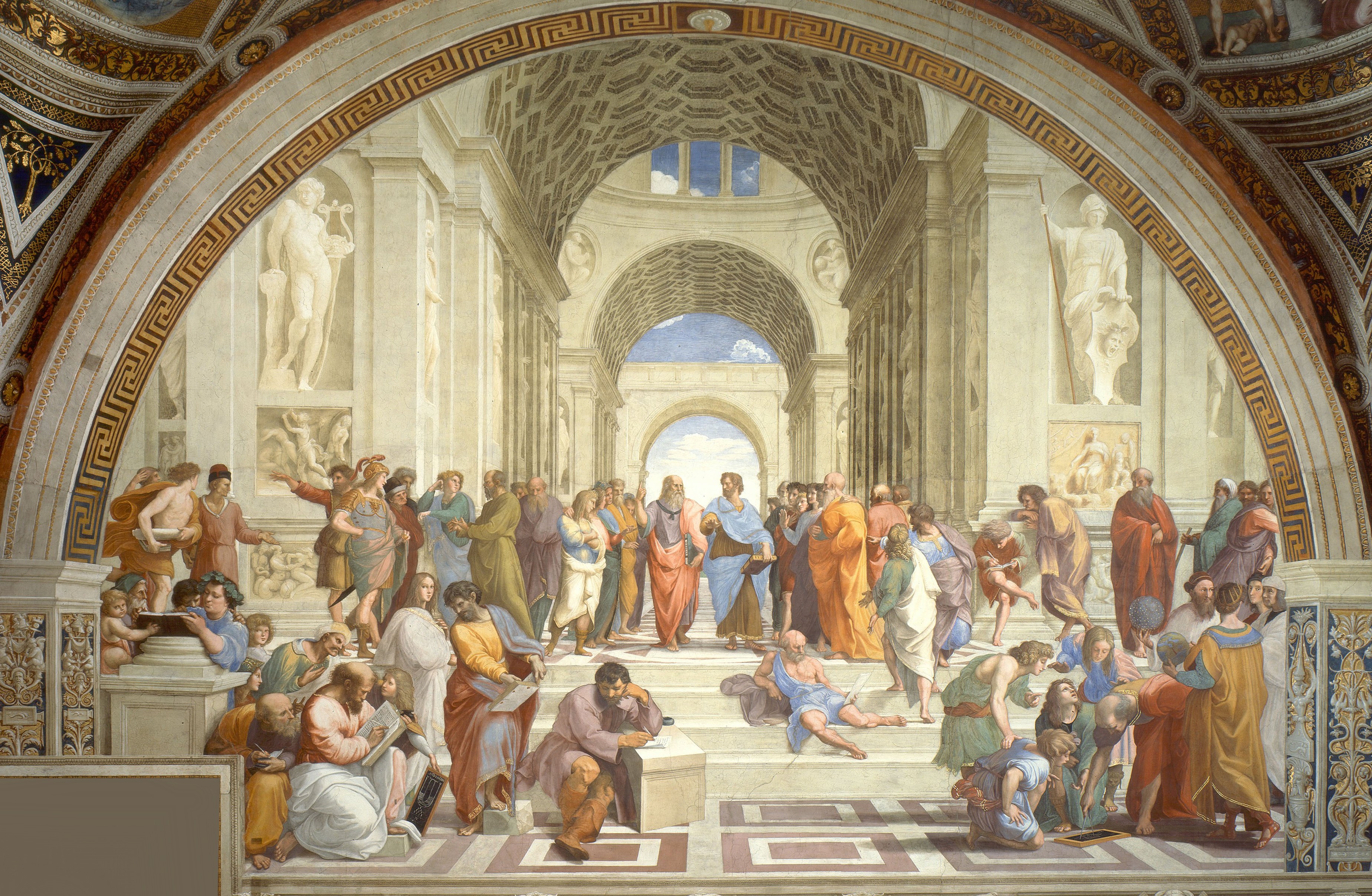
If you know of Raphael's famous School of Athens you may know that Plato and Aristotle are the figures at the center of the work. Coram - as an Art History minor - and I both love the painting, and had discussed it prior to selecting our name. After we came to Timaeus, however we returned to the painting because, as I knew (but Coram did not), the dialogue that is under Plato's arm is the Timaeus. There's something fitting about that, because just as Plato and his academy were one of the first forays into forming a scientific community - and just as Raphael's own artistic and scientific community was a rekindling of that same spirit of inquiry - we believe that modern science education should shift to include more students in the debate around the nature of science, the world, and the pursuit of knowledge. Regardless of what happens with our particular technological and curricular tools, that aim is one we both will share with, we hope, an ever-increasing number of educators for the rest of our lives.
LDT stands for Learning, Design, and Technology, and as my project partner Coram and I ruminated, our final project was equal parts all three. We were hardly alone in that, as our cohort's projects were much the same, despite ranging in content from nutrition apps for adults to math games for kids. Each project incorporated the three main aspects of the program well, despite - as far as I know - much work to explicitly make sure it happened that way. It's a testament to LDT that the kinds of problems we wanted to tackle were the kind that required a little L, a little D, and a little T.
I'm getting ahead of myself, however, because I haven't described my own project yet. Timaeus, as we happened to call it*, is a web-based visualization tool designed to support dialogue around the scientific process and the nature of science. That's a bit of a mouthful, but I'll do my best to convey the essence of the project here, before I ruminate about the Expo experience.
* Yes, I can't help it, and no, I'm not sorry.**
** That's for my college roommate Joe. Timaeus is a very St. John's thing to call my Master's Project, even if it did happen by accident. Because we Johnnies have a hard time getting away from our eminent Johnny-ness (some might call it "pretension," but that's not quite it, even if it's close), we have to develop a mechanism for acknowledging that sometimes we end up dropping Platonic dialogue names in casual conversation, much to the chagrin to everyone else in the room. The best response, Joe has found (and I think I agree), is in the posterisk before this one.
---------------------------------------------------------
Coram and I, at the outset of working on our project, decided that we wanted to do something around dialogue. We did not know what subject area we would design around, or how we would incorporate technology into a design for dialogic pedagogy, but we both agreed that good conversations in the classroom is the best way to facilitate learning.* The design problem, here, is that technology doesn't really support dialogue in the sense we wanted to support it. Sure, there are Internet forums and there's Twitter and stuff like that, but that's not really dialogue so much as, as one of Coram's Professors described it, "Shouting in a crowded room."
* Yes, I can't help it, and no, I'm not sorry.
One of the tricks to good dialogue is that it can't just be a group of people talking about their opinions. "I think this" followed by "Well, I think that" is all well and good for political "discussion" shows and all (especially when accompanied with a good deal of shouting and thumping), but no one really learns anything without trying out new ideas and really listening to each other. The problem is, without a good shared basis of understanding, most people find there's not really a lot to talk about except life stories, geography, and meteorology. When was the last time you and a stranger started randomly talking about philosophy?
For my part, the last time that happened was with Coram; we were talking about Kant before we knew each other's wives names. The reason, though, was not that we're huge nerds,* but rather that we had both read Kant, so we had a shared text about which we could have a conversation. When our Professors brought up modern educational philosophies based on Hegelian phenomenology, we could step outside the classroom and critique the adaptation of Hegel's method to modern education because we were mutually familiar with what Hegel's method was, and how he talked about it. The point is, it's tough to have those conversations without a shared text.
* We probably are, but that's not the point.
Knowing we wanted to support dialogue, and knowing that the best place for technology was not in dialogue in itself, but in the precursor (some kind of shared language, text, cultural artifact, or what-not), we looked for a subject area. Coram has a background in - among other things - Art History, so we bandied about that, especially because of my dabbling in Music History. We both love literature and poetry, so that came up as well. But the thing is, teachers of literature, art, and music usually do a pretty good job of facilitating dialogue. It's easy, really, because you just have to look at a piece of art, study it for a few minutes, and sit down with someone else who has done the same thing to have a rich conversation. Sure, some artistic theory and historical context can help, but it's not necessary. Likewise with literature, where high schoolers across the country have conversations about Romeo, Odysseus, and Tom Sawyer every year. Those may not be the best dialogues in the world, but for the most part they do happen.
Not so in science classes. Rare indeed is the science class that uses dialogue at all, let alone as the dominant pedagogical model. Science teachers will tell you it's because they have to meet so many standards that they have to just convey information. But those same teachers, if you talk to them outside of class, will lament how they have to spend three weeks on stuff that should take two days because they have to repeat it over and over and over again. I would argue that that might have something to do with how people learn: while there are some people who can pay attention and diligently take notes through an hour long lecture, learning everything, that's not the case for most of us. Rather, we learn better in more dynamic environments, having conversations with friends, visualizing concepts, performing actions. A dialogic classroom, potentially, hits all of those things by opening up not only the content, but the very learning process to the learners involved. Students know how they learn best, so let them lead the learning.
Anyway, the systematic problem of didactic science education isn't really a Master's project, because it's simply too big. Instead, we focused on a narrower goal: providing a technological tool that would give students and teachers access to the rich dialogues in science. Biology teachers know that ethical questions are often fascinating and dynamic areas for student involvement in meaningful science debates, so we wanted to leverage that spirit in a way that spans disciplines. Rather than focusing on fringe issues like current events in the ethics of scientific practice (and, after all, it's hard to have a robust debate about the ethics of particle accelerators), we wanted to cut to the heart of the issue: what is science, anyway?
It is remarkable that, despite the general agreement in the scientific community about so many scientific theories, there is almost no agreement as to the nature of science itself. In the following diagram (from our presentation), you can see one of any number of axes along which eminent scientists and philosophers might be arranged.

That a number of well-known and accepted theories and ideas come from scientists across the spectrum speaks to the value of the very debate about what science is. Consider the same graph, but with some famous scientists (and philosophers) on it:

We could argue about whether each of those luminaries is in the right place, but that's exactly the point. Why oh why would we deny students access to this debate? Is there any reason to shut off such a rich source of dialogue? Does it really help to present to students the idea that science is just a set of steadfast rules and methods, practiced exactly the same way by all scientists, in order that they might discover the Truth? Granted, some scientists do think that, too, but that not everyone does - that Newton operated in a way very different from how Heisenberg did - speaks once more to the value of opening up the conversation to high schoolers, especially because, in the course of the debate, they will naturally have to learn content in order to justify and understand their own positions.
---------------------------------------------------------
So what is Timaeus, then? It's a tool to help students visualize the scientific process, not as a static set of five fixed steps, but as a dynamic, evolving, and iterative set of decisions which may not, it turns out, be easy to classify. We give students a set of five colored shapes that represent the traditions steps of the process, and let them build maps of scientific texts, videos, and accounts of experiments. The results look something like this:
 In case you can't read it, the circle stands for "Observation," the square for "Question," the upwards triangle for "Hypothesis," the downwards triangle for "Experiment," and the diamond for "Claim" or "Conclusion." This example in particular charts the process of John Snow in his effort to uncover the causes of the Broad Street Cholera Outbreak of 1854, as described in this Wikipedia article. This is essentially the same map as you may have seen on this blog a few months back, but this was made using our actual tool (which is still in beta, but can do this much as it stands) and not photoshop.
Reading an account of a text closely enough to make analytical and categorical decisions about what is happening at each point is valuable enough, but where Timaeus really shines is in the ability to move from a single student's work to a class's with the search function:
 This image shows the work of six different LDT students mapping Marie Curie's discovery of Radium. From the exact same speech, the there are a wide range of understandings of what, exactly is happening. From a teacher's perspective, this not only lets you see how students are understanding science, but also provides the entry point to a rich conversation around what is happening in a given scientific experiment. When we ran through this exercise, for example, with a group of young Baha'is in the area, they jumped from the map creation to questions about how radium is isolated, where it comes from, and, ultimately, what elements are and how the periodic table is constructed. As a teacher, it's hard to get students interested in learning about the periodic table, so how cool is it when they actually want you to pull it out and explain it?
---------------------------------------------------------
I could go on about the tool a bit more, but I want to talk about Expo as well. Coram and I presented our project in the morning for a panel of five reviewers. Because our project spans across ideas, our reviewers were hardly a homogeneous group. Of the three Stanford Professors in attendance, one was a curriculum specialist, another a science education specialist (whose own work has been in visualization and scaffolding inquiry), one a human-computer interaction specialist from the Computer Sciences department. Our other reviews came from outside of Stanford, one a IT specialist and administrator, and the other a National Board Certified AP Statistics teacher (whose class we had done a user study with, incidentally). Presenting to an audience with such a varied background meant that we had to be sure to address - in our 20 minutes - everything from learning theory to technology design decisions, but I feel we put together a strong presentation and we seemed to be well-received (with the exception of one somewhat tangential question from a non-reviewer in attendance about the "gender" of our project).
In the afternoon we had a three hour long poster session which was packed. In previous years LDT Expos have been held in a smaller space, elsewhere on campus. This year we were in Wallenburg, which opens to the oval and Palm Drive at the front of the school, and we took up the entire lobby and main floor. And there was a time, early in the session, when you could barely move. This may seem unremarkable, but apparently there were about 3 times as many people at this Expo as there have ever been, which means both that our Expo Committee (and our Program Coordinator Karin) did an excellent job getting the word out, and that LDT is gaining some notoriety around the Bay Area and hopefully beyond.
The really value here, though, is that it makes the capstone project of a year's work feel really worth it. It may be exhausting to talk for three hours straight to a continuous string of people wanting to know about your project, but it's awesome that people actually want to know about your project. Even better, for Coram and I, was the feeling we got that people really thought that what we are trying to do is worthwhile. We would believe in it either way, I think, but that doesn't mean that it doesn't help to hear that other people do too.
This project, though, isn't just about feeling good. Because I'll be teaching science back in Hawaii next year with Nalu Studies, I truly do feel that Timaeus is something that can and should be used in the classroom. The kids Nalu is designed for - at-risk and high-risk teens - can benefit as much as anyone from really exploring the nature of scientific work, because it helps them to unlock a whole new way of making and evaluating decisions. For kids who have often already made some bad decisions, there's nothing more empowering than learning how to make better ones in the future, and moreover how to tell the difference ahead of time, how to pick each other up, and how to fail gracefully instead of tragically.
---------------------------------------------------------
As a conclusion, I want to talk a little about the name Timaeus. To be honest, Coram and I struggled to decide on a name for our tool for a long time, finally settling on Timaeus on the day when we had to submit our final name for the LDT Expo poster. As we've thought more about it, however, we're increasingly of the opinion that it fits. In case you don't know, Timaeus is a dialogue by Plato about the nature of the universe. It's a precursor to Aristotle's Physics and his Metaphysics, in that it attempts to layout how the cosmos is arranged, what the soul is, and how we understand and talk about the material and metaphysical world. In short, it's the first foray into describing the nature of science, despite the absence of that term, and the highly logical (instead of empirical) nature of the process.
If you know of Raphael's famous School of Athens you may know that Plato and Aristotle are the figures at the center of the work. Coram - as an Art History minor - and I both love the painting, and had discussed it prior to selecting our name. After we came to Timaeus, however we returned to the painting because, as I knew (but Coram did not), the dialogue that is under Plato's arm is the Timaeus. There's something fitting about that, because just as Plato and his academy were one of the first forays into forming a scientific community - and just as Raphael's own artistic and scientific community was a rekindling of that same spirit of inquiry - we believe that modern science education should shift to include more students in the debate around the nature of science, the world, and the pursuit of knowledge. Regardless of what happens with our particular technological and curricular tools, that aim is one we both will share with, we hope, an ever-increasing number of educators for the rest of our lives.
Tuesday, April 13, 2010
Visualizing the Broad Street Cholera Outbreak

I don't know that this is big enough for you to make out the text (it gets bigger if you click on it!), but you don't need to read the words to get the bigger sense. I won't say much about the theory behind this, since my previous post got into some of that. Instead, I want to provide a brief description of the artifact and let it simmer.
First off, since the legend isn't on this, circles represent questions, squares represent questions, upwards-facing triangles represent hypotheses, downward-facing triangles represent experiments, and diamonds represent conclusions. On the whole, the diagram above represent the process that John Snow used while dealing with the Broad Street Cholera Outbreak in 1854. As you can see, there's a general tendency to move through the traditional steps of the scientific process, but it is notable that questions and observations pop up throughout, where experiments and conclusions are much more infrequent. Of course, the point is not to generalize here, but to open up dialogues: why might observations and questions be more prominent? Should they be?
There's also a lot of room for debate as to whether each node is assigned the correct shape. Some of the observations could be characterized as experiments, for example. Likewise, some observations might be conclusions. How can you separate a hypothesis from the question that leads to it? All of those are discussion points, and the purpose of this artifact is to help generate those kinds of questions.
One other important note here is the cloud down at the bottom right. Since we are planning on making a web-based tool that will help students generate process maps like this one, we also see the potential to jump off of existing questions (and data) in the direction of new discoveries. Historically, this is not uncommon in science, but the jumping-off process - like the narrower process of a single experiment - is usually quite obscure. We want to make it easier to find questions to jump off of, and to make it clear where that jumping off happens.
Anyway, in this artifact in particular, the cloud represents the process that generated germ theory. Snow himself, in solving the cholera problem, did not develop a theory as to why people were getting sick (beyond there being sewage in the water). The attendant question, "why does sewage in water make people sick," may sound silly to us today, but at the time there was no meaningful answer. Snow pursued a more practical path - getting the sewage out of the water - but left it to future scientists to address the bigger question.
Constructing historical exemplars of the dynamic scientific process will be an important part of our project, but in so doing we've already learned how important it is to be careful about phrasing. It is so natural to assume modern knowledge about, for example, bacteria, when in fact that was non-existent at the time Snow was operating. Even the question, "What was in the water?" presupposes things which at the time scientists had no reason to suspect. Of course, in being careful about historical knowledge, we're finding that there are discussion points we hadn't even considered.
Image Credit to Jericha.
Thursday, April 8, 2010
The Scientific Process (feat. Vincent Van Gogh)
I've teamed up with a fellow LDT student, and we're heading towards the first draft of our proposal for a Master's project. I should say, rather, that our proposal is due tomorrow, and we're in the process of constructing something like a draft. Really, our problem is that we have more writing than we can possibly use to fill our 2,000 word limit, and we still haven't written everything we need to write. Such is proposal writing.
Anyway, I won't get into the project too much yet, since I'm sure I'll be sharing more about it as it gets more advanced, and because I want to leave room for a little suspense and imagination. Instead, I want to offer a few thoughts that are central to what we're doing: the scientific process. What, in short, really is the scientific process? How should it be taught? How is it used? What does it look like?
There is, of course, no systematic agreement about what the scientific process is and exactly which steps should be a part of it. Indeed, there is much debate about whether it should be called the "scientific method" or the "scientific process." I choose process because I think that fits better with my conception of how it operates, but "method" is more historical (Francis Bacon deemed his work on the matter a method). Nevertheless, there are generally five steps, through which the scientist is meant to proceed in order (methodically) in order to come to a better understanding of the external natural world. Those steps are as follows:
1) Observation
2) Question
3) Hypothesis
4) Experiment
5) Conclusion
Generally speaking, the scientific process is taught like this, as I said, with perhaps some linguistic modifications. It is not uncommon, of course, to call out the iterative nature of the scientific process - that is, that a conclusion might just qualify as a new observation - but there is general agreement that these steps in this order more or less make up the effort of science, and they are not accidentally a prominent feature in science standards and benchmarks across the country.
Do scientists really follow this process? That is not so clear. It certainly seems as though observations, questions, hypotheses, experiments, and conclusions are important parts of the act of doing science, but are they always used sequentially, in just that order? Reflecting on thought-process in general, it is not clear that we always begin with an observation; rather, we might start from a hypothesis or even an experiment. We might say that we are, nevertheless, making an unconscious observation to get there, but does that substantively change the process, or not?
More telling, however, is when we go from observation to question, back to observation. Or when we go from question to question. Or when we go from question straight to experiment without formulating a hypothesis. All of those things unquestionably do happen. Sometimes, before experimentation, we pass through a long series of observations, questions, and hypotheses. Sometimes, unfortunately, we jump straight from questions to conclusions, favoring action over information-gathering (especially when there's insufficient time to test).
That's all abstract, so here is an example. To keep this broad, I'll use a famous work of art rather than a physical and scientific phenomenon. By analyzing a piece of art, I also want to point out that the scientific process is a heuristic tool useful in more than just science:

Observation - I see houses in this painting.
Question - Why are the lines in the houses so much straighter than lines elsewhere.
(Unconscious) Hypothesis - It has something to do with the nature of houses.
Question - What else is in the painting?
Observation - I see a large green thing.
Question - What is that?
Hypothesis - Maybe it's a tree or a bush?
... (note that here I could do the "experiment" of looking up interpretations)
Question - OK, what else is in the painting?
Observation - There seem to be hills, and a highly stylized sky.
Observation - The lines in the hills are less wavy than those in the sky, but they are still soft and flowing.
Observation - The sky is quite swirly.
Observation - The painting's title, Starry Night, tells me that the yellow spots are starts, though somewhat abstracted.
Observation - The big "star" on the right is actually the moon!
Hypothesis - The moon is meant to imply the sun in this painting.
... (again we could "experiment" here, but I'm trying to stay on the path of my initial question)
Hypothesis - Van Gogh is painting natural things with more and more flowing lines than man-made things.
Observation - The church steeple is quite prominent.
Experiment - An analysis and interpretation of the painting suggests that Van Gogh painted this whilst desiring to reconnect with nature. He was in a psychiatric hospital, and was disconnected from the world literally as well as figuratively - a fact augmented by his recent decision to cut off his own ear, which landed him in the hospital to begin with.
Conclusion - The town in Starry Night is soft and forgiving, but remains less free than the natural aspects of the scenery. The steeple could signify a very human sense of hope, but could also be a menacing intrusion on a much more beautiful and interconnected natural world. It does not seem to me that Van Gogh is arguing anything - least of all a "return to nature," - but nevertheless he expresses a stirring (which seems just the right word) picture of the contrast between the form of nature and the forms constructed by man, all-the-while knowing that his painting expresses more than fulfills his desire to bridge those gaps.
A few things here. First off, I don't have the slightest clue whether this interpretation - my "conclusion" - is at all reasonable. I do know, however, that I arrived at it by following a certain process, which I have traced out above. Part of the reason for giving an example with a work of art, here, is to emphasize that scientific knowledge is not unlike the interpretation I've offered here. A scientific conclusion may be reasonable, but it is hard to claim with certainty that it is necessarily correct. Even expressing the actual, and more verbose, process of scientific thinking - as opposed to the 5-step formula we generally teach - there are steps that I've likely left out (I did go back and add a unconscious hypothesis, and could likely add more, but you get the idea).
At the very least, there are points of contention throughout the process I've laid out. Where did I observe, and where did I hypothesize? How many of those observations were genuinely observations, not constrained by hypotheses I had already built? How well did I do in asking questions that did not lead to an expected answer? All of those things I should reflect on, because a good scientist tries to be objective, not by destroying his subjectivity - an impossible task - but by becoming conscious of what directions his subjectivity is likely to pull him in. Indeed, I might ask, is it problematic that my conclusion was in part determined by the prejudices and beliefs that I brought with me into the analysis? If not, would it be problematic if a scientist doing, say, pharmaceutical research, were guilty of the same thing (that is, expecting or desiring a certain outcome)?
As you may have guessed, a part of opening up the scientific process like this - understanding it as a dynamic and iterative process that need not proceed "in order" and can happily dance around especially in the early stages for a long time - is opening up dialogue. Science, contrary to much modern pedagogy, is actually one of the liberal arts, and the division between science and the humanities is less than helpful. My choice to analyze Van Gogh instead of photosynthesis implies this bias on my part, but I hope that you can see by virtue of my selection that scientific thinking is critical thinking, just as much as literary or artistic analysis, and that science should embrace dialogue.
With that in mind, I want to pose a final question. How could we express this messy, but genuine, version of the scientific process more succinctly, thus making it easier to digest and, hopefully, easier to talk about?
Anyway, I won't get into the project too much yet, since I'm sure I'll be sharing more about it as it gets more advanced, and because I want to leave room for a little suspense and imagination. Instead, I want to offer a few thoughts that are central to what we're doing: the scientific process. What, in short, really is the scientific process? How should it be taught? How is it used? What does it look like?
There is, of course, no systematic agreement about what the scientific process is and exactly which steps should be a part of it. Indeed, there is much debate about whether it should be called the "scientific method" or the "scientific process." I choose process because I think that fits better with my conception of how it operates, but "method" is more historical (Francis Bacon deemed his work on the matter a method). Nevertheless, there are generally five steps, through which the scientist is meant to proceed in order (methodically) in order to come to a better understanding of the external natural world. Those steps are as follows:
1) Observation
2) Question
3) Hypothesis
4) Experiment
5) Conclusion
Generally speaking, the scientific process is taught like this, as I said, with perhaps some linguistic modifications. It is not uncommon, of course, to call out the iterative nature of the scientific process - that is, that a conclusion might just qualify as a new observation - but there is general agreement that these steps in this order more or less make up the effort of science, and they are not accidentally a prominent feature in science standards and benchmarks across the country.
Do scientists really follow this process? That is not so clear. It certainly seems as though observations, questions, hypotheses, experiments, and conclusions are important parts of the act of doing science, but are they always used sequentially, in just that order? Reflecting on thought-process in general, it is not clear that we always begin with an observation; rather, we might start from a hypothesis or even an experiment. We might say that we are, nevertheless, making an unconscious observation to get there, but does that substantively change the process, or not?
More telling, however, is when we go from observation to question, back to observation. Or when we go from question to question. Or when we go from question straight to experiment without formulating a hypothesis. All of those things unquestionably do happen. Sometimes, before experimentation, we pass through a long series of observations, questions, and hypotheses. Sometimes, unfortunately, we jump straight from questions to conclusions, favoring action over information-gathering (especially when there's insufficient time to test).
That's all abstract, so here is an example. To keep this broad, I'll use a famous work of art rather than a physical and scientific phenomenon. By analyzing a piece of art, I also want to point out that the scientific process is a heuristic tool useful in more than just science:
Observation - I see houses in this painting.
Question - Why are the lines in the houses so much straighter than lines elsewhere.
(Unconscious) Hypothesis - It has something to do with the nature of houses.
Question - What else is in the painting?
Observation - I see a large green thing.
Question - What is that?
Hypothesis - Maybe it's a tree or a bush?
... (note that here I could do the "experiment" of looking up interpretations)
Question - OK, what else is in the painting?
Observation - There seem to be hills, and a highly stylized sky.
Observation - The lines in the hills are less wavy than those in the sky, but they are still soft and flowing.
Observation - The sky is quite swirly.
Observation - The painting's title, Starry Night, tells me that the yellow spots are starts, though somewhat abstracted.
Observation - The big "star" on the right is actually the moon!
Hypothesis - The moon is meant to imply the sun in this painting.
... (again we could "experiment" here, but I'm trying to stay on the path of my initial question)
Hypothesis - Van Gogh is painting natural things with more and more flowing lines than man-made things.
Observation - The church steeple is quite prominent.
Experiment - An analysis and interpretation of the painting suggests that Van Gogh painted this whilst desiring to reconnect with nature. He was in a psychiatric hospital, and was disconnected from the world literally as well as figuratively - a fact augmented by his recent decision to cut off his own ear, which landed him in the hospital to begin with.
Conclusion - The town in Starry Night is soft and forgiving, but remains less free than the natural aspects of the scenery. The steeple could signify a very human sense of hope, but could also be a menacing intrusion on a much more beautiful and interconnected natural world. It does not seem to me that Van Gogh is arguing anything - least of all a "return to nature," - but nevertheless he expresses a stirring (which seems just the right word) picture of the contrast between the form of nature and the forms constructed by man, all-the-while knowing that his painting expresses more than fulfills his desire to bridge those gaps.
A few things here. First off, I don't have the slightest clue whether this interpretation - my "conclusion" - is at all reasonable. I do know, however, that I arrived at it by following a certain process, which I have traced out above. Part of the reason for giving an example with a work of art, here, is to emphasize that scientific knowledge is not unlike the interpretation I've offered here. A scientific conclusion may be reasonable, but it is hard to claim with certainty that it is necessarily correct. Even expressing the actual, and more verbose, process of scientific thinking - as opposed to the 5-step formula we generally teach - there are steps that I've likely left out (I did go back and add a unconscious hypothesis, and could likely add more, but you get the idea).
At the very least, there are points of contention throughout the process I've laid out. Where did I observe, and where did I hypothesize? How many of those observations were genuinely observations, not constrained by hypotheses I had already built? How well did I do in asking questions that did not lead to an expected answer? All of those things I should reflect on, because a good scientist tries to be objective, not by destroying his subjectivity - an impossible task - but by becoming conscious of what directions his subjectivity is likely to pull him in. Indeed, I might ask, is it problematic that my conclusion was in part determined by the prejudices and beliefs that I brought with me into the analysis? If not, would it be problematic if a scientist doing, say, pharmaceutical research, were guilty of the same thing (that is, expecting or desiring a certain outcome)?
As you may have guessed, a part of opening up the scientific process like this - understanding it as a dynamic and iterative process that need not proceed "in order" and can happily dance around especially in the early stages for a long time - is opening up dialogue. Science, contrary to much modern pedagogy, is actually one of the liberal arts, and the division between science and the humanities is less than helpful. My choice to analyze Van Gogh instead of photosynthesis implies this bias on my part, but I hope that you can see by virtue of my selection that scientific thinking is critical thinking, just as much as literary or artistic analysis, and that science should embrace dialogue.
With that in mind, I want to pose a final question. How could we express this messy, but genuine, version of the scientific process more succinctly, thus making it easier to digest and, hopefully, easier to talk about?
Sunday, September 27, 2009
Scientism and Humanity
I am the son of a scientist and a mathematician (well, businessman, but trained in math), and in my brief non-academic life I found myself in a program teaching Marine Biology. Now, at Stanford, I am taking courses in education, yes, but also Computer Sciences. One of these courses is the highly scientific Computational Tour of the Human Genome, though some education Professors are more scientific in their approach than the genetics Professors. It may come as a surprise, then, when I say that there is something very unsettling to me about science and the roll it plays in modern society.
Recently I read an article by Mark Slouka in Harper's Magazine while waiting in the Estes Park library. The article was called “Dehumanized: When Math and Science Rule the School." The crux of the article was the slow death of the humanities in education, in the face of increasing “scientism,” a term Slouka uses to remind us of the difference between science, as a way of trying to understand the world, and science, as a dogma. That scientism is rampant is clear from the preponderance of the cliché, “studies show,” as if the studies themselves were more important than how or why they were undertaken, and who is interpreting the results.
I do not intend to summarize the article, because it does an excellent job without my interference. Instead, I want to try to reflect on the seeming opposition of science and humanities, because I don't believe – and neither does Slouka, I imagine – that there is actually a difference. The question, really, is what words, what language, can really capture the actual opposition that exists? Is it scientism against humanity? Is it dogma against critical thinking? Is it money against happiness? Is it good against evil? I doubt any of those captures the problem that Slouka exposes; I know none of them is totally satisfying to me. But hopefully we can at least explore the issue without too much linguistic bewitchment.
Something from my first paragraph is surprising to me, as I look back over it. How is it possible that geneticists – and I don't mean Professors of genetics, the men teaching this class are also at the forefront of their field – are less “scientific” to my untrained eye than my Professor of Language, Identity, and Classroom Learning? It makes no sense that, when studying something as transparently linguistic as “identity,” you'd have a highly refined and quantitative attempt to understand how people characterize themselves. There has been an explosion of possible identities – according to my Professor – as time has gone on. More and more words are being used to describe who we are, and each study of identity needs to be more complicated than the last.
Well, yeah! A little Kant is all you need to remind yourself that, really, we're not dealing with objective realities here, and subjective realities are as numerous as there are people on the earth. There may be some overlap in what we mean when we say “I am an American,” or “I am a surfer,” or “I am well-educated,” but there's a lot that does not overlap as well. Even simple geographic identities are rife with connotation and symbolism, such that “Americans” are sometimes called “true Americans” or “red-blooded Americans,” because they embody some mystical and poetic meaning of the word that transcends being a mere citizen. How much more complicated does identity get when we characterize pathologies or neuroses, when we try to understand cultures and sub-cultures, or when we try to explain the various ways students learn?
The value of typing people into various identities is unquestionable, because it allows marketers to target certain groups, it allows educators to tailor lessons, and it allows social networks to grow. The broader the definition, in some sense, the more accurate it is, but the less precise. Like with the motions of electrons, the more we hone in on particular individuals, the more illusive identity becomes. And yet the very effort of scientifically classifying identities is just that: an attempt to hone in on individuals, to type more effectively and more precisely, to determine exactly who someone is according to some objective and external criteria.
Contrast that to the geneticists. “This is the dogma, and like most dogmas, it is wrong,” was the prelude to our review of how genes are translated and transcribed. Those very things you may have learned in high school – though, lets be honest, who remembers mRNA and protein synthesis? – and which you can find in educational youtube videos don't quite happen that way. That's just a simplification. Indeed, my main takeaway so far in A Computational Tour of the Human Genome is that, frankly, biology is complicated, and most of the mainstream understanding of the field is deeply flawed.
That's not to say that the geneticists are not trying to probe deeper, or to reach more concrete and precise conclusions about the nature of “junk DNA” (DNA that, as far as we know, serves no purpose) or mobile, self-replicating strands that jump around through your chromosomes. It just means that geneticists recognize and are comfortable with the conditional nature of their work in a way that, it seems to me, the identity “scientists” are not. I say this from the perspective of process, mainly. Genetics is a science, and the scientists and their experiments are following a process that is, after all, the work of over a thousand years of philosophy. The modern study of identity – which might seem a philosophical, or literary, or musical question – is none of these; instead it is the work of scientism, the belief that the scientific process requires laboratories and computer programs and clearly defined variables in order to be useful. In summary, the geneticists are willing to admit confusion, difficulty, and the possibility that they are wrong, where the study of identity is not.
While I'm more interested in the process of understanding identity compared to the process used in genetics. There is, however, something of a confluence in the subject matter that identity and genetics study, and, ironically, I would argue that genetics has a more nuanced understanding of identity than literature about identity does. That's not to say that there is any agreement as to which gene codes for which trait at this point in the development of genetics, because that is certainly not true. There are numerous obstacles between now and a true, practical sequencing of the human genome. What we do know, however, is that no two people – even twins – have exactly the same genetic structure, or even the same amount of DNA (that is, the same number of base pairs). What we do know, however, is that different populations and ethnic cultures have tendencies for widely different genetic structures – let alone particular genes.
In other words, genetics can create of kind of broad classification of genetic identity – though, of course, few geneticists would argue that your whole identity comes from your genes. This kind of grouping is perhaps less philosophically instructive than we would hope, but it does give us a framework around which we can, ultimately, delve into those philosophical questions. What does it mean to be European, or African, or Polynesian? In what way has culture influenced genetics, or vice-versa? What are the essential genetic traits that characterize a tendency for artistic thinking, or mathematical thinking, or athletic skill? The kind of conditional understanding present in the study of genetics demonstrates a humility in the face of these questions; it does not assume that answers will be easily forthcoming, or that we can truly understand what is in the soul of a human being through experimentation alone.
There's more to be said about genetics and identity, I'm sure, but that's not really what I'm after. Instead, I want to better understand why it is that we put in opposition scientific thinking and philosophical or literary thinking, and what it is about the way we have come to understand science that makes that opposition seem so natural.
Historically, science was once “natural philosophy,” and rose out of the efforts of philosophers to understand the natural world. It was also, largely, the product of a newfound focus on the process of understanding instead of on ideas. Whereas the ancients – Plato, Aristotle, and the like – were concerned with eternal “forms,” Descartes and the moderns that followed (how's that for reducing the history of science to a sentence?) were focused on how that knowledge related to the material world, and how it came about. Discourse on Method is a telling title for a work that, really, is the origin of modern thinking.
That's not where science and philosophy separate, however. That happened sometime more recently, and Husserl's Crisis of the European Sciences – for all of its nonsensical jargon – was a response to an alarming transformation in the way that philosophy, and the humanities more generally – were interacting with science. Unfortunately, Husserl uses terms like “problem-hozion” and “meaning-fundament,” which confused me quite a bit when I was reading him as a Senior at St. John's, so I'm not really equipped to talk about Husserl. Nevertheless, the essential message is well-taken: somewhere, somehow, science and the humanities became opposed fields, and, worse, science became “practical” while the humanities became “a waste of time.”
That's not totally fair, since plenty of people who went to liberal arts colleges get jobs, and even art and music majors manage to make a living in most cases, but I bring up the discrepancy in the way we talk about the humanities and the sciences for good reason. The connotations surrounding the humanities are generally unflattering. Consider the following: fuzzy, pie-in-the-sky, metaphysical, vague, impractical, touchy-feely, intangible. These are the kinds of words that get attached to the humanities. The sciences, on the other hands, get the following: hard facts, practicality, logical, tangible, reasonable.
Part of my point, here, is that the associations we tend to make are flawed. It's the scientists who are generally more conscious of the vague, impractical, and intangible in their work, and often the humanities – especially subject to the desire to turn themselves into science – make a claim on hard facts and logic. Of course, even non-scientism humanities are anything but touchy-feely. They may be confusing, and they may require a less structured thought-process in order to comprehend (or to not comprehend, which is sometimes the point), but they are far from useless when confronting issues like, say, trying to understand one's hopes and aspirations, or solving the philosophical and moral problems we confront every day when we drive, or cook, or write emails.
No one ever wrote a symphony about emails, for reasons other than mere anachronism, and most musicians and philosophers are concerned with “deeper” issues that, ultimately, our society might call impractical for good reason. But what's the value of practicality anyway? That's probably the bigger question. Why do we, as a species, as a society, or as individuals, choose to pursue the kind of ends we have become accustomed to calling appropriate? Is profit the best organizing principle for a society? For a lifestyle? What about survival? Or art? Is scientific knowledge more valuable than an opera? Is it better to answer questions, or to ask them?
I don't know how to address those questions, nor do I know if I should, and we're veering dangerously close to an overly-abstracted and philosophical discussion at this point, so let me re-frame the issue one last time. Science is a study of the natural world, while scientism is an attempt to apply the scientific process in a deliberate and quantitative way to abstract concepts. What happens to humanities in this system, and what should happen?
Well, for one thing, we see that students who play an instrument score higher on standardized tests. So we encourage engaging with the humanities because it makes our population smarter. We'll ignore, for the moment, that wealthier students score higher on standardized tests, and that welathier students are also way more likely to play an instrument. Assuming that playing music – or drawing, or reading literature – does increase a student's ability to solve qualitative and quantitative problems, why aren't the humanities taken seriously? Is it because the humanities are only valuable, under that construction, as a means to a particular end, rather than as an end in themselves?
Modern humanities often consist in classes like “History of Rock and Roll” or “Introduction to Sit-Com Writing.” Fun as those classes may be, it's no wonder they're not taken seriously. I dare you to laugh at a class about Plato's Repulbic, or Dante's Divine Comedy. But this self-marginalization is a symptom of a belief that science, not philosophy or literature or music, is what really matters. Except it's not the scientists who think that, it's the rest of us. Scientism is dangerous for this reason, more than any; the very experts – the priests and cardinals at the top of the hierarchy – don't actually follow the religion. There is a way of thinking where the sum of human knowledge and experience and debate is important, and no particular area has precedence, because we need citizens – who can consider moral questions – as much as we need employees – who can fill in spreadsheets. What happens when we lose the citizens? And have we lost them already? And why?
Husserl's crisis, it seems to me, is a subtle one, and the movement away from liberal arts and humanities has made schools like St. John's College “obsolete,” or at least terribly impractical. Except liberal arts are not obsolete or impractical, and the real crisis we're dealing with is not a scientific one. It's a crisis of identity, not for individual people, but for a whole way of thinking. The humanities are too broad for a particular identity, of course, but it's not their crisis I'm worried about. Scientism – the recourse of a society that defines itself on a certainty built upon mere words and concepts no two philosophers would define the same way – gives us a false sense of cultural, global identity. Man is the creature that knows, we might say. But Man is also the creature that deceives himself, and he would be a lot better off if he was willing to say “I don't know” more often.
Subscribe to:
Posts (Atom)

 Posts


