A recent Pitchers and Poets podcast spoke to an issue about which I have a strong opinion. I suppose I have a great many strong opinions - or at least I present them strongly - but I would argue that the vast majority of those remain conditional. It is important, I think, to be open-minded enough to be persuaded by a contrary, or more likely, an entirely new perspective on an issue.
For my own part, my political convictions - which were (and are) quite strong - have undergone quite a few radical shifts since I first was granted the right to vote. The outcome of that was, in the 2008 election, a ballot which included at least one vote for a member of each of the following parties: Democrat, Republican, Libertarian, Green, and Independent. Why? Because I felt, in each of those races, that the party in question was irrelevant, and that the person most capable of doing the job was worthy of my vote. Anyway, the point here is not to discuss politics, but to point out that even what seems a fervent position on my part is liable to change if I am confronted with a valid alternative that seems compelling enough. At the very least, I am easily persuaded by nuance, especially nuance that takes on accepted cultural narratives.
There is, however, one duality which I reluctantly accept, and about which I firmly and probably irrevocably believe in one position. That duality is specialization versus generalization, or the competing ideas that a person should focus on learning a small number of things exceedingly well, on the one hand, or a large number of things in less depth. Of course, as Ted and Eric point out in their podcast, we live in a time where being a generalist is almost impossible. Specialization has so much won the day that it's practically a sin to have too many interests.
Of course, I think it's difficult to draw an exact line between the specialist and the generalist. How many fields must one study to be a generalist? How advanced must a person's knowledge of a particular field be in order to qualify as a specialist? What about people who are somewhere in between? And, moreover, isn't the true generalist also a specialist in some sense?
All of those are valid questions, and I think the duality here is - like most dualities - not totally fair. I believe there are a great many people who are, in fact, both generalists and specialists, and there's no reason those things have to be mutually exclusive. I think there is, however, a marked difference in mentality between the two. It is especially rare to find someone who will advocate specialization whilst also celebrating the "Renaissance Man," as we like to call generalists (implying their anachronism).
It seems to me, however, that this is a horrible mistake, and particularly important in education. A lot of what people say is "wrong" with education amounts to this: it's not specialized enough. Certainly it's not fair to look at students and to say that they all need the exact same, incredibly broad education, but it's also not fair to say that we should tailor everything we teach to some appropriate and predetermined career pathway for each student. Specialization, at its extreme, suggests that students should not learn anything that isn't directly relevant to what they're going to do in their lives. Of course, the extreme generalist learns anything completely regardless of its value, which is equally silly, but that's the point. Going to an extreme here is bad, and these days, as we cut arts programs, recess time, and gym class, we're much closer to the extreme of specialization.
The reason this debate is important in education, however, reaches far beyond the classroom. It is in our adult lives where we, generally speaking, are forced to specialize most. Indeed, the older we get and the further along we go in our career paths, the more and more narrow our focus becomes. Professors at most Universities don't just study a field (like Sociology) or even a sub-field (like the Sociology of Business), but a specific aspect of that sub-field (like gender relations in rural small businesses, or some such). At a certain point, the robust thought processes that shaped the original study become so fine that, I would argue, they are no longer useful.
The same could be said in the business world. One of the reasons we have such a strongly established hierarchical structure in business - besides being a vestige of feudalism - is the fact that all of the specialists that make multi-national corporations go can't speak to each other without an interpreter. The fact of being able to talk to the IT guy, the operations guy, the finances guy, and the engineer, and the ability to translate between those branches is, as far as I'm concerned, the primary function of most executives at major companies. Making decisions and selling the company are of minor importance by comparison.
Unlike in academia, however, in business there is an established method for getting specialists to interact, and it mostly works. Indeed, if specialization didn't work, we wouldn't use it. It's almost impossible to argue with specialization, in fact, from within our existing social and economic system, because of how effective it is. The point, however, is that if we step outside of the specialized world and look at the other consequences of a society built around the extreme specialist, it's not quite as pretty as it seems from the inside.
Bertrand Russell was fond of pointing out that things like useless knowledge and idle inquiry are vital to a person's happiness. A child does not ask questions because he wants to master his world, but merely because he is curious. Over time, curiosity tends to diminish and ambition increase, and as a result people become more successful and less happy. Education, from my perspective, works best not when it forwards a person's professional goals, but when it reminds him or her that there are other important goals as well. What good is money if you are so specialized that you don't know where and when to spend it? What good is success if you are so specialized that you can't have a conversation with anyone?
From the individual point of view, specialization, I think, can be somewhat soul-crushing. A professor I had at Stanford told me that the day he got tenure was one of the best and saddest of his life. Best because he was secure and successful, saddest because it meant he was locked in, all of the potential paths he might take had been narrowed to one that he had taken and would take from then on. Why must we do that to people? Does our society benefit so much that taking away the wonder of exploration and inquiry into ideas unknown and unconsidered is necessary?
The answer, I think, is clearly no. Our society may benefit from specialization in that we are able to produce more goods, more "knowledge" (which so few people can use, because it's highly specialized), and more advertising. But isn't one of the biggest problems we face as a world that we produce too much? There are too many people on the world, eating too much food, using too much plastic, guzzling too much gas, and wasting too much electricity. It's all well and good to address those problems by creating legions of conservation specialists, I suppose, but wouldn't it be better to just ease up off the ever-racing production line? Indeed, it seems to me a self-perpetuating cycle. Less specialized work means more generalization, more "Renaissance Men" who can step back and see that, hey, the world is a better place when we communicate more and produce less.
Again, I don't advocate the extreme, here, else nothing at all would get done and we'd all starve, but it seems to me that we've ventured too far in the direction of specialization. What's more, my other fervently held opinions - that process is more important than outcome, and that cooperation is generally a better model than competition - seem to me to be complementary here. Specialization encourages competition, which in turn is concerned with outcomes. Generalization encourages cooperation, which is much more about processes (stuff like how people work together and whether they're doing the right thing) than outcomes.
All told, it's unlikely that we'll see a world of generalists anytime soon. But it is the case, in my experience, that we "Renaissance Men" have serious advantages, even in this society, over extreme specialists. Generalists learn to say "both... and..." while specialists are stuck with "either... or..." As a teacher, there's no bigger selling point: generalists get to be leaders and visionaries, while specialists have to do what they're told. As a human being, I believe my breadth of interests may make it harder for me to define myself to other people, but it makes it easier for me to move around joyfully and inquisitively. And, really, what else is there?
Showing posts with label business. Show all posts
Showing posts with label business. Show all posts
Thursday, September 2, 2010


Tuesday, June 1, 2010
Have Done Versus Will Do
After watching the above video - sent along to me and my fellow LDTers by one of our cohort members - I'm struck not by the differences in the ways we interact with time, but by the similarities. Regardless of whether we tend towards present hedonism or are instead future oriented - or, I suspect most often, some balance of the two - I think we are all beholden to the past in a subtle and not always obvious way. That is, whether we live in the moment or live for the future, it is the past that shapes that living, and the past which allows us to create expectations for both the present and the future.
A silly example of this is in how baseball teams sign players. While increasingly the MLB is moving towards younger, cheaper talent, there is still tendency to pay enormous salaries to older players not because of what they will do, but because of what they have done so far. The same problem runs rampant in the NFL and the NBA and, I imagine, European Soccer.
Where the reality of paying for what has happened instead of what will becomes more troublesome is in business or politics. In theory, where baseball and football players reach the heights of their abilities in their late twenties, we men and women of the real world don't really even start our proper careers until we're 30, and aren't expected to have the skills or experience necessary to lead until we're 50 or older. The assumption here - based on experience, granted - is that we continue to learn and improve as we get older, and that more knowledge, especially experiential knowledge, equates with more ability.
The problem is, while even the most future-oriented decision maker elects to do what he thinks will result in the best outcome, all of that future orientation comes from what has happened so far, collected from both personal experience and from learning through books, articles, and conversations with others (that is, the personal experience of others). That's not a problem, per se, expect that it is a terribly unreliable way to make effective decisions.
Which is not to say that there's a better way to make decisions. We can't, after all, depend upon much else than past information. Indeed, the word "information" practically has the past built into its very meaning. Rather, what I think we too often fail to realize is that, because the past is an imperfect predictor of the future, and because the systems and situations in which we make decisions are usually mind-boggling complex (whether we acknowledge it or not), there is simply no good way to know what will work, and it is irrational to expect anyone to make the right decision at almost any time.
The famous saying "hindsight is 20/20," comes to mind. But that's just the thing; hindsight isn't 20/20. Sure, we can know what happened, and we can watch the "will do" turn into a "has done," but even so, we are left with a single, anecdotal data point in a vast field of possible results. "What would you have done differently?" is, actually, one of the most difficult questions to answer when you really think about it, because there's simply no way to know what the effects of a different action would have been.
All of which is to say, time is a complicated, confusing thing that we often take for granted because, frankly, we must. Efforts like those in the video above to characterize our personal conceptions of time are useful, certainly, but we have to also remember that how we interact with the temporal world is not so easily categorized that it fits into neat boxes. All of us - at least all of us Westerners - to one degree or another, understand time in a fundamentally similar way, and while there are permutations between our understandings, it is not easy to say that high school drop-outs do so because they have different temporal priorities. Hindsight, in that case, is not 20/20, and there is no reason to believe that addressing that supposed cause will change anything about the future.
Friday, May 14, 2010
An Ode to Stardock
As a Stanford graduate student, it is almost impossible to avoid design. Never mind that "design" is in the title of the program I'm a part of, design permeates the Stanford world. Why? Because almost everything we interact with day-to-day, as well as the way that we interact with those things, is the product of some design process. Good design process, however, is hard to find.
I won't go too far into what Stanford bills "Design Thinking" right now. Instead I want to talk a little about video game design, and the difference between what most companies do and what one company in particular - Stardock - does. Along the way perhaps we'll get some design thinking, too.
Most game companies, like Electronic Arts, develop game ideas that they think will be marketable and will appeal to a wide audience. The Madden series is a good example of this. Americans love football, especially long passes, bone-crushing sacks, stiff-arms, and spin-moves, so EA developed a game that is, essentially, a hyped up version of football that is realistic enough to not feel gimicky, but far enough removed from being realistic that it's not frustrating to play for the majority of EA's consumer-base. That's a model that works, and EA has gotten away with progressive minor graphical upgrades and occasional feature additions on the way to huge sales year after year of what is essentially the same game.
Of course, EA is not alone in this. Almost every major game - especially on the PC, but also on consoles - these days is a sequel. Mass Effect 2, Tropico 3, Majesty 2, Fallout 3, Final Fantasy 7,326, and so on. In sports gaming, perhaps it's inevitable that all games are remakes, but in strategy, or RPG, or action it's not so much good game-design as good business.
Stardock does things a little differently. Don't get me wrong, they are still doing what they need to do to make money. Because Stardock is a hybrid company, they use their massive enterprise software profits to support a game-development branch that can afford to and does risk doing things differently. The result has been some of the most innovative games of the last few years: Sins of a Solar Empire, Demigod, and Galactic Civilizations. All three were successful and, in their own ways, completely different from what anyone had done before.
At the moment, Stardock is developing Elemental: War of Magic. Old-time gamers will recognize Master of Magic, one of the most famous strategy games of all time, and the godfather of Elemental.

What is striking about Elemental, besides the far superior, post-1995 visuals, is the process Stardock has used in its development. Design Thinking 101, you might call it.
(Here's a link to some screenshots)
Stardock opened the Beta for Elemental to any and all pre-ordering customers over a year before their scheduled release date. In essence, they made available to the public an early alpha version of the game, sans graphic engine, sans most features, sans fun. Why? Because they wanted to know what their customers wanted to have in the game. They had a lot of good ideas themselves, of course, and as experienced game designers they knew what they reasonably could and could not hope to accomplish. But the most important first step to good design thinking is to build empathy, to know not what you can, should, and desire to make, but rather what you ought to make, and for whom. Stardock, more than any other game designer, does just that.
For example, Stardock's last game, Demigod, was a multi-player focused RTS/RPG hybrid. It released buggy, struggled in reviews, and never really took off despite a fairly solid game mechanic and an innovative structure. Stardock learned, from the subsequent year's customer survery - which, I should mention, they publish freely - that most of their buyers don't really care for multi-player games. In a time when the gaming world is going MMORPG, where World of Warcraft has a larger annual income than many countries, this is a stunning revelation. It's not that people don't want multi-player, it's that there are a whole bunch of gamers who simply don't play online, but for whom almost no one is developing games anymore.
As they continually build a sense of what their future players want, Stardock also continues to introduce the prototypes of ideas they develop in their own brainstorm. The public beta has allowed for more feedback than most games could ever hope to get, both in the form of bug-catching and in terms of refining the game engine. This is also design thinking: rapid prototype, show to users, and refine based on feedback. Whereas EA doesn't show this year's Madden to a large audience until release, at which point features are locked in and only bugs remain (because it's way easier to catch bugs with 1,000,000 players than with 100 testers). Stardock, by making the game available before it is finished, is allowing the game's future players to actually help determine what's in the game.
The most exciting thing about Stardock, however, is that they're not just a bunch of crazy idealists. They have a business model, a successful plan. They are already a strong, established company, and they are just as susceptible to the need for profits as any other corporation. What's exciting, then, is that they do things the right way anyway, because, as it turns out, that's a more sustainable model for customer satisfaction, long-term profits, and, when it comes down to it, good, satisfying design. Where Electronic Arts is lagging in innovation compared to companies like Paradox Interactive and Bioware (who they essentially bought-out), Stardock is leading the way in building games for people, rather than building games for games.
I won't go too far into what Stanford bills "Design Thinking" right now. Instead I want to talk a little about video game design, and the difference between what most companies do and what one company in particular - Stardock - does. Along the way perhaps we'll get some design thinking, too.
Most game companies, like Electronic Arts, develop game ideas that they think will be marketable and will appeal to a wide audience. The Madden series is a good example of this. Americans love football, especially long passes, bone-crushing sacks, stiff-arms, and spin-moves, so EA developed a game that is, essentially, a hyped up version of football that is realistic enough to not feel gimicky, but far enough removed from being realistic that it's not frustrating to play for the majority of EA's consumer-base. That's a model that works, and EA has gotten away with progressive minor graphical upgrades and occasional feature additions on the way to huge sales year after year of what is essentially the same game.
Of course, EA is not alone in this. Almost every major game - especially on the PC, but also on consoles - these days is a sequel. Mass Effect 2, Tropico 3, Majesty 2, Fallout 3, Final Fantasy 7,326, and so on. In sports gaming, perhaps it's inevitable that all games are remakes, but in strategy, or RPG, or action it's not so much good game-design as good business.
Stardock does things a little differently. Don't get me wrong, they are still doing what they need to do to make money. Because Stardock is a hybrid company, they use their massive enterprise software profits to support a game-development branch that can afford to and does risk doing things differently. The result has been some of the most innovative games of the last few years: Sins of a Solar Empire, Demigod, and Galactic Civilizations. All three were successful and, in their own ways, completely different from what anyone had done before.
At the moment, Stardock is developing Elemental: War of Magic. Old-time gamers will recognize Master of Magic, one of the most famous strategy games of all time, and the godfather of Elemental.
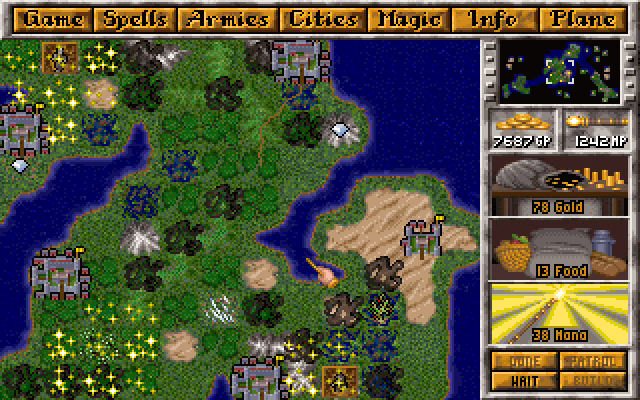
What is striking about Elemental, besides the far superior, post-1995 visuals, is the process Stardock has used in its development. Design Thinking 101, you might call it.
(Here's a link to some screenshots)
Stardock opened the Beta for Elemental to any and all pre-ordering customers over a year before their scheduled release date. In essence, they made available to the public an early alpha version of the game, sans graphic engine, sans most features, sans fun. Why? Because they wanted to know what their customers wanted to have in the game. They had a lot of good ideas themselves, of course, and as experienced game designers they knew what they reasonably could and could not hope to accomplish. But the most important first step to good design thinking is to build empathy, to know not what you can, should, and desire to make, but rather what you ought to make, and for whom. Stardock, more than any other game designer, does just that.
For example, Stardock's last game, Demigod, was a multi-player focused RTS/RPG hybrid. It released buggy, struggled in reviews, and never really took off despite a fairly solid game mechanic and an innovative structure. Stardock learned, from the subsequent year's customer survery - which, I should mention, they publish freely - that most of their buyers don't really care for multi-player games. In a time when the gaming world is going MMORPG, where World of Warcraft has a larger annual income than many countries, this is a stunning revelation. It's not that people don't want multi-player, it's that there are a whole bunch of gamers who simply don't play online, but for whom almost no one is developing games anymore.
As they continually build a sense of what their future players want, Stardock also continues to introduce the prototypes of ideas they develop in their own brainstorm. The public beta has allowed for more feedback than most games could ever hope to get, both in the form of bug-catching and in terms of refining the game engine. This is also design thinking: rapid prototype, show to users, and refine based on feedback. Whereas EA doesn't show this year's Madden to a large audience until release, at which point features are locked in and only bugs remain (because it's way easier to catch bugs with 1,000,000 players than with 100 testers). Stardock, by making the game available before it is finished, is allowing the game's future players to actually help determine what's in the game.
The most exciting thing about Stardock, however, is that they're not just a bunch of crazy idealists. They have a business model, a successful plan. They are already a strong, established company, and they are just as susceptible to the need for profits as any other corporation. What's exciting, then, is that they do things the right way anyway, because, as it turns out, that's a more sustainable model for customer satisfaction, long-term profits, and, when it comes down to it, good, satisfying design. Where Electronic Arts is lagging in innovation compared to companies like Paradox Interactive and Bioware (who they essentially bought-out), Stardock is leading the way in building games for people, rather than building games for games.
Friday, April 23, 2010
Corporate Education
It's the direction we're heading, like it or not. I for one, decidedly do not, but have been surprised in one of my Spring quarter courses to find that not everybody has the same reservations I do. Indeed, there is a big push - especially in the technology world - to embrace the disruptive and innovative opportunities that a more corporate model of education offers. Our current reading for the aforementioned class, Disrupting Class, by Clayton Christensen, speaks to how technology will revolutionize education, the undying undertone being: technology will turn education corporate. Scary? Big time.
First things first, what exactly does a more corporate model of education look like? Well, for one thing, we're already moving down that track in the language that schools use. Former Chicago Superintendent and current Secretary of Education Arne Duncan did not go by "Superintendent" in his previous post. Rather, he was the Chief Executive Officer (CEO) of his district. It is hardly a bad things that schools are paying more and better attention to how they spend their money, and to what their results are, but it is also important to ask about what comes along with bringing business to schools.
For one thing, the emphasis we now place on test scores is a vestige of business, which, even in its most dynamic and innovative forms, is always concerned with producing certain usable products for its consumers, whose use can then be measured. It does Apple no good to produce a product if they cannot later tell how and why people are using it, so they do extensive market research, they do intensive user-feedback and bug fixing, and so on. Some business types think that education needs exactly this: we should think of curriculum content as a product, students as consumers, and thus tailor the whole educational experience to the wants and needs of individual students. In many ways, that would be an improvement, but the first difficulty here is how we do our evaluations.
Standardized testing is an effort to scientifically compare students across time, space, and culture. Moreover, it is a mechanism by which we can make policy decisions in education, electing who to fund and who to fire, which students to slap "at-risk" labels or "learning disabled" labels on, and which to call "gifted." In all, assessment is the framework upon which modern education is built, and it is almost certainly not going anywhere soon. The tricky thing is making assessment more dynamic, which would be a step towards fulfilling a more business-y model of education. How can we do that? Is there really a meaningful way to engage students beyond, on some level, their knowledge of content? It's really hard to standardize essays - because good writing is so varied - or to assess thousands of students on their knowledge of the scientific process, because those are performance-based and intensive processes. Even computers, with their amazing, disruptive capabilities cannot replace a human eye for the aesthetic component that comes along with assessing learning.
Apple measures how consumers use the iPhone quantitatively and qualitatively. They need both. In education, we do a little of each, but quantitative measures dominate. As long as content is important to education, quantitative measures will continue to dominate. Or, is that the other way around? As long as it is important to assess, content will be the purpose. Christensen rightly believes that technology is transforming education, but he still understands that transformation as being formal, and not centered around content as such. That is, he does believe that each student will be able to learn a content based on individual preference, but he still sees the purpose of education as the delivery of content. Technology makes it easier to do that, and to assess it, but is that really what we want out of our schools (or computers)?
Why does Christensen value content over, say, thought process, innovation, or critical thinking? Because he is, I believe, stuck in a businessman's world, where outcomes need to be assessable, and where all things can be understood in terms of production, consumption, and exchange. For a long time - and even still to a degree in these sad times where tests dominate the schools - K-12 education in America has been a place where students were at least partially extracted from a capitalist, survival-of-the-fittest world in favor of exposing them to myriad possibilities and thought-patterns, ranging from artistic expressions to advanced mathematics to world history. The why of all of that content was never "because Johnny needs to know who won the war of 1812," but rather because Johnny's quality of life would be higher, his citizenship more robust, and, yes, his contributions to the work-force more meaningful if he knew how to think about a wide variety of topics.
Christensen takes for granted that students, given the choice, will pursue what topics are most interesting and important to them, but that is exactly the trouble. Without the guidance of a teacher, who personally knows and personally interacts with a student, none of us might ever have found our respective callings. Computers can certainly do some of that work, but where is the teacher who encourages you to take a subject even though you don't want to, ultimately to your benefit? How many - to give a concrete example - St. John's graduates would ever take Greek or Music Theory on their own? How many, having taken those courses, regret it? I think the answer to both is almost none.
Education is not a business because students are not consumers. The vision of a public education system has always been to create intelligent, moral citizens. Public education is essential to Democratic government precisely because Democracy is non-disciplinary, non-specialized. It asks its members to be adept at weighing evidence and testimony in any and every subject. It desires citizens conversant with history, with mathematics, with science, with arts, with music, with foreign languages, and so on. More important than the content of any of those subjects, however, Democracy requires citizens who know how to think like historians, mathematicians, scientists, artists, musicians, and linguists. A business model of education is not interested in such a broad ambition as this, and yet this is the very ambition upon which public education in America was founded.
There is a telling analogy in Christensen's book, which I think captures the essence of his argument, and also my reservations. He describes the disruptive technological effect of recorded sound, and how it allowed for high-quality recordings to be distributed far more widely than a visit to a concert hall ever could (whilst leaving the possibility of attending a concert intact). By analogy, he sees education as moving in a similar direction. Great teachers can distribute - through video, or through as yet uninvented technologies - their teaching over a wider network than ever before. Sure, it's not necessarily as good as in person, but its a whole lot better than nothing.
All of that I agree with, but the problem with Christensen's analogy is that he ignores what happened to music with the invention of recorded sound. What was once an art form pursued and distributed primarily for its own sake - Beethoven and Brahms didn't write music because it made them rich - became, with wider distribution, more economized, more capitalized. That's not to say music for the sake of music doesn't exist now, but it can be really hard to tell the difference. More importantly, though, in the everyone-can-access-everything modern music world commercial viability has replaced quality. Christensen tellingly uses Rachmaninoff and Mozart as his exemplars in his analogy, and he's right to say that now more people can listen to Mozart than every could before. But do more people actually choose to? That's another question.
I've shared my thoughts about great music here, and my readers are free to disagree. In education, however, I think we'll all agree that some teaching is better than other teaching. Some classes are more instructive. Some schools do a better job of turning out critical thinkers. The problem with market forces is that there's no reason to believe that they will allow good teachers to succeed. Good online courses won't necessarily do best, rather, the most popular ones will. There's much to be said for the wisdom of the crowd, sure, but I also wonder whether the direction of a student's education ought to follow a path created by someone (or a culture, broadly) who believes that Justin Timberlake is a better musician than John Tavener, Usher better than Scott Joplin.
My biggest concern with applying business to education is the same as my biggest concern when applying business to life: what's the point? Business is built around an internal structure of meaning. Namely, money is meaning. The point is to compete, to get rich, to produce, to consume, and to iterate on that process ad infinitum (until you die or your planet can no longer support you). Nowhere, in that cycle, are you to ask, "Why?" Why breaks the whole thing apart. It is as if, finding the question, "What is the meaning of life?" too unwieldy, we have decided to build a whole structure that makes asking the question impossible. But I think we need to demand, not answers, but the freedom - and there is no other freedom - to ask "Why?"
What is the purpose of education? I demand that you answer me, Mr. Christensen, and with you all the businessmen who would reform education in the image of Toyota, Starbucks, Virgin Records, Southwest Airlines, Apple, and McDonalds. What is the purpose of education?
Subscribe to:
Posts (Atom)

 Posts


