It's easy to think that learning is what happens at school. It's not particularly difficult to imagine other places of learning to go alongside the classroom: museums, for example, or (many years ago) libraries. It's a little more challenging to imagine learning taking place while watching TV or playing a video game, sending a text message or reading an email. But as long as the mind is remotely active, I would argue that learning, in some form, happens.
Now, it's not particularly interesting that learning happens all the time. In some ways, it's so obvious that it's hardly worth mentioning, and so much of our learning is so mundane that we'd rather not hear or think about it for fear of choking on our boredom. Learning, for example, that it's slightly faster - or at least more pleasant - to walk to the left of the science building on the way to class in the morning, is not particularly groundbreaking for anyone, including the learner (unless he were to fall through an unnoticed but open manhole, but that's not the point).
No, what's particularly interesting about this learning that happens all the time is how much of it is designed, despite how incidental it seems. That is, even the route from car to classroom is designed in some sense, if not with learning in mind, with learning as a kind of ancillary and unanticipated outcome. Of course, a science building on the whole very much is designed with learning in mind in a much more direct way. And that's only the beginning.
Rather than list all of the myriad areas where learning design is potentially relevant, I want to talk about a couple in particular, an obvious one and a not-so-obvious one. The first is the school, the classroom, the curriculum. The second, video games, and not those horrid "educational games," so many of which pollute the game-o-sphere with their terrible controls, their convoluted plots, and their utter disdain for fun. No, I mean real games, games like Portal or Final Fantasy, Civilization or Little Big Planet.
What do I want to say about each of the very different worlds of game design, on the one hand, and traditional education, on the other? Well, I want to say that, at their hearts, they share a fundamental commonality: they are both designed, and they are both deeply concerned with learning. Now, education might shun the "design" label and games might shun the "learning," but words are just words, and the actual actions behind these particular words bridge the vocabulary gap with or without my help.
That game design and curriculum construction have much in common is hardly a unique idea. James Gee's career, for example, is largely built on recognizing the parallels between gaming and more traditional teaching and learning. It is my opinion, however, that there's more that could be done here, not just in recognizing and defining those parallels, but in uncovering how the two might inform each other better, seeing what game design has to teach educators, and what educators have to teach game design. I would not be surprised, moreover, if the expected conversation - that is, with game design bringing an understanding of design, and education bringing an understanding of learning - is totally reversed. Game designers may know a lot more about learning than we'd like to give them credit for,* and educators more about design, even if they're using different language.
* Consider the challenge they face daily: make a game that is just hard enough to keep the player's interest, and make sure that difficulty scales well as the player gets more advanced. In doing so, however, the designer must take into account the learning of the player - that is, the rate at which he or she improves - as well as the wide variety of potential play styles, learning styles, and personalities that might come in contact with the game. In many ways, that's very much what a teacher does, with the added difficulty that the game designer has to code his game ahead of time. He has to anticipate, because he won't be there to fix it on the fly, except in the abstract way of writing patches.
These suspicions of mine, however, about the potential exchange of information, ideas, and learning design between two very different industries are not sufficient or advanced enough to be beliefs or even arguments. Rather, they are questions. What explicit and hidden learning design processes does the gaming industry use? What about education, both formal and informal? What are their vocabularies? What are their objectives, and how do those objectives aid or detract from improving learning (for example, does making learning itself your core objective make it harder to produce good learning)?
Within the gaming industry - as within the world of education - there are, I'm sure, an infinite variety of approaches. There are certainly a variety of types of studios, from the major AAA production companies like Electronic Arts or Sega to the smaller, lesser-known mid-market studios like Paradox or Stardock, all the way to the miniature independent producers like 2D Boy (makers of the wildly popular World of Goo). In addition to wondering about the game industry as a whole, I think it's fair to ask about the differences within the game industry.
I suppose what I'm suggesting is a kind of ethnography of learning design in the video game industry, and in traditional education. The value of such an effort seems to me to hinge on the observation that learning - if only learning how to play the game - is built into each and every game that gets put on the market. Failure to do so means failure to sell and, thus, failure to survive. Despite the (mostly) non-profit incentives in education, failure to adequately design for learning has much more dire and far-reaching consequences, and yet the conceit of the educator (or education policy maker, or education researcher) is too often to assume that no one else has faced the question of how to design for learning.
Showing posts with label Stardock. Show all posts
Showing posts with label Stardock. Show all posts
Thursday, June 16, 2011


Friday, May 14, 2010
An Ode to Stardock
As a Stanford graduate student, it is almost impossible to avoid design. Never mind that "design" is in the title of the program I'm a part of, design permeates the Stanford world. Why? Because almost everything we interact with day-to-day, as well as the way that we interact with those things, is the product of some design process. Good design process, however, is hard to find.
I won't go too far into what Stanford bills "Design Thinking" right now. Instead I want to talk a little about video game design, and the difference between what most companies do and what one company in particular - Stardock - does. Along the way perhaps we'll get some design thinking, too.
Most game companies, like Electronic Arts, develop game ideas that they think will be marketable and will appeal to a wide audience. The Madden series is a good example of this. Americans love football, especially long passes, bone-crushing sacks, stiff-arms, and spin-moves, so EA developed a game that is, essentially, a hyped up version of football that is realistic enough to not feel gimicky, but far enough removed from being realistic that it's not frustrating to play for the majority of EA's consumer-base. That's a model that works, and EA has gotten away with progressive minor graphical upgrades and occasional feature additions on the way to huge sales year after year of what is essentially the same game.
Of course, EA is not alone in this. Almost every major game - especially on the PC, but also on consoles - these days is a sequel. Mass Effect 2, Tropico 3, Majesty 2, Fallout 3, Final Fantasy 7,326, and so on. In sports gaming, perhaps it's inevitable that all games are remakes, but in strategy, or RPG, or action it's not so much good game-design as good business.
Stardock does things a little differently. Don't get me wrong, they are still doing what they need to do to make money. Because Stardock is a hybrid company, they use their massive enterprise software profits to support a game-development branch that can afford to and does risk doing things differently. The result has been some of the most innovative games of the last few years: Sins of a Solar Empire, Demigod, and Galactic Civilizations. All three were successful and, in their own ways, completely different from what anyone had done before.
At the moment, Stardock is developing Elemental: War of Magic. Old-time gamers will recognize Master of Magic, one of the most famous strategy games of all time, and the godfather of Elemental.

What is striking about Elemental, besides the far superior, post-1995 visuals, is the process Stardock has used in its development. Design Thinking 101, you might call it.
(Here's a link to some screenshots)
Stardock opened the Beta for Elemental to any and all pre-ordering customers over a year before their scheduled release date. In essence, they made available to the public an early alpha version of the game, sans graphic engine, sans most features, sans fun. Why? Because they wanted to know what their customers wanted to have in the game. They had a lot of good ideas themselves, of course, and as experienced game designers they knew what they reasonably could and could not hope to accomplish. But the most important first step to good design thinking is to build empathy, to know not what you can, should, and desire to make, but rather what you ought to make, and for whom. Stardock, more than any other game designer, does just that.
For example, Stardock's last game, Demigod, was a multi-player focused RTS/RPG hybrid. It released buggy, struggled in reviews, and never really took off despite a fairly solid game mechanic and an innovative structure. Stardock learned, from the subsequent year's customer survery - which, I should mention, they publish freely - that most of their buyers don't really care for multi-player games. In a time when the gaming world is going MMORPG, where World of Warcraft has a larger annual income than many countries, this is a stunning revelation. It's not that people don't want multi-player, it's that there are a whole bunch of gamers who simply don't play online, but for whom almost no one is developing games anymore.
As they continually build a sense of what their future players want, Stardock also continues to introduce the prototypes of ideas they develop in their own brainstorm. The public beta has allowed for more feedback than most games could ever hope to get, both in the form of bug-catching and in terms of refining the game engine. This is also design thinking: rapid prototype, show to users, and refine based on feedback. Whereas EA doesn't show this year's Madden to a large audience until release, at which point features are locked in and only bugs remain (because it's way easier to catch bugs with 1,000,000 players than with 100 testers). Stardock, by making the game available before it is finished, is allowing the game's future players to actually help determine what's in the game.
The most exciting thing about Stardock, however, is that they're not just a bunch of crazy idealists. They have a business model, a successful plan. They are already a strong, established company, and they are just as susceptible to the need for profits as any other corporation. What's exciting, then, is that they do things the right way anyway, because, as it turns out, that's a more sustainable model for customer satisfaction, long-term profits, and, when it comes down to it, good, satisfying design. Where Electronic Arts is lagging in innovation compared to companies like Paradox Interactive and Bioware (who they essentially bought-out), Stardock is leading the way in building games for people, rather than building games for games.
I won't go too far into what Stanford bills "Design Thinking" right now. Instead I want to talk a little about video game design, and the difference between what most companies do and what one company in particular - Stardock - does. Along the way perhaps we'll get some design thinking, too.
Most game companies, like Electronic Arts, develop game ideas that they think will be marketable and will appeal to a wide audience. The Madden series is a good example of this. Americans love football, especially long passes, bone-crushing sacks, stiff-arms, and spin-moves, so EA developed a game that is, essentially, a hyped up version of football that is realistic enough to not feel gimicky, but far enough removed from being realistic that it's not frustrating to play for the majority of EA's consumer-base. That's a model that works, and EA has gotten away with progressive minor graphical upgrades and occasional feature additions on the way to huge sales year after year of what is essentially the same game.
Of course, EA is not alone in this. Almost every major game - especially on the PC, but also on consoles - these days is a sequel. Mass Effect 2, Tropico 3, Majesty 2, Fallout 3, Final Fantasy 7,326, and so on. In sports gaming, perhaps it's inevitable that all games are remakes, but in strategy, or RPG, or action it's not so much good game-design as good business.
Stardock does things a little differently. Don't get me wrong, they are still doing what they need to do to make money. Because Stardock is a hybrid company, they use their massive enterprise software profits to support a game-development branch that can afford to and does risk doing things differently. The result has been some of the most innovative games of the last few years: Sins of a Solar Empire, Demigod, and Galactic Civilizations. All three were successful and, in their own ways, completely different from what anyone had done before.
At the moment, Stardock is developing Elemental: War of Magic. Old-time gamers will recognize Master of Magic, one of the most famous strategy games of all time, and the godfather of Elemental.
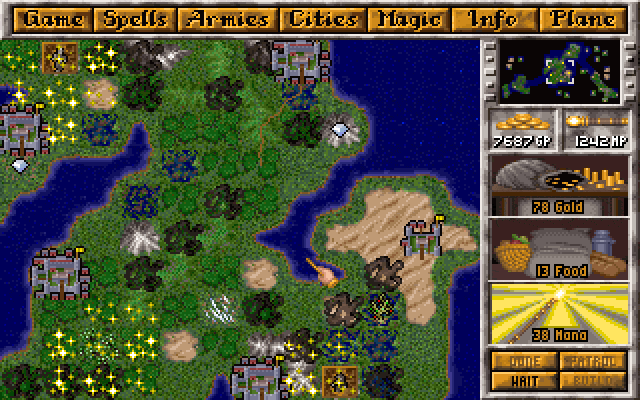
What is striking about Elemental, besides the far superior, post-1995 visuals, is the process Stardock has used in its development. Design Thinking 101, you might call it.
(Here's a link to some screenshots)
Stardock opened the Beta for Elemental to any and all pre-ordering customers over a year before their scheduled release date. In essence, they made available to the public an early alpha version of the game, sans graphic engine, sans most features, sans fun. Why? Because they wanted to know what their customers wanted to have in the game. They had a lot of good ideas themselves, of course, and as experienced game designers they knew what they reasonably could and could not hope to accomplish. But the most important first step to good design thinking is to build empathy, to know not what you can, should, and desire to make, but rather what you ought to make, and for whom. Stardock, more than any other game designer, does just that.
For example, Stardock's last game, Demigod, was a multi-player focused RTS/RPG hybrid. It released buggy, struggled in reviews, and never really took off despite a fairly solid game mechanic and an innovative structure. Stardock learned, from the subsequent year's customer survery - which, I should mention, they publish freely - that most of their buyers don't really care for multi-player games. In a time when the gaming world is going MMORPG, where World of Warcraft has a larger annual income than many countries, this is a stunning revelation. It's not that people don't want multi-player, it's that there are a whole bunch of gamers who simply don't play online, but for whom almost no one is developing games anymore.
As they continually build a sense of what their future players want, Stardock also continues to introduce the prototypes of ideas they develop in their own brainstorm. The public beta has allowed for more feedback than most games could ever hope to get, both in the form of bug-catching and in terms of refining the game engine. This is also design thinking: rapid prototype, show to users, and refine based on feedback. Whereas EA doesn't show this year's Madden to a large audience until release, at which point features are locked in and only bugs remain (because it's way easier to catch bugs with 1,000,000 players than with 100 testers). Stardock, by making the game available before it is finished, is allowing the game's future players to actually help determine what's in the game.
The most exciting thing about Stardock, however, is that they're not just a bunch of crazy idealists. They have a business model, a successful plan. They are already a strong, established company, and they are just as susceptible to the need for profits as any other corporation. What's exciting, then, is that they do things the right way anyway, because, as it turns out, that's a more sustainable model for customer satisfaction, long-term profits, and, when it comes down to it, good, satisfying design. Where Electronic Arts is lagging in innovation compared to companies like Paradox Interactive and Bioware (who they essentially bought-out), Stardock is leading the way in building games for people, rather than building games for games.
Subscribe to:
Posts (Atom)

 Posts
Posts


