Yes, I know. It's a little tacky to talk about who one's heroes are. Thing is, today was my first day working at LePort Schools, and at one point we were each asked to name a personal hero, and to explain why said person was a hero. I actually found this a challenging question to respond to, however, because I have a great many heroes. Or perhaps the better word is idols. Or mentors. Or maybe a mix of the two.
You see, I'm not entirely sure what a "hero" is. It's a Greek idea, and like many Greek ideas I think it's gotten both too puffed up and too trivialized in translation over time and space and through the linguistic wringer that is English. The Greek idea of a hero was mythical, magical even, and very strange. Achilleus, Heracles, Antigone... these were heroes. I don't know if they were supposed to inspire us to greatness or to warn us against hubris or what.
So maybe the better words are idols and mentors. I have a mix in my own life. There are artists and thinkers who I idolize, whose work has left enough of a mark that I have had the chance to get to know that work, and be inspired by it. I also have mentors, who are influences of another kind. They have all inspired me on a more personal level, as teachers, friends, employers, or family members.
I could only name one hero today, but there were a lot of names dancing around in my head. So here are my heroes, or rather, my idols and mentors.
Idols
Walt Whitman
I selected Walt Whitman as my hero today, because I think no writer has been more influential for me. Whitman's Song of Myself remains my favorite poem, essay, or writing of any kind. No less than three of the most important moments of my life have been punctuated by reading the poem in its entirety (twice aloud). I have read portions of it at weddings and at funerals, and for a time carried one of its more memorable cantos in my wallet.
What is it that I love about Song of Myself - and, really, the whole of Leaves of Grass - in all its incessant and meandering glory? I love its spirit, its body, and its sound. It is a poem not only about poetry, but about why human beings write poetry in the first place, and maybe even why writing poetry isn't particularly necessary. It's a poem about love, and death, and sex, and independence. It's lewd and wildly inappropriate. It's political (abolitionist, in particular), but deeply impolitic about it. It celebrates contradictions and impossibilities. Above all, though, it's a poem that asks the reader to live without it, to compose his own songs and live his own life. I return to Song of Myself, from time to time, to remind myself to celebrate and sing myself. But it would be a deep misapprehension of Whitman to study him overmuch.
Ludwig Van Beethoven
Like Whitman, Beethoven was a rebel. Whitman was at least partially responsible for what we now call "free verse," and Beethoven was at least partially responsible for what we call romanticism. He personalized and emotionalized music to a degree that was essentially unheard of prior to his work. His symphonies radically transformed the very structure of the symphony (there is a vast formal and structural difference between symphonies written before and after Beethoven).
Beethoven inspires me, though, not because he was a passionate musician, but because his passion was so precisely measured and expressed. He was a master of composition, even after he lost his hearing, and however wild his music was - especially for its time* - it never feels out of control to me. Contrary to the popularized Hollywood renditions of Beethoven which paint him as a mad genius, who translates his anger and lust and frustration to the score feverishly and slavishly, I believe Beethoven was more a master of music than a slave to it. Passion is admirable, but excellence requires mastery of that passion. I idolize this, above all, about Beethoven.
* This cannot be overstated. These days Beethoven seems rousing, but expected. In his own day his music was truly shocking. The length of the Third Symphony alone, not to mention its harmonic and formal curiosities, would have struck any contemporary listener as bizarre.
Thelonious Monk
Speaking of rebels, Thelonious Monk was a musical rebel. In many ways, he's a contemporary version of Beethoven: a true master of his craft whose rule-breaking was always more measured than it sounded. My idolization of Monk, however, is much narrower. I appreciate him, primarily, as a pianist. I do not sound like him, when I play piano, but he is nevertheless my greatest inspiration as a pianist, and especially as an accompanist. If you listen to recordings of Monk playing, what you'll find is that he is an exceptionally soloist, yes, but also an exceptionally good listener and accompanist. Not every one who played with him knew how to play with him, but those who did - Charlie Rouse, for example - play off of and with him in a way that most epitomizes, to me, what jazz is all about.
Langston Hughes
I actually knew fairly little about Hughes until fairly recently, when I read his autobiography, The Big Sea. I knew, of course, that he was a central figure in the Harlem Renaissance, and I had read, as a student, A Dream Deferred. Through his autobiography I came to appreciate more about Hughes, the man and poet, and not just the symbol he has come to be in the traditional curriculum.
I'll leave you to read The Big Sea, yourself. What I most appreciated about the book, and about Hughes, was his commitment to the joy of life. Like Whitman and Beethoven, he celebrates and sings his own odes to the joy of simply being. He is as masterful a wordsmith as any poet, and even his most biting and political poetry has a metrical and rhythmic levity. So, Hughes too is political without being politic, as much concerned with the everyday working man or woman as with the seeming greatness of leaders and decision makers. He shows and indeed lives the silently dignified life of a real person with real troubles and real celebrations.
Mentors
All of the above idols are dead poets and musicians. They give shape to the way I live my life: the humanistic content which on some level defines who I am, how I read, and what I believe. And yet, while I have pretensions to being a musician and a poet, at heart I increasingly feel that I truly am a teacher (even when I was streaming, I was really being a teacher). With that in mind, these mentors are most responsible for teaching me how to learn and how to teach.
Denise Pope
Denise is a researcher and lecturer at Stanford who co-founded Challenge Success, an organization I have been fortunate to work with over the past couple of years. In contrast to many researchers, Denise is primarily focused on using her expertise as a researcher to make a positive impact on education writ large. Challenge Success, in particular, is inspiring because it focuses on a massive systemic issue in our education system which too often gets swept under the rug by more popular celebrated causes. That issue is, in short, how we define success. Too many students (and parents, and educators, and educational institutions) see success narrowly in terms of grades and matriculation records. As a result, students increasingly live unbalanced lives. They spend too much time doing homework, they burn-out and get sick, they don't get enough sleep, they cheat. Denise's book Doing School, chronicles this phenomenon by following a handful of exceptional students, hand-picked by the administration of her partner school. The results are staggering, because these exceptional students are living, by and large, unhealthy and unfulfilled lives.
In my work with Denise, she has shown me what it is to be an ethical and balanced leader who lives what she preaches. Like any Stanford faculty member, she faces a barrage of emails and requests for attention, but she remains ever graceful in the face of such potential stressors. Perhaps most inspiring to me is her position: Senior Lecturer. I suspect she could be a Professor, if she so chose, but it seems to me that the priorities of a full professor are misaligned with her priorities as an educational leader (and as a mother). I suppose it is no accident that she was one of the first people to call me when I went on leave from Stanford to offer me encouragement, and she was one of the first to applaud my decision to find a teaching job when I did so. After all, she taught me the value of using academic knowledge to do good in the world.
Todd Kelly
Todd was my piano teacher growing up, and was of course a huge influence on my musical style. He let me start out learning how to improvise and play jazz, rather than drilling classical theory and technique into me. His own unique style as a composer and musician - I'd say he's a mix between George Winston and Ethan Iverson, an odd couple if there ever was one - certainly rubbed off on me.
But Todd was more than a piano teacher, and was as much an influence on me as an educator as he was on my musical development. I spent more time learning with and from him than any other teacher in my life, and I think a great deal of my own pedagogy derives from the way that he taught me. He treated me like an intellectual and musical equal long before I actually was one, and in so doing pushed me to be a better pianist and better musician. Our frank conversations about what I hoped to get out of music, and how much I was willing to put it taught me how to be self-reflective and metacognitive, and how to set goals for myself. Our co-compositions taught me the value of creative collaboration, a value which I have always sought to impart on my own students.
Sam Reynolds
There are teachers and mentors with whom I've spent much more time than Sam. I've only met Sam in person once, and spoken to him a handful of other times. My chief interaction with him was through a pre-recorded online course of his I took back when I had just graduated from St. John's and still had no idea what I wanted to do (I hadn't even decided on education as a field, yet). Nevertheless, Sam's influence on me is significant.
Sam Reynolds is a professional astrologer who, like me, came from a philosophy background which imparted upon him the value of scientific skepticism. Through practicing and studying astrology, however, he found sufficient evidence to make it his career. This post isn't the place for me to defend my astrological practice (I don't say belief, because I do more than believe in astrology, I practice it), but I would be remiss if I didn't include Sam as a mentor for me precisely because of the way that Sam teaches and practices astrology. Without, to my knowledge, ever studying educational theory, Sam gets pedagogy and curriculum. His course had one of the better curricula I've ever encountered in any class I've taken (and that includes classes at Stanford).
It's also worth noting that Sam is as intellectual a person as I've ever met. He's well-educated and well-read, incredibly wise, with a biting wit befitting a Scorpio. What Sam has taught me, then, besides a thing or two about how to read a chart, is how to stand up for what you believe even when it's unpopular. He brings to bear his education and intellect in defense of what he does and who he is, but he is never malevolent about it. Nor does he brook the malevolence of others. He is, as any good teacher should be, a model professional thinker and communicator.
Sharon Sikora (or "Mom")
My mom is a teacher, and so it should come as no surprise that she's been a tremendous influence on my own growth as an educator. I won't go into mushy details here about the ways in which she inspires me, but suffice to say she is as excellent a teacher as you will ever find. She has modeled, throughout my life, everything that I value in an educator: she believes in and respects her students, knows her content, designs excellent curriculum and assessments, knows how to think about technology (she neither fears nor worships it, but rather uses it as a tool), and communicates well with her colleagues. She, also, has tried to balance her career as a teacher and educator with her life as a mother and wife. Those who know me and my family will know that this has been no small task, and yet it was a task she performed - and continues to perform - with optimism and joy, in spite of all that has happened.
Showing posts with label Learning. Show all posts
Showing posts with label Learning. Show all posts
Monday, August 4, 2014


Monday, September 23, 2013
Video Games and Curriculum
There are three ways that I'm interested in thinking about the intersection of video games and curriculum. I'll discuss each briefly here, starting from the most-researched to the least-researched.
1) Video Games as Curriculum Support
Most of the early research on video games and learning has been about "educational games" or the less baggage-laden rebranding "games for learning." The idea is, in short, that students enjoy playing games, and so we can trick them into learning by putting curriculum into a game. If, like me, you grew up with Math Blaster, Where in the World is Carmen San Diego, or Mario Teaches Typing you know what these games are like: enjoyable to a point, but ultimately limited in their appeal to the particular curricular situations in which they are employed.* Rarely are educational games - even the best of them - actually all that great as games. They are often closer to gamified curriculum than game for learning.
* OK, I get that Carmen San Diego in particular has some appeal beyond the classroom, but it really is one of the most exceptional educational games ever created.
It is fair to say that games for learning have come a long way in the past 20 years, however, and today there are many exceptionally enjoyable games that are explicitly designed to encourage learning. For example, the work of Motion Math (founded by fellow LDT students) shows the potential to engage students in a learning experience that still has good game design.
A related idea involves commercial games instead of games for learning. A recent Stanford graduate named Dylan Arena wrote his dissertation on commercial video games as preparation for future learning. The idea is that, by engaging students in a good game experience, you give them motivation and a reference point for understanding curricular material. His results are fascinating, demonstrating that we can, in fact, use games like Civilization and even the much-maligned Call of Duty to motivate students as they learn history.
In all, this is a vitally important area of research and innovation, and only good things can be said about the improvement of games for learning. The issue, to my mind, is that for many researchers the intersection of games and curriculum stops here. The question is an important one: How can we use games to teach what we already teach? But it's far from the only question we should be asking about learning and games.
2) Game Design as a Subject
As the game industry grows, there are more and more people who wish to become game designers, or to study game design and development. Game design programs are cropping up everywhere, but these are rarely founded upon principles of good curriculum development. In part this is because game design is a moving target. How can we design backwards when we don't really know what the end point should be?
Needless to say, there's a research opportunity here: how can we best teach game design? There are texts out there, but I don't think any are grounded in data about the outcomes of potential designers who go through game design programs.
I don't want to get bogged down, however, in thinking that game design should be exclusively a post-secondary and specialized study. I would rephrase the research question in this way, then: how can we best teach game design in such a way that any student at any level can better understand games and their role in society? Game design is a practical discipline and a career, in some sense, but it is also a theoretical subject with implications for just about everybody (because who doesn't play or watch games of some kind?). In this sense, game design is less about job training and more about learning to think.
3) Video Games as Curricular Artifacts
In some sense this is a related idea to the above, but I want to make a distinction between studying game design and studying games. In the above, game design is a vehicle for teaching creativity and critical thinking, but the subject is still the design process. This final idea is about games as art. Games as literature. Games as intrinsically valuable and interesting curricular artifacts. In much the way that we ask students to read books, to analyze them, to discuss them and write about them, I propose that we could and should do the same with games. Not all games, or any game, but certain games.
Why should we do this? Well, why should we study literature? Because games, like literature, can be insightful and profound, can teach us more about what it means to be human, can offend us, can expose us to other ways of thinking about the world, can allow us to imagine living lives very different from our own. And like literature, it is a waste to play (as with books, some) games unthinkingly. But when and where do we teach students to play games well? Not just to be good at games, but to be a good and critical reader/player of games? At present, the closest we get is by reading books in English class. But this is learning by analogy, when we could use games as artifacts in their own right.
The counter-argument here, of course, is that games are not worthy of the status we bestow upon books. But that is a position with which I cannot agree. True, there are a great many games which are far from great literature, but there are also a great many books which are unworthy of deep study. Why condemn games as a genre because some - and some of the most successful commercially - are philosophically, literately, or creatively deficient? There are gems (Journey, Shadow of the Colossus, To The Moon to name three) that are every bit as interesting as any text. And what's more, they afford conversations about more than just narrative: they invite questions about interactivity, about design, about linearity and non-linearity of experience. It is my conviction that a well-designed curriculum that studies games as art would be at least as effective - if not more so - at teaching the kinds of thinking, writing, and speaking skills - as well as the qualities of introspection, skepticism, and critique - we want students to acquire in humanities courses in their K-12 and college experiences.
Perhaps I should voice that conviction as a question: are video games valuable curricular artifacts in their own right? I may believe so, but I suspect few do. Most importantly, I know of anyone who has any data or research that supports either position.
Friday, September 13, 2013
An Observation about Research on Video Games in Education
I'm hoping to get back into writing on this blog in the near future. In particular, I plan to write some short-ish posts to help collect my thoughts about video games, learning, and education. This first post is a kind of brief overview and problem statement. Others - including, I hope, some analysis of actual games - will follow.
Research on video games in education tends to fall into two broad camps. The first is research on "games for learning," a rebranding of "educational games." While games for learning have come a long way in the past few years, they are still by-and-large less interesting, less polished, and less fun than commercial games. They may be successful at teaching what they are trying to teach, but they have limited appeal beyond the specific curricular situation they were designed for. In some sense they are to commercial games what textbooks are to other books.
The second major camp of video game research in education is on the social aspects of gaming. This includes research on phenomena like guilds in MMORPGs, where under-performing students can sometimes show tremendous mathematical, organizational, and leadership ability within the context of the game whilst failing to exhibit those same qualities in the classroom. It also includes studies on gaming communities and the extend to which they are or are not communities of practice. By-and-large this kind of research focuses on multiplayer and social gaming, though there are exceptions.
In my reading of research from both of these camps, I've seen a general shortcoming that plagues many studies: while games are ostensibly part of the subject of the research, rarely is game genre, quality, or design taken into account by the researchers. It's as if we wanted to research books, and then didn't differentiate between Hamlet, The Lord of the Rings, and Rainbow Six. Those are books of wildly different genres, wildly different styles and time periods, and of various qualities (I doubt even Clancy himself would consider his book worthy of inclusion in a high school curriculum, for example).
I think this problem stems from the generational gap around games. While more and more researchers realize that games are a big deal - Constance Steinkuehler is fond of pointing out that the gaming industry outpaces movies and music combined in revenue these days - there are still precious few researchers who are actually gamers. What's more, the cultural stigma around games is that they are entertainment at best, and at worst social disease. To return to the book analogy, it's as if researchers on literature weren't avid readers, and indeed doubted whether books were legitimate forms of artistic and creative expression. A little skepticism is probably good, but skepticism should be born of familiarity, not ignorance.
Wednesday, October 12, 2011
An Alternative Pedagogy for the PhD Core
Introduction
Because my last post was a little bit negative, and perhaps somewhat dramatic,* I want to offer a constructive follow-up. Let me make explicit, first, the criticism that is really at the heart of yesterday's post. Then, I'll offer an alternative.
* I never, ever write overly-dramatic posts, do I?
The problem with my two required courses is that they are not, at least so far, good courses. One is a Doctoral Proseminar that every first year PhD student has to take. Its stated objectives are, in part, taking a broad look at the field of education research and, in part, getting to know the rest of the cohort. The other required course - the spark for yesterday's existential angst - is the first leg of a three course series of introductory research methods courses required within the first two years by all Education PhD students.
The How
How are these courses bad? Well, they are both co-taught, but there is not even a semblance of collaboration between the Professors co-teaching the courses. In both sections, one Professor gets up and lectures while the other sits around looking bored, only occasionally interjecting. At some point the Professors might switch places when the topic changes, but that's really it. There's no dynamic interaction, there's no prior planning, there's no engagement.
The lack of interaction is perhaps not damning, but the lack of student participation is. Now, a student in one of these courses might very well object that, yes, we do participate some. This is true. The lecture style in both classes is not pure, incessant blather. There is some opportunity for back-and-forth. But there is no room for dialogue, even so. The path of the "conversation" is, if not predetermined by the Professor, managed in its entirety by him.* Students don't have the opportunity to speak to each other without Professorial interpolation. That's not dialogue, that's Q&A.
* I say 'him' because three of the four Professors in question are male, and the three men are the chief pontificates.
A word on the classroom that both of these courses take place in. It's not exactly conducive to dialogue. It's basically a small-to-medium sized meeting hall, perfect for a breakfast get-together. There are a number of round tables that fit four people each, with a longer desk at the front of the room, in front of a SmartBoard (that, incidentally, none of the Professors knows how to use). At the back of the room is a blackboard. Notably, one wall contains creative artifacts made by STEP (Stanford Teacher Education Program) students, who use this same room more dynamically.
For a typical class, students will read a few articles and do a kind of preparation activity. In the Proseminar these are basically note-taking activities designed to reinforce good reading skills. In the methods course, these are writing activities, some of which have proven interesting and valuable, and others, well, yeah. My last post addresses that. Regardless, with the rare exception of some small-group work at the tables, whether a student has done the reading or not has no particular bearing on the course because the Professor simply stands around expounding about said reading for far too long, asking theoretically probing questions that the same five students answer.
In short, it's a typical University class. But what is striking is how different it is from my experience at this very University as a Master's student. It is said that the difference between the Master's level and the PhD level is that the latter is more focused on research. It seems that, in addition, because research is the important thing, pedagogy goes totally out the window as well.
A final note on the how and why of the problems with these required courses. In addition to troubling pedagogical practices, the curricula of both courses are far from compelling. There is no clear "this is what you're getting out of this class." That means that, while the assessments are fairly good, there's not a strong sense of how said assessments measure whatever it is that we as students are supposed to be learning. For example, the book review required in Proseminar may develop good habits of mind, but it does not connect in any meaningful way with the readings or the lectures, at least so far. In the methods course, we're supposed to design a study around our research interests and questions, but in the first three weeks (30% of the quarter), we've not even spoken about research questions, research design, or what makes for a good study, let alone actually done anything.*
* It's becoming a source of personal amusement that, in a certain sense, my tennis course is pedagogically superior to my other courses. Each session we show up, we warm up by working on whatever part of our skill set we want to, then the instructor shows us a new skill or a wrinkle on an old one and we go practice it for a half-hour as he wanders around giving pointers. And you know what? My ability to play tennis is improving much faster than my ability to research. I know it's not a totally fair analogy, but that doesn't mean it's not worth thinking about.
The Why
Why are these courses the way they are? Perhaps the Professors teaching these courses are doing it because they're trying to curry favor with the administration, and thus they don't want to invest in designing a strong curriculum or practicing good pedagogy. Perhaps the course curriculum, because it is designed by committee and not by the teacher, is innately unfocused. Perhaps no one has recognized the problems with the room the courses are housed in, and therefore hasn't tried to come up with a more engaging way of using the space.
Whatever the reason, at its heart is this: Stanford University, like most institutions of higher education, is primarily interested in research.* While many Professors like to teach, they frequently have little to no actual teaching training, and their jobs are in no way dependent on the quality of their teaching. Students, similarly, are generally less invested in classes** because they're wrapped up in research agendas and assistantships and meeting other requirements and trying to survive in the Bay Area on the roughly $20,000 a year they make as PhD students.
* Well, research and football, anyway.
** A quotation from a Doctoral student well-along on her path: "Your classes don't matter." In that case, I wonder, why do we have them at all?
In summary, Professors are not accountable to their employers for their teaching. They are accountable to their students, but their students don't particularly care whether they teach well or not. As a result, there's no particular motivation to improve a course, no particular need to assess whether it is "working" or not,* and no particular place for a student who does care about the quality of his courses (and the pedagogy therein) to voice concerns. It's a self-perpetuating, broken system. Except it's not broken at all: it's exactly what almost everyone involved wants it to be, which indicates that maybe the real problem is much, much deeper. But we'll have to leave that for another time.
* At Stanford in particular such an assessment would be confounded by the fact that most students here are extremely good at doing well in and taking as much as they can from poorly taught classes. Otherwise they wouldn't have made it to Stanford in the first place.
An Alternative Pedagogy
Vogon Guard: "Alright, so what's the alternative?"
Ford Prefect: "Well, stop doing it, of course! Tell them you're not going to do it anymore. Stand up to them!"
Vogon Guard: "Doesn't sound that great to me."
- Douglas Adams, Hitchhiker's Guide to the Galaxy
The alternative to lecturing is, simply enough, not lecturing. The alternative to none - or few - students participating is getting them all to participate. Perhaps this is my St. John's education speaking, but I still think there's a lot to be gained from students talking to each other, and there's no reason that can't happen in these required courses.
How does that work? First of all, no more powerpoint slides. No more prepared lectures or conversational agendas. No more "this is what this article means" declarations. Questions - even pointed ones - to shape a conservation are fine, but presupposed answers are death to inquiry. If the goal is for new doctoral students to learn to interpret research, to discuss or analyze a text, and to be able to construct and argument as to what that text means, then it's imperative that they get practice at actually doing it. That does not mean "write a summary," that means dialogue, conversation, and argumentation.
So instead of two Professors trading off droning - with occasional interruption - at 30 students, let's put all of the manpower and brainpower in the classroom to work. Split the class into two groups of fifteen,* and send one Professor off with each group.** Sit in one great big circle, let the Professor ask a question about the text, and let the students work together to try to answer that question. Have, in other words, a dialogue.
* And rotate the groups around each week, so there's always a different mix in each group.
** Alternatively, split into even smaller groups - say five groups of six - and let the Professors float around, or put them into different groups each session.
Does that sound like St. John's? Of course it does. And why do I suggest it? Because it works. Stanford PhD students are smart people. If you put fifteen of them in a room with a text and ask them to figure out what it means and why it's important, odds are they're going to succeed. So why not give it a chance? They'll be developing interpretive skills, learning to talk to each other about research (which, vitally, may not even be in their area), and getting to know each other much better than they can when they're sitting four-to-a-table and being lectured at for two hours.
It is true that Professors are generally experts in these fields while students are not, but their wealth of experience does not mean that they are innately better readers than their students, or that they can say something more insightful about a text. What's more, even if they are better at those things, students will not learn simply by watching them talk. I cannot learn tennis without swinging for myself (and sometimes hitting it into the net), so how can I be expected to learn to speak to my future colleagues about research without being given a chance to do so, even if sometimes our interpretations are wrong, or we cut each other off, or we oversimplify? By doing will we learn, not by watching.
The Professor's role in this picture is to be the net. When I hit a tennis ball too short, I can tell. When I say something stupid, the Professor can chime in. But here's the really cool part: even that can be given over to students. If you let us talk to each other, we'll learn how to point out each other's mistakes, as much as highlight each other's strengths. In short, we'll form and learn to be a part of an intellectual community much like the one we're supposedly entering as future PhD-holding scholars.
Perhaps the objection could be raised that dialogue doesn't happen among Professors, either, and that therefore such a pedagogical system would not prepare students for the Academy. If that's so, then this alternative to lecturing becomes doubly important: we need academics who do more than merely pontificate, but who can actually communicate. The only way we'll get them is by training them to do so from the beginning. And anyway, it's a lot easier to transfer the ability to dialogue into giving a good lecture than the other way around.
A St. John's-ian dialogue, of course, is not the only valid alternative to a lecture class. Not all good classes are discussion classes. I do, however, pose it as a radical opposite pole. Somewhere in between is an equally good place where co-teachers actually work together, where the affordances of the room are taken into consideration when shaping the curriculum, and where the students are allowed to practice and be engaged with the material (and each other) for the whole two to three hours. Such pedagogical strategies exist. I wish that some enterprising Professor teaching a required, core course would use them.
Monday, October 3, 2011
Four Random Thoughts on Reading Gerald Graff's Professing Literature (and Sundry Other Works)
Ok, so this is a response to my reading for my "Future of English" class this week, but I believe it is actually broad enough that it should more or less make sense to people who aren't in the class.
---------------------------------------------------------
When I taught creative writing last summer, we spent a day with Italo Calvino's Invisible Cities. It's an enigmatic book, a difficult one, but intensely perceptive. Getting high schoolers to appreciate – nay, to comprehend – the project of the work I feared would be impossible. As we read sections together, my fears were realized: they had no idea what was going on.
So instead of forcing a conversation, I jumped into the later part of the activity sooner. I sent them out of the classroom (this was a private school, so I was allowed to do this) to find a place on campus that they found interesting, and then to compose something in the style of Calvino (or at least his translator). An example:
A City In Perpetual Motion
The city in perpetual motion is constantly rising upwards as its inhabitants' visions grip the stars with the dreams swirling in their minds. The city is made of glass allowing a communal flow of energy to circulate through its streets. Glass wall upon glass wall are lined and stacked to form endless buildings, those too, upon glass. The glossy skyscrapers are filled with rarities and talents and treasures, seemingly weightless and untainted. The glassy floor is covered in flourishing plots of herb and flower, each of their seeds pulled from the farthest edges of the universe. As the city in perpetual motion rises upward, it expands, its inhabitants determined to take their place above the stars.
Perhaps not as skillful as Calvino – certainly not as impressive as the vast, interwoven collection he produces, complete with self-reference and surprising invisible threads and the strange Marco Polo / Kublai Kahn back story – but good enough to give rise to a question. Did the students actually fail to understand Invisible Cities? What was I looking for? What ought I have done?
---------------------------------------------------------
It strikes me that the history Graff describes is a history of Hegelian dialectic aborted. Time after time, apparent theoretical, pedagogical, and interpretive opposites have circled each other in the English Department, seeking synthesis, but unable to find it thanks to an unwillingness or inability for the the institution to engage the conflict.
---------------------------------------------------------
I wonder what a similar history of the School of Education would look like? What conflicts have been subsumed into the now-incoherent structure of the institution? Certainly the tripartite division between the researchers who identify themselves with 1) the humanities, 2) the social sciences, 3) the hard sciences comes from some historical disagreement that Schools of Ed participated in, but continue to shield their students from (instead requiring methods courses in each of these research techniques separately, without asking them to consider the fundamental question: what is research?)
---------------------------------------------------------
What does the ideal University look like, or is there such a thing? Perhaps a better question is: if one had the power to build not just a University or a College, but indeed the Educational system or, deeper still, the entire society itself from scratch, what would it look like? I suspect one would need to go to social values to make any meaningful, fundamental change. Why?
Is it maybe the case that, given our social values the system we have is the ideal, or at least a very good representation of those values?
---------------------------------------------------------
When I taught creative writing last summer, we spent a day with Italo Calvino's Invisible Cities. It's an enigmatic book, a difficult one, but intensely perceptive. Getting high schoolers to appreciate – nay, to comprehend – the project of the work I feared would be impossible. As we read sections together, my fears were realized: they had no idea what was going on.
So instead of forcing a conversation, I jumped into the later part of the activity sooner. I sent them out of the classroom (this was a private school, so I was allowed to do this) to find a place on campus that they found interesting, and then to compose something in the style of Calvino (or at least his translator). An example:
A City In Perpetual Motion
The city in perpetual motion is constantly rising upwards as its inhabitants' visions grip the stars with the dreams swirling in their minds. The city is made of glass allowing a communal flow of energy to circulate through its streets. Glass wall upon glass wall are lined and stacked to form endless buildings, those too, upon glass. The glossy skyscrapers are filled with rarities and talents and treasures, seemingly weightless and untainted. The glassy floor is covered in flourishing plots of herb and flower, each of their seeds pulled from the farthest edges of the universe. As the city in perpetual motion rises upward, it expands, its inhabitants determined to take their place above the stars.
Perhaps not as skillful as Calvino – certainly not as impressive as the vast, interwoven collection he produces, complete with self-reference and surprising invisible threads and the strange Marco Polo / Kublai Kahn back story – but good enough to give rise to a question. Did the students actually fail to understand Invisible Cities? What was I looking for? What ought I have done?
---------------------------------------------------------
It strikes me that the history Graff describes is a history of Hegelian dialectic aborted. Time after time, apparent theoretical, pedagogical, and interpretive opposites have circled each other in the English Department, seeking synthesis, but unable to find it thanks to an unwillingness or inability for the the institution to engage the conflict.
---------------------------------------------------------
I wonder what a similar history of the School of Education would look like? What conflicts have been subsumed into the now-incoherent structure of the institution? Certainly the tripartite division between the researchers who identify themselves with 1) the humanities, 2) the social sciences, 3) the hard sciences comes from some historical disagreement that Schools of Ed participated in, but continue to shield their students from (instead requiring methods courses in each of these research techniques separately, without asking them to consider the fundamental question: what is research?)
---------------------------------------------------------
What does the ideal University look like, or is there such a thing? Perhaps a better question is: if one had the power to build not just a University or a College, but indeed the Educational system or, deeper still, the entire society itself from scratch, what would it look like? I suspect one would need to go to social values to make any meaningful, fundamental change. Why?
Is it maybe the case that, given our social values the system we have is the ideal, or at least a very good representation of those values?
Monday, September 26, 2011
Two Research Ideas
One of my first assignments here at Stanford was to draft a possible research question and propose a methodology to use in answering that question. Because I have multiple interests, I wrote two.
The Dialogic Pedagogy of St. John's College
Questions
What is a dialogue? Obviously there is plenty of research about how to support dialogue in the classroom, and the role of discussions in learning. From my own limited experience, however, as a graduate student and as a teacher, there is a tremendous difference between dialogue as it is conceived in such research and dialogue as it occurs in, particularly, the classrooms of St. John's College.
As a graduate of St. John's, I have first hand experience in those classrooms. Far from providing answers, my experience only raises more questions. What is it about the culture, the pedagogy, and the organization of learning at St. John's that makes their classrooms unique? How is it that students in the St. John's seminar are able to speak so directly to each other about such complicated texts with minimal Professorial intervention? Or are they actually able to do so, after all? What is the relationship between the dialogic pedagogy of the college and its Great Books curriculum? Do they support each other, are they separable, or do they detract from each other? Perhaps most importantly: what, if anything, does the pedagogy – as distinct from the curriculum – have to teach educational systems at large?
All of these questions interest me, and they serve as a backdrop for a possible research agenda. In the short term, however, I want to focus particularly on undergraduate programs and dialogue. That is, I want to address this question: What constitutes a dialogue at St. John's, and how is it distinct from dialogues in other undergraduate academic environments?
Method
In order to begin to answer that questions, an initial qualitative, ethnographic foray into the college would be invaluable. A visit to the Santa Fe campus would allow me to conduct interviews with current students and faculty, as well as observe seminars in action with a researcher's – rather than a student's – eye. Video analysis of seminars could also be helpful, though that would require both the necessary equipment and approval from the school (recording of seminars is traditionally forbidden). While direct observation and interviews would only be possible when present, with permission and help I might be able to record video of a seminar or seminars throughout a semester or more.
In addition to doing qualitative data collection at St. John's, I would want to follow a similar interview and observation (and/or video analysis) protocol at another or other institutions. Perhaps the most feasible option would be to look at undergraduate courses at Stanford, as well as another local college or university (such as San Jose State). I would strive to find courses which describe themselves as “seminars” and which intend to use discussion-based pedagogies. I would strive, at this stage, to match specific content across the colleges in question.
Having collected my data, I would code and analyze in the qualitative tradition, with an eye towards answering my initial question, but also with the hope of discovering the appropriate path towards addressing the deeper questions that inspire my research.
Design in Game Development and Curriculum Construction
Questions
J.P. Gee, among others, has noticed that game developers do an excellent job of scaffolding learning into their products. That is, gamers learn how to play the game from simply playing it, whether because there is a built-in tutorial, or because the mechanics of the game are somehow made obvious by experimentation, or because the game is similar enough to other games in the genre that new players can be expected to transfer skills and strategies. Regardless, learning to play a game is a significant portion of what makes games fun.
School environments and activities, on the other hand, are frequently designed with a much more acute eye for learning, but too often without the same success. What, then, is it about the game design process that makes games so effective? How does that process differ from the curriculum and educational design process? Is the difference cultural, mechanical, or philosophical?
School environments and activities, on the other hand, are frequently designed with a much more acute eye for learning, but too often without the same success. What, then, is it about the game design process that makes games so effective? How does that process differ from the curriculum and educational design process? Is the difference cultural, mechanical, or philosophical?
I'm particularly interested in an analysis of the design process game and curriculum development, as it pertains to learning in those respective environments. The question is not, then, whether students learn better from games, or what games do so effectively. It is how games are designed and how that process differs in education.
Method
I believe this question lends itself to an ethnographic approach. On the one hand, ethnography of a game development studio – or, indeed, a multitude of studios, as different studios likely have different design processes – and on the other, a similar ethnography of a school or other academic institution engaged in curriculum and activity design. Many public schools, of course, have little say in the details of their curricula, so perhaps a textbook company or other curriculum developer (Foss, for example) would serve as an interesting foil instead.
Spending time observing and interviewing participants in the design processes in these two environments, I would hope to discover what, if any, vocabulary is shared, and what is different. I would also hope to see to what degree learning is an explicit or implicit part of the design process. I expect a variety of other notable differences might arise as well, in terms of relationship to prototyping, the degree to which the process itself arises organically during development, and the passion and engagement of the people working on the design, among other things.
Purpose
Ultimately, my hope is that the game design process might hold some keys as to how educators might help to unlock the powerful learning potential of games in education, without forcing us to conclude that boring “educational games,” irrelevant commercial games, or tacky gamification are the only options. That is, perhaps traditional learning might be benefit at the level of design from contact with the game design world. And, in reverse, perhaps the game design world can benefit from contact with the education design process.
Saturday, July 23, 2011
A Brief Thought on Final Exams
The long-awaited Part Four of the Beethoven series is finally in the works, but in the meantime, I wanted to talk a little about final exams.
In many subjects - particularly science and math - the culminating assessment of student learning is a final exam. Students are meant to demonstrate their understanding of the material by answering a massive collection of multiple choice and free response questions. In principle, this all seems like a good idea: after all, if the subject is really important enough that students should take the class in the first place, we need to make sure students know the material at the end of the course.
The problem is, there's no reason to believe that final exams (or tests in general) really do assess student knowledge in a meaningful way. What do I mean? Well, what is learning? I would argue that, for learning to really have occurred, students should retain the skills and knowledge from that learning well beyond the end of the course. What good is it to memorize the various organelles in a cell if two weeks after the test you won't remember them? Why do we test students on their ability to remember formulas that they will later be able to look up? Why do we force students to test alone when in their real lives they'll almost always be working with others (collaboration is called "cheating" on a final exam)?
My point, however, is not to raise those questions, but this one. How many students from your most recent class in which you had a final would pass that final if they took it again today? Would you pass your high school Chemistry final? Physics? Biology? Could you succeed on an Algebra test? Geometry? US History?
What values do we show when we design assessments that test knowledge that is not actually important or useful? Why do we make students demonstrate their learning by taking tests they will not be able to pass even months - let alone years - later? What good does that do?
Now consider the alternative: project based assessments, collaborative design challenges, even portfolios. I know mathematics and science teachers in particular might find those foreign to their subjects, but they meet a criterion that seems important to me. Students who can succeed at completing a Physics design challenge in high school will likely be able to complete that same challenge with the same level - if not greater - success later on in their lives. Why is that? Because that design challenge is testing the stuff we do care about, like collaboration, the ability to find and filter information, and, yes, physics content knowledge, but in a way that actually matters instead of in abstract and meaningless questions.
As I completed my own creative writing course this summer, I reflected on the wonder of teaching skills-based, instead of content-based courses. Assessment can be about growth, and can be designed in such a way that students could succeed equally well twenty years from now as they did this summer. But the "content-based" excuse for bad assessment is just that, an excuse.
Thursday, June 16, 2011
Designing Learning
It's easy to think that learning is what happens at school. It's not particularly difficult to imagine other places of learning to go alongside the classroom: museums, for example, or (many years ago) libraries. It's a little more challenging to imagine learning taking place while watching TV or playing a video game, sending a text message or reading an email. But as long as the mind is remotely active, I would argue that learning, in some form, happens.
Now, it's not particularly interesting that learning happens all the time. In some ways, it's so obvious that it's hardly worth mentioning, and so much of our learning is so mundane that we'd rather not hear or think about it for fear of choking on our boredom. Learning, for example, that it's slightly faster - or at least more pleasant - to walk to the left of the science building on the way to class in the morning, is not particularly groundbreaking for anyone, including the learner (unless he were to fall through an unnoticed but open manhole, but that's not the point).
No, what's particularly interesting about this learning that happens all the time is how much of it is designed, despite how incidental it seems. That is, even the route from car to classroom is designed in some sense, if not with learning in mind, with learning as a kind of ancillary and unanticipated outcome. Of course, a science building on the whole very much is designed with learning in mind in a much more direct way. And that's only the beginning.
Rather than list all of the myriad areas where learning design is potentially relevant, I want to talk about a couple in particular, an obvious one and a not-so-obvious one. The first is the school, the classroom, the curriculum. The second, video games, and not those horrid "educational games," so many of which pollute the game-o-sphere with their terrible controls, their convoluted plots, and their utter disdain for fun. No, I mean real games, games like Portal or Final Fantasy, Civilization or Little Big Planet.
What do I want to say about each of the very different worlds of game design, on the one hand, and traditional education, on the other? Well, I want to say that, at their hearts, they share a fundamental commonality: they are both designed, and they are both deeply concerned with learning. Now, education might shun the "design" label and games might shun the "learning," but words are just words, and the actual actions behind these particular words bridge the vocabulary gap with or without my help.
That game design and curriculum construction have much in common is hardly a unique idea. James Gee's career, for example, is largely built on recognizing the parallels between gaming and more traditional teaching and learning. It is my opinion, however, that there's more that could be done here, not just in recognizing and defining those parallels, but in uncovering how the two might inform each other better, seeing what game design has to teach educators, and what educators have to teach game design. I would not be surprised, moreover, if the expected conversation - that is, with game design bringing an understanding of design, and education bringing an understanding of learning - is totally reversed. Game designers may know a lot more about learning than we'd like to give them credit for,* and educators more about design, even if they're using different language.
* Consider the challenge they face daily: make a game that is just hard enough to keep the player's interest, and make sure that difficulty scales well as the player gets more advanced. In doing so, however, the designer must take into account the learning of the player - that is, the rate at which he or she improves - as well as the wide variety of potential play styles, learning styles, and personalities that might come in contact with the game. In many ways, that's very much what a teacher does, with the added difficulty that the game designer has to code his game ahead of time. He has to anticipate, because he won't be there to fix it on the fly, except in the abstract way of writing patches.
These suspicions of mine, however, about the potential exchange of information, ideas, and learning design between two very different industries are not sufficient or advanced enough to be beliefs or even arguments. Rather, they are questions. What explicit and hidden learning design processes does the gaming industry use? What about education, both formal and informal? What are their vocabularies? What are their objectives, and how do those objectives aid or detract from improving learning (for example, does making learning itself your core objective make it harder to produce good learning)?
Within the gaming industry - as within the world of education - there are, I'm sure, an infinite variety of approaches. There are certainly a variety of types of studios, from the major AAA production companies like Electronic Arts or Sega to the smaller, lesser-known mid-market studios like Paradox or Stardock, all the way to the miniature independent producers like 2D Boy (makers of the wildly popular World of Goo). In addition to wondering about the game industry as a whole, I think it's fair to ask about the differences within the game industry.
I suppose what I'm suggesting is a kind of ethnography of learning design in the video game industry, and in traditional education. The value of such an effort seems to me to hinge on the observation that learning - if only learning how to play the game - is built into each and every game that gets put on the market. Failure to do so means failure to sell and, thus, failure to survive. Despite the (mostly) non-profit incentives in education, failure to adequately design for learning has much more dire and far-reaching consequences, and yet the conceit of the educator (or education policy maker, or education researcher) is too often to assume that no one else has faced the question of how to design for learning.
Thursday, May 5, 2011
Interrogating the Internet, Part Three: Information
In spite of all the mean things I said about e-commerce in my last post, there is a notable exception to the Internet-as-giant-money-machine routine. Wikipedia is a free website, a vast and successful experiment in crowd-sourcing, and a remarkable human accomplishment. While the site still requires money to run, it is the rare enormous non-profit enterprise run truly for the good of mankind, and not for the good of some one man.
Wikipedia is the height of information on the Internet, but it is not the hub, nor is it perfect. Like any source of information, it is constantly in flux, a battleground for ideology and interpretation. That scholars often scoff Wikipedia does not make it less valuable, but it does indicate that, especially when highly specialized knowledge is involved, the site might be just as guilty of perpetuating myths or, at least, subtly flawed characterizations of information as it is deserving of praise for striving to make anything and everything available to the curious. Of course, while the debate continues over Wikipedia's overall fidelity compared to traditional encyclopedias, there is no question that it is more comprehensive and more-userfriendly. The "wiki" has spread far beyond wikipedia.org, and for good reason: behind the specific information presented on the site, there's a process for how to present information that has proven extremely effective.
As I said above, however, Wikipedia is not the hub of information on the Internet, because Google is. Whereas Wikipedia is a non-profit organization dedicated primarily to providing articles on any and every piece of information available, Google is a for-profit, publicly traded search engine that, some time ago, began to reach far beyond search. Google's success in part owes to the fact that, when the search engine battleground was still densely populated, Google chose to separate out "sponsored results" from organic ones, giving users the opportunity to make their own decision, rather than being forced towards some marketing campaign by a page worth of disguised but paid-for search results. Google, internally, put this kind of decision under a broader heading: "don't be evil."
I won't venture into the question of whether Google has become evil, whether it has maintained it's plucky start-up idealism as it has become a publicly traded corporation, slowly but surely taking its place as one of the most successful companies - and certainly the most successful brand - in the world. Rather, I want wrap up this post by talking about where information fits in the picture of the Internet, in light of the two organizations discussed here.
Can information ever be unbiased? Probably not. Any historical event, for example, will have dozens of different interpretations, even at the time that it occurred. How much more so twenty years later, or a hundred, or a thousand? What, then, can a provider of information do? Wikipedia strives for an unbiased account, where possible, but its crowd-sourced mechanism for doing so is susceptible to the tyranny of the masses. On the other hand, the expert - who pens the Brittanica entry, for example - is liable to skew information in favor of his own perspective, ignoring competing theories or interpretations, even if he does so subconsciously. Especially troubling is not just interpretation, but hierarchy: not just what happened, but how important any given event - or other piece of information - is might also be debatable, and the cause or result of bias.
The Internet does nothing to change the conundrums of information, it merely makes them more pronounced. Wikipedia, to my mind, has as good an approach as can be expected: tap into the knowledge of the masses, edit carefully and vigilantly, strive for a lack of bias even when impossible. As a source for answers to factual questions, there is no better resource in the history of mankind.
Google's approach, meanwhile, is more complex. As a search engine, it is not actually designed to provide the user information. Rather, Google connects users with websites, websites which may contain information, but may (and usually do) also contain advertisements, interpretations, arguments, and other kinds of networks. Google takes minimal responsibility for what you find on the other end of your search, and rightfully so, but it bears remembering that the output part of the search enginge experience is not merely fallible, but often malicious as well.
We might say the same about Wikipedia, of course, if in a different way, because we might say the same about information as a whole. What the Internet does, I would argue, is that it elevates information by making it so sublimely accessible. That we can answer almost any question about history, etymology, science, mathematics, sports, weather, or just about anything else almost instantly has made us almost too comfortable with information. So much of our web-based learning, thanks to Wikipedia and Google, is the transmission and acquisition of information that we might not be doing so well on the critical thinking, interpretation, and creativity side of the equation.
Not that those things don't exist. Indeed, I have no evidence to suggest that we, as a society or as a world, are any less creative or critical now than we ever have been. Rather, my point is that, from my own experience, easy availability of information can inspire a kind of intellectual laziness that is far from fatal, but is troubling nonetheless. Where we should see an opportunity to do more and better critical thinking thanks to the Internet, all-too-often we're satisfied merely to link from one piece of information to the next, as if connections alone comprised analysis. Society wide, it seems to me that we're more interested in saying what a text (for example) reminds us of or what it resembles than we are in what it means, as if meaning were just another piece of networked information.
What does the Internet do, then? It makes information readily available to anyone and everyone. What doesn't it do? It doesn't assess the validity and uncover the biases of that information, it doesn't interpret it, and it doesn't create meaning. None of that is troubling, in itself, because those tasks are - to some extend - the exclusive right of the mind. Rather, what is troubling is that it is so easy to believe that the Internet does assess validity and bias, does interpret, and does create meaning, and, indeed, that it does so better than we can. Combined, especially, with the obvious but secret fact that the Internet is moved by money, first and foremost, and there is a strong incentive for information to be a commodity, for interpretation and meaning to be bought and sold.
Sunday, April 24, 2011
Rethinking the Great Books
Introduction
As a graduate of St. John's college, it's practically sacrilegious for me to suggest that there might be some flaw in the curriculum of the college. "The Program" may not be sacred, per se, but it is founded upon the thinking of philosophers that the modern world - though perhaps not philosophy departments - largely ignores, and therefore there's a kind of internal sanctity to the whole thing. You see, St. John's is an academic institution that shuns modern academia, a place where research - the modus operandi of every University in the world - is not frowned upon so much as regarded with a bemused detachment. That is, it's taken very seriously, in a certain sense, but also challenged on the grounds that it cannot answer all of the questions it asks. Where modern academia believes that the best questions are the ones that can be answered with rigorous experimental design and good implementation, St. John's rather tends towards the view that the best questions are the ones that cannot be answered, and, furthermore, that the process of dialogue around those questions might be more valuable to students - and to the world at large - than the more "practical" aims of research.
Perhaps "more valuable" is too much, there. I should say, instead, that we live in a world overrun by research, largely devoid of dialogue (in its root sense*). As Husserl might say - if he weren't such a terrible writer - we have plenty of answers, but we don't really know what any of them mean, or why they are important. Perhaps we can't know, but at least we can ask, and we rarely do that anymore, either.
* OK, a parenthetical isn't enough here. Dialogue comes from Greek, dia meaning through, logos meaning all kinds of stuff, such as language, words, logic, ratio, and so on. So dialogue is kind of talking through, but also thinking through, or logic-ing through. We do plenty of talking in the modern world, but how often do you see two (or more) people talk through the logic of a question, try to analyze it together and really build an answer, or at least a framework from which to understand that question? I certainly don't see it often.
Not surprisingly, given its anachronistic concern with meaning, St. John's has been largely misunderstood by most of the academics I have met since my graduation. Unfortunately, that misunderstanding has been for reasons I would never have guessed. Rather than objecting to its philosophical purposes, I've heard time and again that the problem with St. John's is the Great Books, the hegemonic, conservative, rich-white-maleyness of the whole endeavor. It matters not, it seems, what the books Johnnies read are about, or even the way in which those books are read, but rather what matters is who wrote the books in the first place. Context, to the modern researcher's mind, is more important - or at least easier to pin down - than meaning, so St. John's is attacked on the basis of context.
It would be foolish to discount the criticisms of the Great Books, however, simply because they misunderstand the purposes of the college. No, it is my belief that while St. John's itself may not be in need of any drastic reform, any program based on the principles of the college might benefit from an infusion of some of the modern research on learning, for one, and some of the great - or at least very good - works of the last hundred years. With that in mind, I want to discuss the two distinct parts of the St. John's program, including whether they are interdependent or not, and what might be done differently.
The Great Books
It is certainly true that there is a preponderance of work from white males in the traditional Great Books curriculum, but that owes more to the vagaries of history, I would argue, than an innate bias from the founders of the program or the current faculty and administration at the college. It is an unfortunate truth that, for much of the history of the western world, it has been only wealthy white males who have had access to the resources and means to print and distribute works widely and effectively enough that those works had a chance to survive to the modern day. It is inevitably true and extremely frustrating that there were great thinkers who never had an opportunity to write among the oppressed women of Europe or the many foreign cultures that the Europeans subjugated, from the Islamic Northern Africans to the Arabic civilizations of the middle east (who did, incidentally, produce plenty of writing, much of which was lost to marauding crusaders) to the various islanders and tribal societies crushed under foot during the age of imperialism.
The fact of oppression, however, does not mean that we ought to ignore the works that are available to us, written by the oppressors though they may be. Indeed, it is among what we now consider the "Great Books" that the most vocal opposition to said oppression can be found, where writers like Montaigne dare to suggest that the "savages" of the New World might be just as civilized - or moreso - than their European counterparts. That, I know, does not excuse Europe any more than, say, American citizens who objected to Japanese internment camps during World War Two, but that's not the point.
No, the point is that history is valuable, and not just history as a retelling of the past. The history of ideas is important, the history of science and philosophy and art and music and literature. I, because I have read the Great Books, because I am white and male, have been accused of being a part of the hegemonic, oppressive culture that is still, in many ways, at work in the modern world. But I would argue the opposite. Because I have read Aristotle, Plato, Descartes, Aquinas, Kant, Hegel, Hume, and so on (and so on), I actually know that "oppressive" world from the inside out, and I can tell you that despite the context, the meaning was, more often than not, valuable. Tracing the philosophical history of a patriarchal and oppressive West may come across as a worthless (at best) or even evil (at worst) project to the staunch multi-culturalist, but in fact it is remarkable and too easily overlooked how deeply, and often subtly, influenced by the authors and thinkers that comprise the Great Books curriculum our modern world is.*
* I don't have anything to add, here. This is just a ploy to get you to re-read that sentence, especially the final clause.
The real distinction here, then, is the same as I mentioned above. As a reader of the Great Books, I may have all kinds of hidden (or not so hidden, but potentially "dead white male" inspired) biases - like my insistence that meaning matters - but as a St. John's student I was never asked to read books from the perspective of a dead white male, or a European conquistador, or, for that matter, from any subaltern perspective either. No, I was asked to read the works sans context, sometimes to the point of absurdity (ignoring, for example, collecting knowledge or interpretation of American colonial history while reading the Federalist Papers). We were never asked to think about how Aristotle wrote, about what the condition of his Athens was, about who was oppressed and who wasn't, about his place in history. While some of these things inevitably would come up, from time to time (and depending on the author), they were never the focus. No, instead we were asked to think about what Aristotle was saying, why he was saying it, and why it mattered (or didn't).
Now there is a legitimate argument to be made that what St. John's tries to do is flawed, that meaning cannot be separated from context. But I guess my argument is that context cannot be separated from meaning either, and that in a world where we are much better trained to think about context, thinking about meaning is more valuable precisely because it is rare. To talk about context alone is to talk about nothing, and while I am amenable to discussing the flaws in the Great Books curriculum as a list of books worth reading, the perspective that something is wrong with the inherent process behind the way those books are read and discussed is, to me, a deeply flawed argument.
Unfortunately, the arguments I have heard against the Great Books do exactly that: they throw the whole thing out simply because it challenges the context-centric thinking that dominates modern academia, refusing to acknowledge that there might be something to be gained in such an education, at least for some students. Without a hint of irony, the modern academic does to the Great Books curriculum exactly what they accuse the European authors of the Great Books of doing to other cultures throughout history. I know, not a fair comparison, but worth pointing out because it underlines the main point: the kind of thinking that the St. John's curriculum is after is the kind of thinking that sees and understands how and why we think about questions and problems in the ways that we do.
The question is, where does that thinking really come from? The Great Books themselves - the vast reading list - is only a part of the story. Perhaps more important is the approach, which is much more than just the focus on meaning over context discussed above. No, in spite of what is perceived as an anachronistic, conservative, and just generally stuffy curriculum, there's a pedagogy at St. John's so radical that it inspires the most progressive of educators.
A Dialogic Pedagogy
In the St. John's classroom there is no Professor. Each class is led by a Tutor, a faculty member who is responsible for guiding and facilitating a conversation, but not for having mastery over the material or the ability to answer difficult questions about the reading in question. Students and Tutors, in fact, use the same naming conventions, calling each other by "Mr." or "Ms." even when the Tutor holds a Doctorate. Whereas the modern academic environment in the broader world, then, is extremely hierarchical, St. John's is not.
In addition to the somewhat superficial - but very telling - nomenclature of the college, there are other pedagogical policies that truly make St. John's radical. For example:
- Instead of hiring experts in various fields and assigning them to Professorships in those fields, every St. John's Tutor is made to teach classes in every subject. A Tutor with a PhD in Political Science will, in time, lead courses in Ancient Greek, Music, Science, and Math. The result is that Tutors are often learning as much (or more) than the students in their classes, operating functionally as another member of the class - "model learners" - instead of teachers.
- All classes are discussion based. There are no - or at least only very rarely - lectures at St. John's. There is also, however, no hand raising. The Tutor does not call on students, either. "Discussion based" classes at St. John's are different from discussion based classes everywhere else I have been in this regard, because they depend upon the focus and listening of the members of the class, the experience that makes it possible to hold a dialogue with over a dozen people without some artificially imposed system to stop everyone from talking all at once. While this may seem crazy in our modern world (on a political television show it's a miracle if three people can have a conversation without constantly interrupting each other), after the Freshman year actual interruption is fairly rare. As much as Johnnies are learning to think about meaning, they are also learning to listen.
- There are no tests, no worksheets, few papers, and only superficial grades at St. John's. Assessment remains the job of the Tutor, but only as a way of helping the student to learn to assess his or her own learning. Tests would serve no purpose in a college where the effort to understand the material is more important than the material itself. Moreover, tests notoriously do a better job assessing student ability in taking tests more than content knowledge anyway. Instead, St. John's assesses based upon classroom participation and by means of the occasional writing assignments, which emphasize good ideas over good writing. In the end, grades are awarded, but only because graduate schools demand that they be. Philosophically, St. John's would not award grades if it did not have to.
- The classroom is only the beginning of the conversation. While there is no requirement that Johnnies carry their philosophical musings outside the classroom, in inevitably happens. In a small academic community where every single student shares the same reading list, the same pedagogical style in their classes, and many of the same questions about what the books they are reading mean, it is only natural that the conversations permeate throughout the life of the student. Oh, college students are still college students, but there's something to be said for the drunk 21 year old who's arguing about Kant at a party. Even conversations about things that are not on the reading list take on characteristics of the classroom conversation, and ideas are put through the same intellectual ringers. In short, St. John's is a community of learning, a place where thinking, reading, and conversation happen constantly. I have heard it compared to a military academy in terms of the level of discipline and the amount of single-minded focus on the curriculum that the students generally have. The difference is, at St. John's that happens without students being required to have that discipline and focus.
The pedagogy of St. John's is unlike the pedagogy of any other school, university, or academic program I have encountered.* Obviously there are a great many preconditions to creating such a culture: it has to be institution wide, it helps that students are old enough to take responsibility for their own learning, etc. Nevertheless, the unique approach of the college towards how learning ought to happen contains lessons that are more widely applicable. Particularly, it turns out, in multi-cultural, progressive classrooms. Indeed, I was stunned to read Paolo Freire's Pedagogy of the Oppressed, only to discover that, ironically enough, the pedagogy he describes as being ideal is almost exactly what St. John's does.
* The closest thing, strangely enough, is the d.school at Stanford, which holds many of the same philosophies about academic hierarchy, group participation, and learning assessment, despite the very different end-goal of producing things.
Curriculum and Pedagogy in the 21st Century
As much as I love the St. John's curriculum and its attendant pedagogy, I feel as though there is room for improvement. Two areas, in particular, afford a great deal of potential for the college's approach to education, namely 1) a re-imaging of the curriculum with an eye towards incorporating more works from the last eighty or so years, and 2) incorporating appropriate technologies, where appropriate, to enhance what is already going on in the classroom.
A Multi-Cultural Great Books Curriculum
The first of these two possibilities is almost too obvious. Of course St. John's should incorporate more works from the last eighty years! How could they not? Because the still in-use Great Books curriculum was founded and shaped around the 1930s, it has changed little since that time. At its inception, then, it was modern, including works that were then contemporary and influential. The core of the program has always been historical, but the finishing touches, I believe, were never meant to stagnate in the way they have. The Great Books, in any time, ought to span from the earliest available writings to the most recently available, as long as those works are, by some measure, great. That's a sticky distinction, of course, and difficult decisions have to be made at every turn (for example, focusing on the West in the core program of St. John's means that the great works of China, India, and Japan are largely ignored, though the college also offers an Eastern Classics Master's program).
Any re-imaging of the St. John's curriculum, then, would require sacrifices and compromises, which is unlikely to occur as long as faculty and staff each have their own and separate favorites. When arguments for staying the same and for changing are equally valid, we tend to resist change, and so St. John's is slow to adapt to the modern world because there is - as seen above - a compelling case for the status quo. Nevertheless, I do believe there are things which could be cut which would not ruin the curriculum or rob it of its heart, and which would allow for the inclusion of more modern works. I won't bore you with details, especially because any one personal opinion need not be decisive in reforming or recreating the St. John's curriculum.
Instead, I see a new Great Books curriculum as a backwards design challenge. If the ultimate core goal of St. John's is to produce critical thinkers, and the secondary goals are to acquaint students with the history of Western thought, to encourage students to learn to dialogue, and to ensure participation in a community of learning, then there are many legitimate curricular choices that might lead to those end goals. Indeed, my argument boils down to this: I believe St. John's could actually do a better job acquainting students with the history of Western thought.
The danger of making the Great Books curriculum more multi-cultural is, of course, tokenism. When you add, for example, a book by Toni Morrison, are you adding it because it's great, or because it was written by a black woman? Even if the answer is the former, the problem remains in the perception of people looking at the program. So it is even now, as when I tell people we do, in fact, read W.E.B DuBois and Virginia Woolf (among a few other non-white men) at St. John's I'm told that we're just engaging in tokenism, and not really taking seriously the subaltern viewpoint.
What's more, in the multi-cultural world there are a preponderance of cultures and sub-cultures, so much so that the very notion of greatness has lost its perceived legitimacy, or at least its practicality. It is simply impossible to read the seminal works of every single sub-culture of American society (much less world society), because there are just way too many sub-cultures with way too many seminal works. To me, however, this is a challenge that a modern Great Books curriculum ought to rise to, rather than ignore. If it is impossible to read the great Japanese-American, Korean-American, Chinese-American, Phillipino, Hawaiian, American Indian, African-American, Afro-European, Polish-American, Czech-American, Arab-American and so on and so on (and so on) great works, at least we can raise the question by picking those particularly influential academic works like the famous Can the Subaltern Speak? or by choosing (and even rotating?) important literary works like The Woman Warrior or Their Eyes Were Watching God (or so many others) from among the many wonderful options.
The explosion of excellent, provocative, and maybe even great writing in the modern world is not something that the Great Books should ignore. There's an opportunity to shape an even better curriculum, here, if only the few people who are shaping such curricula would rise to the challenge.
Dialogic Pedagogy in the Digital Age
Perhaps even a bigger opportunity than reshaping the Great Books curriculum, however, is the chance to use technology to further the goals of the dialogic pedagogy of St. John's. I do not believe that technology can significantly improve the classroom experience and discussion at the college - though certainly there are times when a quick Wikipedia check for factual information would be beneficial - but that does not mean that there's no place for it in the Great Books education. Even when I was a student, the Internet had already become a source not just of news, but of contextual or biographical information.
"Now wait," you're saying. "Didn't you say that you're not supposed to talk about context at St. John's?" I did say that, but only because I was contrasting a focus on context with a focus on meaning. Inevitably questions about context do arise, not as a central talking point, but as aids to understanding meaning. Sometimes it is useful to know context not because it can explain, and not because we want to hide behind contextual connections between texts as a way to ignore talking about more difficult and more profound matters. Rather, the value of context is in coloring meaning, in resolving a dispute about who came first, or who studied with whom. The easy availability of something as simple as a timeline can radically transform a conversation not because era and meaning are innately interconnected, but simply because era does sometimes explain away things like simple lexicographical differences.
Beyond merely making more information available, however, I think there's another dimension to what St. John's could do with the Internet. As social media have become increasingly prominent on the web - with Facebook (a social site) occasionally outranking Google (an information site) - it has become clear that we, as a society, need to understand how human interaction translates to the web. Unfortunately, it seems to translate fairly directly; that is, where most person-to-person interactions are rife with people refusing to listen to each other, willfully misunderstanding, and generally being pigheaded and closed-minded, the same is doubly true on the Internet thanks to the added veil of anonymity and the security that affords. It's all too easy to come to an Internet forum (whether a literal forum or a networking site like Facebook or Twitter) with an agenda and an opinion that never gets revised. True, the availability of information means that opinions based upon faulty factual information can be easily proven wrong, but even then the pigheaded will not change their minds.
Now, obviously not all denizens of the net are guilty of closed-mindedness. Like in the real, material world, there's a range, and some people use the Internet precisely because it's a way to expand one's exposure to ideas and cultures and ways of thinking. I just think that's relatively rare, because it's much easier to use the Internet for pleasure of various kinds, whether carnal, social, or intellectual. Technology easily fools us into thinking that everything should be easy and fun. But good thinking is still hard, even with technology to help (though perhaps it is more fun), and doing things that are hard requires a certain discipline of mind.
So where does St. John's - or some other dialogic Great Books-y curriculum - fit in this picture? Well, I believe that it can shape - perhaps only for its students, but perhaps more broadly - a more dialogic mode of digital interaction. Perhaps true dialogue is impossible on the web (perhaps it's impossible, period), but a place as committed to dialogue as St. John's ought to at least explore the possibility that some of the ways of communicating that it holds dear might be transferable to an online space.
What does that look like? That's a difficult question, the answer to which would require a careful effort to understand what good dialogue really is, and how it might be recreated in a web space. Maybe, in the end, that looks like Twitter or a Facebook wall? Maybe - and this is what I would guess, but can't know - it looks unlike anything currently available on the web. The thing is, in order to get there someone needs to make the effort to design and create a real web (or other technology) based tool for real dialogue.
If such a thing existed, in whatever form it might take, the role in a modernized St. John's is at least partially obvious. The classroom could be supplemented, yes, but the more valuable use would be in reaching beyond the 800 or so enrolled students at the college. If the world desperately needs to learn to dialogue, why not make it possible to learn - at least in part - with technology
Conclusion
Not surprisingly, my suggestions and analysis here are based upon processes and not outcomes. If I were tos summarize this essay, I'd say that the St. John's (or any other program with similar goals) could stand to reevaluate not what they do, but the way they do it. How might St. John's better fit itself into the modern world, keeping its fundamental strengths intact? How might St. John's reshape its curriculum to encompass Western thought not just from 1000 BC to 1935, but to 2011? How might St. John's use technology to support its dialogic goals, both in the classroom and beyond? Given that St. John's does do a good job - in my opinion - preparing it's students for life, how might St. John's do an even better job preparing its students for the modern, networked, distributed, changing, technological world? In the end, the answer might be "stay the same," but it's a question worth asking, nonetheless.
Saturday, July 31, 2010
Timaeus at the LDT Expo
Yesterday was the glorious final exhibition of my and my cohort's final Master's Projects. That means that we're all but done, but for the piecing together of a final paper and the assembly of a portfolio of the work we've done over the year (plus, for me anyway, moving out of my apartment in preparation for a return to Hawaii). The Expo was, I must say, a fitting ending to an intense, but rewarding year at Stanford. Fitting because it was intense but rewarding in much the same way.
LDT stands for Learning, Design, and Technology, and as my project partner Coram and I ruminated, our final project was equal parts all three. We were hardly alone in that, as our cohort's projects were much the same, despite ranging in content from nutrition apps for adults to math games for kids. Each project incorporated the three main aspects of the program well, despite - as far as I know - much work to explicitly make sure it happened that way. It's a testament to LDT that the kinds of problems we wanted to tackle were the kind that required a little L, a little D, and a little T.
I'm getting ahead of myself, however, because I haven't described my own project yet. Timaeus, as we happened to call it*, is a web-based visualization tool designed to support dialogue around the scientific process and the nature of science. That's a bit of a mouthful, but I'll do my best to convey the essence of the project here, before I ruminate about the Expo experience.
* Yes, I can't help it, and no, I'm not sorry.**
** That's for my college roommate Joe. Timaeus is a very St. John's thing to call my Master's Project, even if it did happen by accident. Because we Johnnies have a hard time getting away from our eminent Johnny-ness (some might call it "pretension," but that's not quite it, even if it's close), we have to develop a mechanism for acknowledging that sometimes we end up dropping Platonic dialogue names in casual conversation, much to the chagrin to everyone else in the room. The best response, Joe has found (and I think I agree), is in the posterisk before this one.
---------------------------------------------------------
Coram and I, at the outset of working on our project, decided that we wanted to do something around dialogue. We did not know what subject area we would design around, or how we would incorporate technology into a design for dialogic pedagogy, but we both agreed that good conversations in the classroom is the best way to facilitate learning.* The design problem, here, is that technology doesn't really support dialogue in the sense we wanted to support it. Sure, there are Internet forums and there's Twitter and stuff like that, but that's not really dialogue so much as, as one of Coram's Professors described it, "Shouting in a crowded room."
* Yes, I can't help it, and no, I'm not sorry.
One of the tricks to good dialogue is that it can't just be a group of people talking about their opinions. "I think this" followed by "Well, I think that" is all well and good for political "discussion" shows and all (especially when accompanied with a good deal of shouting and thumping), but no one really learns anything without trying out new ideas and really listening to each other. The problem is, without a good shared basis of understanding, most people find there's not really a lot to talk about except life stories, geography, and meteorology. When was the last time you and a stranger started randomly talking about philosophy?
For my part, the last time that happened was with Coram; we were talking about Kant before we knew each other's wives names. The reason, though, was not that we're huge nerds,* but rather that we had both read Kant, so we had a shared text about which we could have a conversation. When our Professors brought up modern educational philosophies based on Hegelian phenomenology, we could step outside the classroom and critique the adaptation of Hegel's method to modern education because we were mutually familiar with what Hegel's method was, and how he talked about it. The point is, it's tough to have those conversations without a shared text.
* We probably are, but that's not the point.
Knowing we wanted to support dialogue, and knowing that the best place for technology was not in dialogue in itself, but in the precursor (some kind of shared language, text, cultural artifact, or what-not), we looked for a subject area. Coram has a background in - among other things - Art History, so we bandied about that, especially because of my dabbling in Music History. We both love literature and poetry, so that came up as well. But the thing is, teachers of literature, art, and music usually do a pretty good job of facilitating dialogue. It's easy, really, because you just have to look at a piece of art, study it for a few minutes, and sit down with someone else who has done the same thing to have a rich conversation. Sure, some artistic theory and historical context can help, but it's not necessary. Likewise with literature, where high schoolers across the country have conversations about Romeo, Odysseus, and Tom Sawyer every year. Those may not be the best dialogues in the world, but for the most part they do happen.
Not so in science classes. Rare indeed is the science class that uses dialogue at all, let alone as the dominant pedagogical model. Science teachers will tell you it's because they have to meet so many standards that they have to just convey information. But those same teachers, if you talk to them outside of class, will lament how they have to spend three weeks on stuff that should take two days because they have to repeat it over and over and over again. I would argue that that might have something to do with how people learn: while there are some people who can pay attention and diligently take notes through an hour long lecture, learning everything, that's not the case for most of us. Rather, we learn better in more dynamic environments, having conversations with friends, visualizing concepts, performing actions. A dialogic classroom, potentially, hits all of those things by opening up not only the content, but the very learning process to the learners involved. Students know how they learn best, so let them lead the learning.
Anyway, the systematic problem of didactic science education isn't really a Master's project, because it's simply too big. Instead, we focused on a narrower goal: providing a technological tool that would give students and teachers access to the rich dialogues in science. Biology teachers know that ethical questions are often fascinating and dynamic areas for student involvement in meaningful science debates, so we wanted to leverage that spirit in a way that spans disciplines. Rather than focusing on fringe issues like current events in the ethics of scientific practice (and, after all, it's hard to have a robust debate about the ethics of particle accelerators), we wanted to cut to the heart of the issue: what is science, anyway?
It is remarkable that, despite the general agreement in the scientific community about so many scientific theories, there is almost no agreement as to the nature of science itself. In the following diagram (from our presentation), you can see one of any number of axes along which eminent scientists and philosophers might be arranged.

That a number of well-known and accepted theories and ideas come from scientists across the spectrum speaks to the value of the very debate about what science is. Consider the same graph, but with some famous scientists (and philosophers) on it:

We could argue about whether each of those luminaries is in the right place, but that's exactly the point. Why oh why would we deny students access to this debate? Is there any reason to shut off such a rich source of dialogue? Does it really help to present to students the idea that science is just a set of steadfast rules and methods, practiced exactly the same way by all scientists, in order that they might discover the Truth? Granted, some scientists do think that, too, but that not everyone does - that Newton operated in a way very different from how Heisenberg did - speaks once more to the value of opening up the conversation to high schoolers, especially because, in the course of the debate, they will naturally have to learn content in order to justify and understand their own positions.
---------------------------------------------------------
So what is Timaeus, then? It's a tool to help students visualize the scientific process, not as a static set of five fixed steps, but as a dynamic, evolving, and iterative set of decisions which may not, it turns out, be easy to classify. We give students a set of five colored shapes that represent the traditions steps of the process, and let them build maps of scientific texts, videos, and accounts of experiments. The results look something like this:
 In case you can't read it, the circle stands for "Observation," the square for "Question," the upwards triangle for "Hypothesis," the downwards triangle for "Experiment," and the diamond for "Claim" or "Conclusion." This example in particular charts the process of John Snow in his effort to uncover the causes of the Broad Street Cholera Outbreak of 1854, as described in this Wikipedia article. This is essentially the same map as you may have seen on this blog a few months back, but this was made using our actual tool (which is still in beta, but can do this much as it stands) and not photoshop.
Reading an account of a text closely enough to make analytical and categorical decisions about what is happening at each point is valuable enough, but where Timaeus really shines is in the ability to move from a single student's work to a class's with the search function:
 This image shows the work of six different LDT students mapping Marie Curie's discovery of Radium. From the exact same speech, the there are a wide range of understandings of what, exactly is happening. From a teacher's perspective, this not only lets you see how students are understanding science, but also provides the entry point to a rich conversation around what is happening in a given scientific experiment. When we ran through this exercise, for example, with a group of young Baha'is in the area, they jumped from the map creation to questions about how radium is isolated, where it comes from, and, ultimately, what elements are and how the periodic table is constructed. As a teacher, it's hard to get students interested in learning about the periodic table, so how cool is it when they actually want you to pull it out and explain it?
---------------------------------------------------------
I could go on about the tool a bit more, but I want to talk about Expo as well. Coram and I presented our project in the morning for a panel of five reviewers. Because our project spans across ideas, our reviewers were hardly a homogeneous group. Of the three Stanford Professors in attendance, one was a curriculum specialist, another a science education specialist (whose own work has been in visualization and scaffolding inquiry), one a human-computer interaction specialist from the Computer Sciences department. Our other reviews came from outside of Stanford, one a IT specialist and administrator, and the other a National Board Certified AP Statistics teacher (whose class we had done a user study with, incidentally). Presenting to an audience with such a varied background meant that we had to be sure to address - in our 20 minutes - everything from learning theory to technology design decisions, but I feel we put together a strong presentation and we seemed to be well-received (with the exception of one somewhat tangential question from a non-reviewer in attendance about the "gender" of our project).
In the afternoon we had a three hour long poster session which was packed. In previous years LDT Expos have been held in a smaller space, elsewhere on campus. This year we were in Wallenburg, which opens to the oval and Palm Drive at the front of the school, and we took up the entire lobby and main floor. And there was a time, early in the session, when you could barely move. This may seem unremarkable, but apparently there were about 3 times as many people at this Expo as there have ever been, which means both that our Expo Committee (and our Program Coordinator Karin) did an excellent job getting the word out, and that LDT is gaining some notoriety around the Bay Area and hopefully beyond.
The really value here, though, is that it makes the capstone project of a year's work feel really worth it. It may be exhausting to talk for three hours straight to a continuous string of people wanting to know about your project, but it's awesome that people actually want to know about your project. Even better, for Coram and I, was the feeling we got that people really thought that what we are trying to do is worthwhile. We would believe in it either way, I think, but that doesn't mean that it doesn't help to hear that other people do too.
This project, though, isn't just about feeling good. Because I'll be teaching science back in Hawaii next year with Nalu Studies, I truly do feel that Timaeus is something that can and should be used in the classroom. The kids Nalu is designed for - at-risk and high-risk teens - can benefit as much as anyone from really exploring the nature of scientific work, because it helps them to unlock a whole new way of making and evaluating decisions. For kids who have often already made some bad decisions, there's nothing more empowering than learning how to make better ones in the future, and moreover how to tell the difference ahead of time, how to pick each other up, and how to fail gracefully instead of tragically.
---------------------------------------------------------
As a conclusion, I want to talk a little about the name Timaeus. To be honest, Coram and I struggled to decide on a name for our tool for a long time, finally settling on Timaeus on the day when we had to submit our final name for the LDT Expo poster. As we've thought more about it, however, we're increasingly of the opinion that it fits. In case you don't know, Timaeus is a dialogue by Plato about the nature of the universe. It's a precursor to Aristotle's Physics and his Metaphysics, in that it attempts to layout how the cosmos is arranged, what the soul is, and how we understand and talk about the material and metaphysical world. In short, it's the first foray into describing the nature of science, despite the absence of that term, and the highly logical (instead of empirical) nature of the process.
If you know of Raphael's famous School of Athens you may know that Plato and Aristotle are the figures at the center of the work. Coram - as an Art History minor - and I both love the painting, and had discussed it prior to selecting our name. After we came to Timaeus, however we returned to the painting because, as I knew (but Coram did not), the dialogue that is under Plato's arm is the Timaeus. There's something fitting about that, because just as Plato and his academy were one of the first forays into forming a scientific community - and just as Raphael's own artistic and scientific community was a rekindling of that same spirit of inquiry - we believe that modern science education should shift to include more students in the debate around the nature of science, the world, and the pursuit of knowledge. Regardless of what happens with our particular technological and curricular tools, that aim is one we both will share with, we hope, an ever-increasing number of educators for the rest of our lives.
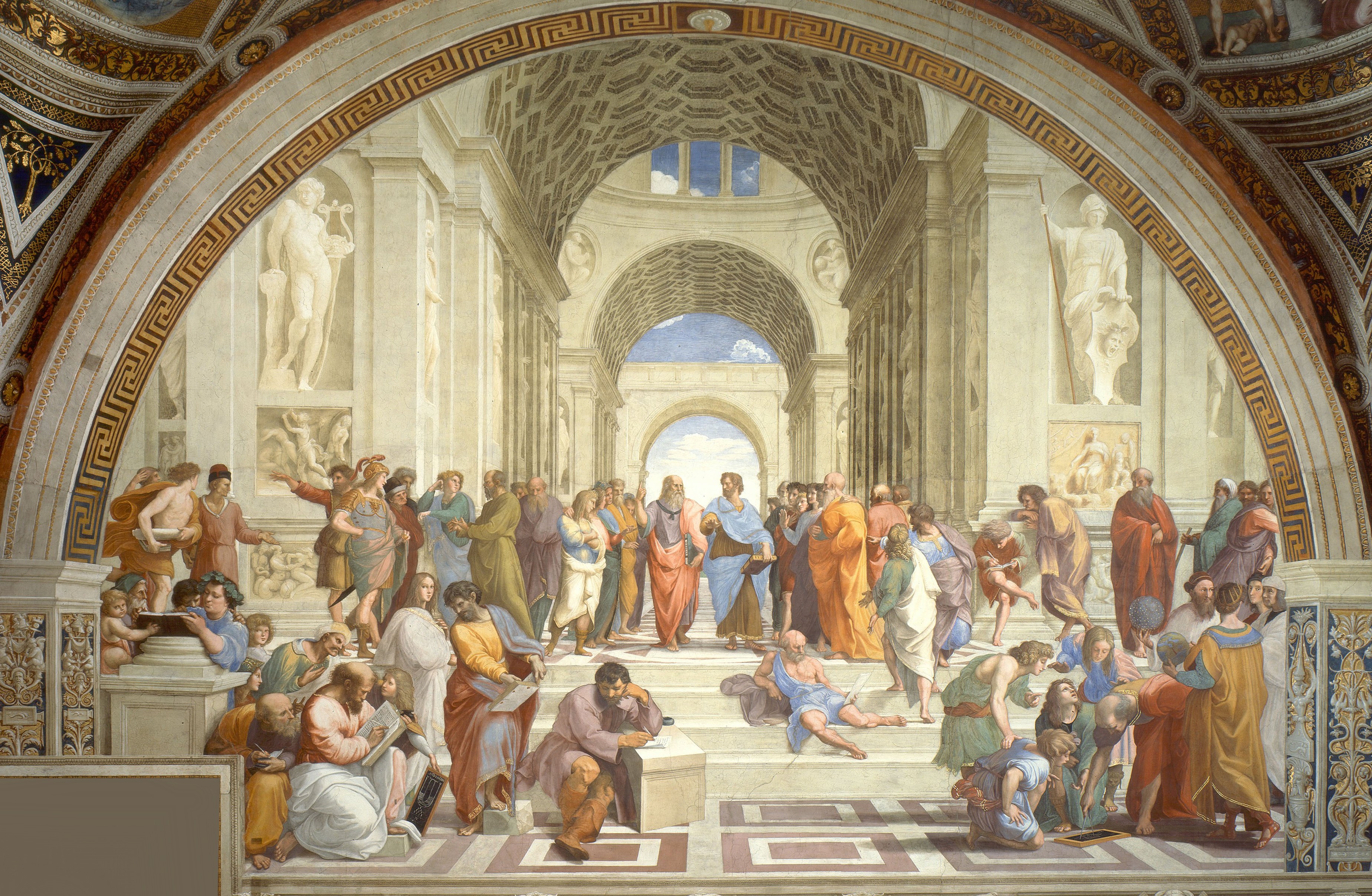
Subscribe to:
Posts (Atom)

 Posts


