It's easy to think that learning is what happens at school. It's not particularly difficult to imagine other places of learning to go alongside the classroom: museums, for example, or (many years ago) libraries. It's a little more challenging to imagine learning taking place while watching TV or playing a video game, sending a text message or reading an email. But as long as the mind is remotely active, I would argue that learning, in some form, happens.
Now, it's not particularly interesting that learning happens all the time. In some ways, it's so obvious that it's hardly worth mentioning, and so much of our learning is so mundane that we'd rather not hear or think about it for fear of choking on our boredom. Learning, for example, that it's slightly faster - or at least more pleasant - to walk to the left of the science building on the way to class in the morning, is not particularly groundbreaking for anyone, including the learner (unless he were to fall through an unnoticed but open manhole, but that's not the point).
No, what's particularly interesting about this learning that happens all the time is how much of it is designed, despite how incidental it seems. That is, even the route from car to classroom is designed in some sense, if not with learning in mind, with learning as a kind of ancillary and unanticipated outcome. Of course, a science building on the whole very much is designed with learning in mind in a much more direct way. And that's only the beginning.
Rather than list all of the myriad areas where learning design is potentially relevant, I want to talk about a couple in particular, an obvious one and a not-so-obvious one. The first is the school, the classroom, the curriculum. The second, video games, and not those horrid "educational games," so many of which pollute the game-o-sphere with their terrible controls, their convoluted plots, and their utter disdain for fun. No, I mean real games, games like Portal or Final Fantasy, Civilization or Little Big Planet.
What do I want to say about each of the very different worlds of game design, on the one hand, and traditional education, on the other? Well, I want to say that, at their hearts, they share a fundamental commonality: they are both designed, and they are both deeply concerned with learning. Now, education might shun the "design" label and games might shun the "learning," but words are just words, and the actual actions behind these particular words bridge the vocabulary gap with or without my help.
That game design and curriculum construction have much in common is hardly a unique idea. James Gee's career, for example, is largely built on recognizing the parallels between gaming and more traditional teaching and learning. It is my opinion, however, that there's more that could be done here, not just in recognizing and defining those parallels, but in uncovering how the two might inform each other better, seeing what game design has to teach educators, and what educators have to teach game design. I would not be surprised, moreover, if the expected conversation - that is, with game design bringing an understanding of design, and education bringing an understanding of learning - is totally reversed. Game designers may know a lot more about learning than we'd like to give them credit for,* and educators more about design, even if they're using different language.
* Consider the challenge they face daily: make a game that is just hard enough to keep the player's interest, and make sure that difficulty scales well as the player gets more advanced. In doing so, however, the designer must take into account the learning of the player - that is, the rate at which he or she improves - as well as the wide variety of potential play styles, learning styles, and personalities that might come in contact with the game. In many ways, that's very much what a teacher does, with the added difficulty that the game designer has to code his game ahead of time. He has to anticipate, because he won't be there to fix it on the fly, except in the abstract way of writing patches.
These suspicions of mine, however, about the potential exchange of information, ideas, and learning design between two very different industries are not sufficient or advanced enough to be beliefs or even arguments. Rather, they are questions. What explicit and hidden learning design processes does the gaming industry use? What about education, both formal and informal? What are their vocabularies? What are their objectives, and how do those objectives aid or detract from improving learning (for example, does making learning itself your core objective make it harder to produce good learning)?
Within the gaming industry - as within the world of education - there are, I'm sure, an infinite variety of approaches. There are certainly a variety of types of studios, from the major AAA production companies like Electronic Arts or Sega to the smaller, lesser-known mid-market studios like Paradox or Stardock, all the way to the miniature independent producers like 2D Boy (makers of the wildly popular World of Goo). In addition to wondering about the game industry as a whole, I think it's fair to ask about the differences within the game industry.
I suppose what I'm suggesting is a kind of ethnography of learning design in the video game industry, and in traditional education. The value of such an effort seems to me to hinge on the observation that learning - if only learning how to play the game - is built into each and every game that gets put on the market. Failure to do so means failure to sell and, thus, failure to survive. Despite the (mostly) non-profit incentives in education, failure to adequately design for learning has much more dire and far-reaching consequences, and yet the conceit of the educator (or education policy maker, or education researcher) is too often to assume that no one else has faced the question of how to design for learning.
Showing posts with label LDT. Show all posts
Showing posts with label LDT. Show all posts
Thursday, June 16, 2011


Saturday, July 31, 2010
Timaeus at the LDT Expo
Yesterday was the glorious final exhibition of my and my cohort's final Master's Projects. That means that we're all but done, but for the piecing together of a final paper and the assembly of a portfolio of the work we've done over the year (plus, for me anyway, moving out of my apartment in preparation for a return to Hawaii). The Expo was, I must say, a fitting ending to an intense, but rewarding year at Stanford. Fitting because it was intense but rewarding in much the same way.
LDT stands for Learning, Design, and Technology, and as my project partner Coram and I ruminated, our final project was equal parts all three. We were hardly alone in that, as our cohort's projects were much the same, despite ranging in content from nutrition apps for adults to math games for kids. Each project incorporated the three main aspects of the program well, despite - as far as I know - much work to explicitly make sure it happened that way. It's a testament to LDT that the kinds of problems we wanted to tackle were the kind that required a little L, a little D, and a little T.
I'm getting ahead of myself, however, because I haven't described my own project yet. Timaeus, as we happened to call it*, is a web-based visualization tool designed to support dialogue around the scientific process and the nature of science. That's a bit of a mouthful, but I'll do my best to convey the essence of the project here, before I ruminate about the Expo experience.
* Yes, I can't help it, and no, I'm not sorry.**
** That's for my college roommate Joe. Timaeus is a very St. John's thing to call my Master's Project, even if it did happen by accident. Because we Johnnies have a hard time getting away from our eminent Johnny-ness (some might call it "pretension," but that's not quite it, even if it's close), we have to develop a mechanism for acknowledging that sometimes we end up dropping Platonic dialogue names in casual conversation, much to the chagrin to everyone else in the room. The best response, Joe has found (and I think I agree), is in the posterisk before this one.
---------------------------------------------------------
Coram and I, at the outset of working on our project, decided that we wanted to do something around dialogue. We did not know what subject area we would design around, or how we would incorporate technology into a design for dialogic pedagogy, but we both agreed that good conversations in the classroom is the best way to facilitate learning.* The design problem, here, is that technology doesn't really support dialogue in the sense we wanted to support it. Sure, there are Internet forums and there's Twitter and stuff like that, but that's not really dialogue so much as, as one of Coram's Professors described it, "Shouting in a crowded room."
* Yes, I can't help it, and no, I'm not sorry.
One of the tricks to good dialogue is that it can't just be a group of people talking about their opinions. "I think this" followed by "Well, I think that" is all well and good for political "discussion" shows and all (especially when accompanied with a good deal of shouting and thumping), but no one really learns anything without trying out new ideas and really listening to each other. The problem is, without a good shared basis of understanding, most people find there's not really a lot to talk about except life stories, geography, and meteorology. When was the last time you and a stranger started randomly talking about philosophy?
For my part, the last time that happened was with Coram; we were talking about Kant before we knew each other's wives names. The reason, though, was not that we're huge nerds,* but rather that we had both read Kant, so we had a shared text about which we could have a conversation. When our Professors brought up modern educational philosophies based on Hegelian phenomenology, we could step outside the classroom and critique the adaptation of Hegel's method to modern education because we were mutually familiar with what Hegel's method was, and how he talked about it. The point is, it's tough to have those conversations without a shared text.
* We probably are, but that's not the point.
Knowing we wanted to support dialogue, and knowing that the best place for technology was not in dialogue in itself, but in the precursor (some kind of shared language, text, cultural artifact, or what-not), we looked for a subject area. Coram has a background in - among other things - Art History, so we bandied about that, especially because of my dabbling in Music History. We both love literature and poetry, so that came up as well. But the thing is, teachers of literature, art, and music usually do a pretty good job of facilitating dialogue. It's easy, really, because you just have to look at a piece of art, study it for a few minutes, and sit down with someone else who has done the same thing to have a rich conversation. Sure, some artistic theory and historical context can help, but it's not necessary. Likewise with literature, where high schoolers across the country have conversations about Romeo, Odysseus, and Tom Sawyer every year. Those may not be the best dialogues in the world, but for the most part they do happen.
Not so in science classes. Rare indeed is the science class that uses dialogue at all, let alone as the dominant pedagogical model. Science teachers will tell you it's because they have to meet so many standards that they have to just convey information. But those same teachers, if you talk to them outside of class, will lament how they have to spend three weeks on stuff that should take two days because they have to repeat it over and over and over again. I would argue that that might have something to do with how people learn: while there are some people who can pay attention and diligently take notes through an hour long lecture, learning everything, that's not the case for most of us. Rather, we learn better in more dynamic environments, having conversations with friends, visualizing concepts, performing actions. A dialogic classroom, potentially, hits all of those things by opening up not only the content, but the very learning process to the learners involved. Students know how they learn best, so let them lead the learning.
Anyway, the systematic problem of didactic science education isn't really a Master's project, because it's simply too big. Instead, we focused on a narrower goal: providing a technological tool that would give students and teachers access to the rich dialogues in science. Biology teachers know that ethical questions are often fascinating and dynamic areas for student involvement in meaningful science debates, so we wanted to leverage that spirit in a way that spans disciplines. Rather than focusing on fringe issues like current events in the ethics of scientific practice (and, after all, it's hard to have a robust debate about the ethics of particle accelerators), we wanted to cut to the heart of the issue: what is science, anyway?
It is remarkable that, despite the general agreement in the scientific community about so many scientific theories, there is almost no agreement as to the nature of science itself. In the following diagram (from our presentation), you can see one of any number of axes along which eminent scientists and philosophers might be arranged.

That a number of well-known and accepted theories and ideas come from scientists across the spectrum speaks to the value of the very debate about what science is. Consider the same graph, but with some famous scientists (and philosophers) on it:

We could argue about whether each of those luminaries is in the right place, but that's exactly the point. Why oh why would we deny students access to this debate? Is there any reason to shut off such a rich source of dialogue? Does it really help to present to students the idea that science is just a set of steadfast rules and methods, practiced exactly the same way by all scientists, in order that they might discover the Truth? Granted, some scientists do think that, too, but that not everyone does - that Newton operated in a way very different from how Heisenberg did - speaks once more to the value of opening up the conversation to high schoolers, especially because, in the course of the debate, they will naturally have to learn content in order to justify and understand their own positions.
---------------------------------------------------------
So what is Timaeus, then? It's a tool to help students visualize the scientific process, not as a static set of five fixed steps, but as a dynamic, evolving, and iterative set of decisions which may not, it turns out, be easy to classify. We give students a set of five colored shapes that represent the traditions steps of the process, and let them build maps of scientific texts, videos, and accounts of experiments. The results look something like this:
 In case you can't read it, the circle stands for "Observation," the square for "Question," the upwards triangle for "Hypothesis," the downwards triangle for "Experiment," and the diamond for "Claim" or "Conclusion." This example in particular charts the process of John Snow in his effort to uncover the causes of the Broad Street Cholera Outbreak of 1854, as described in this Wikipedia article. This is essentially the same map as you may have seen on this blog a few months back, but this was made using our actual tool (which is still in beta, but can do this much as it stands) and not photoshop.
Reading an account of a text closely enough to make analytical and categorical decisions about what is happening at each point is valuable enough, but where Timaeus really shines is in the ability to move from a single student's work to a class's with the search function:
 This image shows the work of six different LDT students mapping Marie Curie's discovery of Radium. From the exact same speech, the there are a wide range of understandings of what, exactly is happening. From a teacher's perspective, this not only lets you see how students are understanding science, but also provides the entry point to a rich conversation around what is happening in a given scientific experiment. When we ran through this exercise, for example, with a group of young Baha'is in the area, they jumped from the map creation to questions about how radium is isolated, where it comes from, and, ultimately, what elements are and how the periodic table is constructed. As a teacher, it's hard to get students interested in learning about the periodic table, so how cool is it when they actually want you to pull it out and explain it?
---------------------------------------------------------
I could go on about the tool a bit more, but I want to talk about Expo as well. Coram and I presented our project in the morning for a panel of five reviewers. Because our project spans across ideas, our reviewers were hardly a homogeneous group. Of the three Stanford Professors in attendance, one was a curriculum specialist, another a science education specialist (whose own work has been in visualization and scaffolding inquiry), one a human-computer interaction specialist from the Computer Sciences department. Our other reviews came from outside of Stanford, one a IT specialist and administrator, and the other a National Board Certified AP Statistics teacher (whose class we had done a user study with, incidentally). Presenting to an audience with such a varied background meant that we had to be sure to address - in our 20 minutes - everything from learning theory to technology design decisions, but I feel we put together a strong presentation and we seemed to be well-received (with the exception of one somewhat tangential question from a non-reviewer in attendance about the "gender" of our project).
In the afternoon we had a three hour long poster session which was packed. In previous years LDT Expos have been held in a smaller space, elsewhere on campus. This year we were in Wallenburg, which opens to the oval and Palm Drive at the front of the school, and we took up the entire lobby and main floor. And there was a time, early in the session, when you could barely move. This may seem unremarkable, but apparently there were about 3 times as many people at this Expo as there have ever been, which means both that our Expo Committee (and our Program Coordinator Karin) did an excellent job getting the word out, and that LDT is gaining some notoriety around the Bay Area and hopefully beyond.
The really value here, though, is that it makes the capstone project of a year's work feel really worth it. It may be exhausting to talk for three hours straight to a continuous string of people wanting to know about your project, but it's awesome that people actually want to know about your project. Even better, for Coram and I, was the feeling we got that people really thought that what we are trying to do is worthwhile. We would believe in it either way, I think, but that doesn't mean that it doesn't help to hear that other people do too.
This project, though, isn't just about feeling good. Because I'll be teaching science back in Hawaii next year with Nalu Studies, I truly do feel that Timaeus is something that can and should be used in the classroom. The kids Nalu is designed for - at-risk and high-risk teens - can benefit as much as anyone from really exploring the nature of scientific work, because it helps them to unlock a whole new way of making and evaluating decisions. For kids who have often already made some bad decisions, there's nothing more empowering than learning how to make better ones in the future, and moreover how to tell the difference ahead of time, how to pick each other up, and how to fail gracefully instead of tragically.
---------------------------------------------------------
As a conclusion, I want to talk a little about the name Timaeus. To be honest, Coram and I struggled to decide on a name for our tool for a long time, finally settling on Timaeus on the day when we had to submit our final name for the LDT Expo poster. As we've thought more about it, however, we're increasingly of the opinion that it fits. In case you don't know, Timaeus is a dialogue by Plato about the nature of the universe. It's a precursor to Aristotle's Physics and his Metaphysics, in that it attempts to layout how the cosmos is arranged, what the soul is, and how we understand and talk about the material and metaphysical world. In short, it's the first foray into describing the nature of science, despite the absence of that term, and the highly logical (instead of empirical) nature of the process.
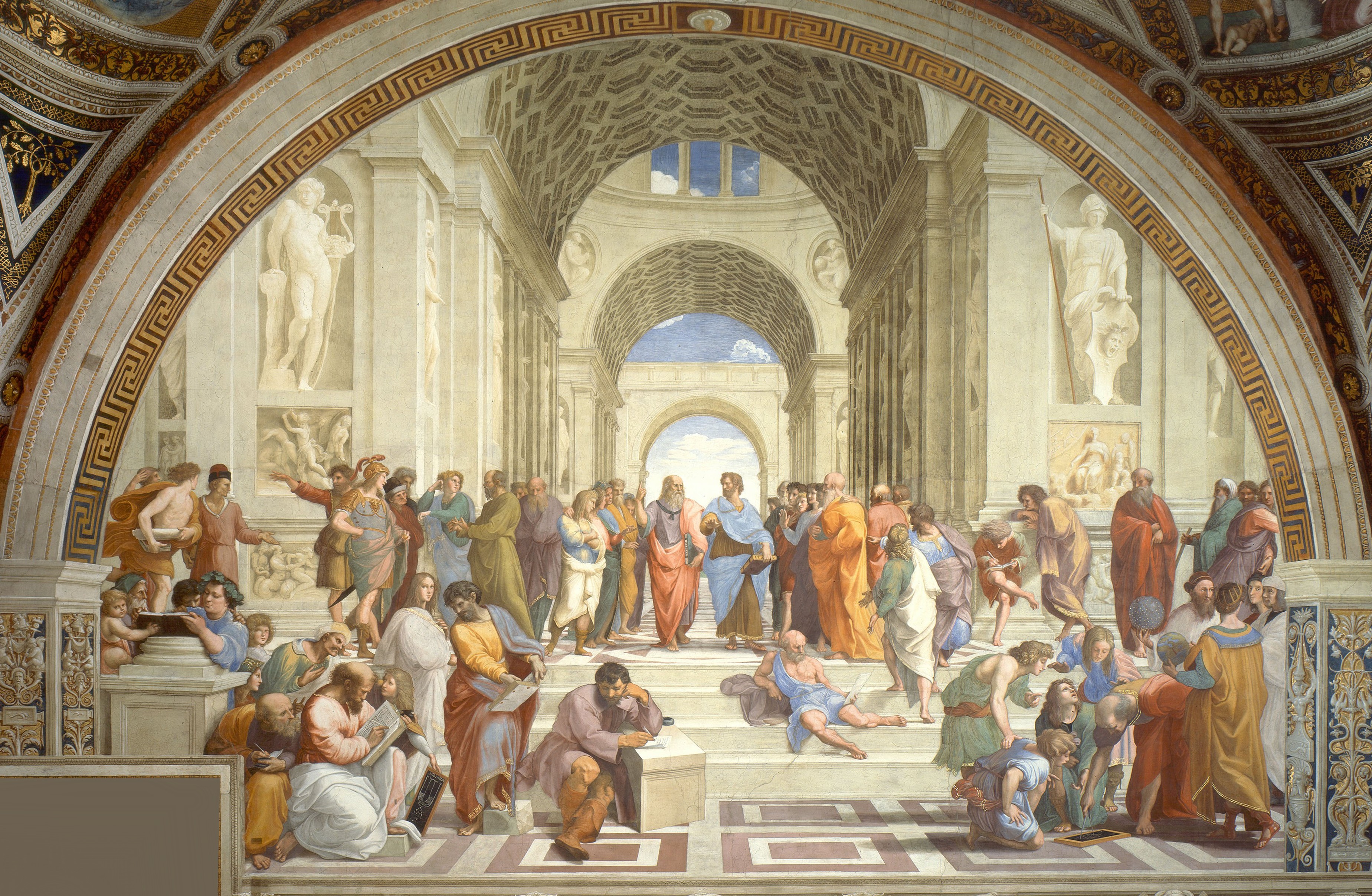
If you know of Raphael's famous School of Athens you may know that Plato and Aristotle are the figures at the center of the work. Coram - as an Art History minor - and I both love the painting, and had discussed it prior to selecting our name. After we came to Timaeus, however we returned to the painting because, as I knew (but Coram did not), the dialogue that is under Plato's arm is the Timaeus. There's something fitting about that, because just as Plato and his academy were one of the first forays into forming a scientific community - and just as Raphael's own artistic and scientific community was a rekindling of that same spirit of inquiry - we believe that modern science education should shift to include more students in the debate around the nature of science, the world, and the pursuit of knowledge. Regardless of what happens with our particular technological and curricular tools, that aim is one we both will share with, we hope, an ever-increasing number of educators for the rest of our lives.

LDT stands for Learning, Design, and Technology, and as my project partner Coram and I ruminated, our final project was equal parts all three. We were hardly alone in that, as our cohort's projects were much the same, despite ranging in content from nutrition apps for adults to math games for kids. Each project incorporated the three main aspects of the program well, despite - as far as I know - much work to explicitly make sure it happened that way. It's a testament to LDT that the kinds of problems we wanted to tackle were the kind that required a little L, a little D, and a little T.
I'm getting ahead of myself, however, because I haven't described my own project yet. Timaeus, as we happened to call it*, is a web-based visualization tool designed to support dialogue around the scientific process and the nature of science. That's a bit of a mouthful, but I'll do my best to convey the essence of the project here, before I ruminate about the Expo experience.
* Yes, I can't help it, and no, I'm not sorry.**
** That's for my college roommate Joe. Timaeus is a very St. John's thing to call my Master's Project, even if it did happen by accident. Because we Johnnies have a hard time getting away from our eminent Johnny-ness (some might call it "pretension," but that's not quite it, even if it's close), we have to develop a mechanism for acknowledging that sometimes we end up dropping Platonic dialogue names in casual conversation, much to the chagrin to everyone else in the room. The best response, Joe has found (and I think I agree), is in the posterisk before this one.
---------------------------------------------------------
Coram and I, at the outset of working on our project, decided that we wanted to do something around dialogue. We did not know what subject area we would design around, or how we would incorporate technology into a design for dialogic pedagogy, but we both agreed that good conversations in the classroom is the best way to facilitate learning.* The design problem, here, is that technology doesn't really support dialogue in the sense we wanted to support it. Sure, there are Internet forums and there's Twitter and stuff like that, but that's not really dialogue so much as, as one of Coram's Professors described it, "Shouting in a crowded room."
* Yes, I can't help it, and no, I'm not sorry.
One of the tricks to good dialogue is that it can't just be a group of people talking about their opinions. "I think this" followed by "Well, I think that" is all well and good for political "discussion" shows and all (especially when accompanied with a good deal of shouting and thumping), but no one really learns anything without trying out new ideas and really listening to each other. The problem is, without a good shared basis of understanding, most people find there's not really a lot to talk about except life stories, geography, and meteorology. When was the last time you and a stranger started randomly talking about philosophy?
For my part, the last time that happened was with Coram; we were talking about Kant before we knew each other's wives names. The reason, though, was not that we're huge nerds,* but rather that we had both read Kant, so we had a shared text about which we could have a conversation. When our Professors brought up modern educational philosophies based on Hegelian phenomenology, we could step outside the classroom and critique the adaptation of Hegel's method to modern education because we were mutually familiar with what Hegel's method was, and how he talked about it. The point is, it's tough to have those conversations without a shared text.
* We probably are, but that's not the point.
Knowing we wanted to support dialogue, and knowing that the best place for technology was not in dialogue in itself, but in the precursor (some kind of shared language, text, cultural artifact, or what-not), we looked for a subject area. Coram has a background in - among other things - Art History, so we bandied about that, especially because of my dabbling in Music History. We both love literature and poetry, so that came up as well. But the thing is, teachers of literature, art, and music usually do a pretty good job of facilitating dialogue. It's easy, really, because you just have to look at a piece of art, study it for a few minutes, and sit down with someone else who has done the same thing to have a rich conversation. Sure, some artistic theory and historical context can help, but it's not necessary. Likewise with literature, where high schoolers across the country have conversations about Romeo, Odysseus, and Tom Sawyer every year. Those may not be the best dialogues in the world, but for the most part they do happen.
Not so in science classes. Rare indeed is the science class that uses dialogue at all, let alone as the dominant pedagogical model. Science teachers will tell you it's because they have to meet so many standards that they have to just convey information. But those same teachers, if you talk to them outside of class, will lament how they have to spend three weeks on stuff that should take two days because they have to repeat it over and over and over again. I would argue that that might have something to do with how people learn: while there are some people who can pay attention and diligently take notes through an hour long lecture, learning everything, that's not the case for most of us. Rather, we learn better in more dynamic environments, having conversations with friends, visualizing concepts, performing actions. A dialogic classroom, potentially, hits all of those things by opening up not only the content, but the very learning process to the learners involved. Students know how they learn best, so let them lead the learning.
Anyway, the systematic problem of didactic science education isn't really a Master's project, because it's simply too big. Instead, we focused on a narrower goal: providing a technological tool that would give students and teachers access to the rich dialogues in science. Biology teachers know that ethical questions are often fascinating and dynamic areas for student involvement in meaningful science debates, so we wanted to leverage that spirit in a way that spans disciplines. Rather than focusing on fringe issues like current events in the ethics of scientific practice (and, after all, it's hard to have a robust debate about the ethics of particle accelerators), we wanted to cut to the heart of the issue: what is science, anyway?
It is remarkable that, despite the general agreement in the scientific community about so many scientific theories, there is almost no agreement as to the nature of science itself. In the following diagram (from our presentation), you can see one of any number of axes along which eminent scientists and philosophers might be arranged.

That a number of well-known and accepted theories and ideas come from scientists across the spectrum speaks to the value of the very debate about what science is. Consider the same graph, but with some famous scientists (and philosophers) on it:

We could argue about whether each of those luminaries is in the right place, but that's exactly the point. Why oh why would we deny students access to this debate? Is there any reason to shut off such a rich source of dialogue? Does it really help to present to students the idea that science is just a set of steadfast rules and methods, practiced exactly the same way by all scientists, in order that they might discover the Truth? Granted, some scientists do think that, too, but that not everyone does - that Newton operated in a way very different from how Heisenberg did - speaks once more to the value of opening up the conversation to high schoolers, especially because, in the course of the debate, they will naturally have to learn content in order to justify and understand their own positions.
---------------------------------------------------------
So what is Timaeus, then? It's a tool to help students visualize the scientific process, not as a static set of five fixed steps, but as a dynamic, evolving, and iterative set of decisions which may not, it turns out, be easy to classify. We give students a set of five colored shapes that represent the traditions steps of the process, and let them build maps of scientific texts, videos, and accounts of experiments. The results look something like this:
 In case you can't read it, the circle stands for "Observation," the square for "Question," the upwards triangle for "Hypothesis," the downwards triangle for "Experiment," and the diamond for "Claim" or "Conclusion." This example in particular charts the process of John Snow in his effort to uncover the causes of the Broad Street Cholera Outbreak of 1854, as described in this Wikipedia article. This is essentially the same map as you may have seen on this blog a few months back, but this was made using our actual tool (which is still in beta, but can do this much as it stands) and not photoshop.
Reading an account of a text closely enough to make analytical and categorical decisions about what is happening at each point is valuable enough, but where Timaeus really shines is in the ability to move from a single student's work to a class's with the search function:
 This image shows the work of six different LDT students mapping Marie Curie's discovery of Radium. From the exact same speech, the there are a wide range of understandings of what, exactly is happening. From a teacher's perspective, this not only lets you see how students are understanding science, but also provides the entry point to a rich conversation around what is happening in a given scientific experiment. When we ran through this exercise, for example, with a group of young Baha'is in the area, they jumped from the map creation to questions about how radium is isolated, where it comes from, and, ultimately, what elements are and how the periodic table is constructed. As a teacher, it's hard to get students interested in learning about the periodic table, so how cool is it when they actually want you to pull it out and explain it?
---------------------------------------------------------
I could go on about the tool a bit more, but I want to talk about Expo as well. Coram and I presented our project in the morning for a panel of five reviewers. Because our project spans across ideas, our reviewers were hardly a homogeneous group. Of the three Stanford Professors in attendance, one was a curriculum specialist, another a science education specialist (whose own work has been in visualization and scaffolding inquiry), one a human-computer interaction specialist from the Computer Sciences department. Our other reviews came from outside of Stanford, one a IT specialist and administrator, and the other a National Board Certified AP Statistics teacher (whose class we had done a user study with, incidentally). Presenting to an audience with such a varied background meant that we had to be sure to address - in our 20 minutes - everything from learning theory to technology design decisions, but I feel we put together a strong presentation and we seemed to be well-received (with the exception of one somewhat tangential question from a non-reviewer in attendance about the "gender" of our project).
In the afternoon we had a three hour long poster session which was packed. In previous years LDT Expos have been held in a smaller space, elsewhere on campus. This year we were in Wallenburg, which opens to the oval and Palm Drive at the front of the school, and we took up the entire lobby and main floor. And there was a time, early in the session, when you could barely move. This may seem unremarkable, but apparently there were about 3 times as many people at this Expo as there have ever been, which means both that our Expo Committee (and our Program Coordinator Karin) did an excellent job getting the word out, and that LDT is gaining some notoriety around the Bay Area and hopefully beyond.
The really value here, though, is that it makes the capstone project of a year's work feel really worth it. It may be exhausting to talk for three hours straight to a continuous string of people wanting to know about your project, but it's awesome that people actually want to know about your project. Even better, for Coram and I, was the feeling we got that people really thought that what we are trying to do is worthwhile. We would believe in it either way, I think, but that doesn't mean that it doesn't help to hear that other people do too.
This project, though, isn't just about feeling good. Because I'll be teaching science back in Hawaii next year with Nalu Studies, I truly do feel that Timaeus is something that can and should be used in the classroom. The kids Nalu is designed for - at-risk and high-risk teens - can benefit as much as anyone from really exploring the nature of scientific work, because it helps them to unlock a whole new way of making and evaluating decisions. For kids who have often already made some bad decisions, there's nothing more empowering than learning how to make better ones in the future, and moreover how to tell the difference ahead of time, how to pick each other up, and how to fail gracefully instead of tragically.
---------------------------------------------------------
As a conclusion, I want to talk a little about the name Timaeus. To be honest, Coram and I struggled to decide on a name for our tool for a long time, finally settling on Timaeus on the day when we had to submit our final name for the LDT Expo poster. As we've thought more about it, however, we're increasingly of the opinion that it fits. In case you don't know, Timaeus is a dialogue by Plato about the nature of the universe. It's a precursor to Aristotle's Physics and his Metaphysics, in that it attempts to layout how the cosmos is arranged, what the soul is, and how we understand and talk about the material and metaphysical world. In short, it's the first foray into describing the nature of science, despite the absence of that term, and the highly logical (instead of empirical) nature of the process.
If you know of Raphael's famous School of Athens you may know that Plato and Aristotle are the figures at the center of the work. Coram - as an Art History minor - and I both love the painting, and had discussed it prior to selecting our name. After we came to Timaeus, however we returned to the painting because, as I knew (but Coram did not), the dialogue that is under Plato's arm is the Timaeus. There's something fitting about that, because just as Plato and his academy were one of the first forays into forming a scientific community - and just as Raphael's own artistic and scientific community was a rekindling of that same spirit of inquiry - we believe that modern science education should shift to include more students in the debate around the nature of science, the world, and the pursuit of knowledge. Regardless of what happens with our particular technological and curricular tools, that aim is one we both will share with, we hope, an ever-increasing number of educators for the rest of our lives.
Thursday, April 8, 2010
The Scientific Process (feat. Vincent Van Gogh)
I've teamed up with a fellow LDT student, and we're heading towards the first draft of our proposal for a Master's project. I should say, rather, that our proposal is due tomorrow, and we're in the process of constructing something like a draft. Really, our problem is that we have more writing than we can possibly use to fill our 2,000 word limit, and we still haven't written everything we need to write. Such is proposal writing.
Anyway, I won't get into the project too much yet, since I'm sure I'll be sharing more about it as it gets more advanced, and because I want to leave room for a little suspense and imagination. Instead, I want to offer a few thoughts that are central to what we're doing: the scientific process. What, in short, really is the scientific process? How should it be taught? How is it used? What does it look like?
There is, of course, no systematic agreement about what the scientific process is and exactly which steps should be a part of it. Indeed, there is much debate about whether it should be called the "scientific method" or the "scientific process." I choose process because I think that fits better with my conception of how it operates, but "method" is more historical (Francis Bacon deemed his work on the matter a method). Nevertheless, there are generally five steps, through which the scientist is meant to proceed in order (methodically) in order to come to a better understanding of the external natural world. Those steps are as follows:
1) Observation
2) Question
3) Hypothesis
4) Experiment
5) Conclusion
Generally speaking, the scientific process is taught like this, as I said, with perhaps some linguistic modifications. It is not uncommon, of course, to call out the iterative nature of the scientific process - that is, that a conclusion might just qualify as a new observation - but there is general agreement that these steps in this order more or less make up the effort of science, and they are not accidentally a prominent feature in science standards and benchmarks across the country.
Do scientists really follow this process? That is not so clear. It certainly seems as though observations, questions, hypotheses, experiments, and conclusions are important parts of the act of doing science, but are they always used sequentially, in just that order? Reflecting on thought-process in general, it is not clear that we always begin with an observation; rather, we might start from a hypothesis or even an experiment. We might say that we are, nevertheless, making an unconscious observation to get there, but does that substantively change the process, or not?
More telling, however, is when we go from observation to question, back to observation. Or when we go from question to question. Or when we go from question straight to experiment without formulating a hypothesis. All of those things unquestionably do happen. Sometimes, before experimentation, we pass through a long series of observations, questions, and hypotheses. Sometimes, unfortunately, we jump straight from questions to conclusions, favoring action over information-gathering (especially when there's insufficient time to test).
That's all abstract, so here is an example. To keep this broad, I'll use a famous work of art rather than a physical and scientific phenomenon. By analyzing a piece of art, I also want to point out that the scientific process is a heuristic tool useful in more than just science:

Observation - I see houses in this painting.
Question - Why are the lines in the houses so much straighter than lines elsewhere.
(Unconscious) Hypothesis - It has something to do with the nature of houses.
Question - What else is in the painting?
Observation - I see a large green thing.
Question - What is that?
Hypothesis - Maybe it's a tree or a bush?
... (note that here I could do the "experiment" of looking up interpretations)
Question - OK, what else is in the painting?
Observation - There seem to be hills, and a highly stylized sky.
Observation - The lines in the hills are less wavy than those in the sky, but they are still soft and flowing.
Observation - The sky is quite swirly.
Observation - The painting's title, Starry Night, tells me that the yellow spots are starts, though somewhat abstracted.
Observation - The big "star" on the right is actually the moon!
Hypothesis - The moon is meant to imply the sun in this painting.
... (again we could "experiment" here, but I'm trying to stay on the path of my initial question)
Hypothesis - Van Gogh is painting natural things with more and more flowing lines than man-made things.
Observation - The church steeple is quite prominent.
Experiment - An analysis and interpretation of the painting suggests that Van Gogh painted this whilst desiring to reconnect with nature. He was in a psychiatric hospital, and was disconnected from the world literally as well as figuratively - a fact augmented by his recent decision to cut off his own ear, which landed him in the hospital to begin with.
Conclusion - The town in Starry Night is soft and forgiving, but remains less free than the natural aspects of the scenery. The steeple could signify a very human sense of hope, but could also be a menacing intrusion on a much more beautiful and interconnected natural world. It does not seem to me that Van Gogh is arguing anything - least of all a "return to nature," - but nevertheless he expresses a stirring (which seems just the right word) picture of the contrast between the form of nature and the forms constructed by man, all-the-while knowing that his painting expresses more than fulfills his desire to bridge those gaps.
A few things here. First off, I don't have the slightest clue whether this interpretation - my "conclusion" - is at all reasonable. I do know, however, that I arrived at it by following a certain process, which I have traced out above. Part of the reason for giving an example with a work of art, here, is to emphasize that scientific knowledge is not unlike the interpretation I've offered here. A scientific conclusion may be reasonable, but it is hard to claim with certainty that it is necessarily correct. Even expressing the actual, and more verbose, process of scientific thinking - as opposed to the 5-step formula we generally teach - there are steps that I've likely left out (I did go back and add a unconscious hypothesis, and could likely add more, but you get the idea).
At the very least, there are points of contention throughout the process I've laid out. Where did I observe, and where did I hypothesize? How many of those observations were genuinely observations, not constrained by hypotheses I had already built? How well did I do in asking questions that did not lead to an expected answer? All of those things I should reflect on, because a good scientist tries to be objective, not by destroying his subjectivity - an impossible task - but by becoming conscious of what directions his subjectivity is likely to pull him in. Indeed, I might ask, is it problematic that my conclusion was in part determined by the prejudices and beliefs that I brought with me into the analysis? If not, would it be problematic if a scientist doing, say, pharmaceutical research, were guilty of the same thing (that is, expecting or desiring a certain outcome)?
As you may have guessed, a part of opening up the scientific process like this - understanding it as a dynamic and iterative process that need not proceed "in order" and can happily dance around especially in the early stages for a long time - is opening up dialogue. Science, contrary to much modern pedagogy, is actually one of the liberal arts, and the division between science and the humanities is less than helpful. My choice to analyze Van Gogh instead of photosynthesis implies this bias on my part, but I hope that you can see by virtue of my selection that scientific thinking is critical thinking, just as much as literary or artistic analysis, and that science should embrace dialogue.
With that in mind, I want to pose a final question. How could we express this messy, but genuine, version of the scientific process more succinctly, thus making it easier to digest and, hopefully, easier to talk about?
Anyway, I won't get into the project too much yet, since I'm sure I'll be sharing more about it as it gets more advanced, and because I want to leave room for a little suspense and imagination. Instead, I want to offer a few thoughts that are central to what we're doing: the scientific process. What, in short, really is the scientific process? How should it be taught? How is it used? What does it look like?
There is, of course, no systematic agreement about what the scientific process is and exactly which steps should be a part of it. Indeed, there is much debate about whether it should be called the "scientific method" or the "scientific process." I choose process because I think that fits better with my conception of how it operates, but "method" is more historical (Francis Bacon deemed his work on the matter a method). Nevertheless, there are generally five steps, through which the scientist is meant to proceed in order (methodically) in order to come to a better understanding of the external natural world. Those steps are as follows:
1) Observation
2) Question
3) Hypothesis
4) Experiment
5) Conclusion
Generally speaking, the scientific process is taught like this, as I said, with perhaps some linguistic modifications. It is not uncommon, of course, to call out the iterative nature of the scientific process - that is, that a conclusion might just qualify as a new observation - but there is general agreement that these steps in this order more or less make up the effort of science, and they are not accidentally a prominent feature in science standards and benchmarks across the country.
Do scientists really follow this process? That is not so clear. It certainly seems as though observations, questions, hypotheses, experiments, and conclusions are important parts of the act of doing science, but are they always used sequentially, in just that order? Reflecting on thought-process in general, it is not clear that we always begin with an observation; rather, we might start from a hypothesis or even an experiment. We might say that we are, nevertheless, making an unconscious observation to get there, but does that substantively change the process, or not?
More telling, however, is when we go from observation to question, back to observation. Or when we go from question to question. Or when we go from question straight to experiment without formulating a hypothesis. All of those things unquestionably do happen. Sometimes, before experimentation, we pass through a long series of observations, questions, and hypotheses. Sometimes, unfortunately, we jump straight from questions to conclusions, favoring action over information-gathering (especially when there's insufficient time to test).
That's all abstract, so here is an example. To keep this broad, I'll use a famous work of art rather than a physical and scientific phenomenon. By analyzing a piece of art, I also want to point out that the scientific process is a heuristic tool useful in more than just science:

Observation - I see houses in this painting.
Question - Why are the lines in the houses so much straighter than lines elsewhere.
(Unconscious) Hypothesis - It has something to do with the nature of houses.
Question - What else is in the painting?
Observation - I see a large green thing.
Question - What is that?
Hypothesis - Maybe it's a tree or a bush?
... (note that here I could do the "experiment" of looking up interpretations)
Question - OK, what else is in the painting?
Observation - There seem to be hills, and a highly stylized sky.
Observation - The lines in the hills are less wavy than those in the sky, but they are still soft and flowing.
Observation - The sky is quite swirly.
Observation - The painting's title, Starry Night, tells me that the yellow spots are starts, though somewhat abstracted.
Observation - The big "star" on the right is actually the moon!
Hypothesis - The moon is meant to imply the sun in this painting.
... (again we could "experiment" here, but I'm trying to stay on the path of my initial question)
Hypothesis - Van Gogh is painting natural things with more and more flowing lines than man-made things.
Observation - The church steeple is quite prominent.
Experiment - An analysis and interpretation of the painting suggests that Van Gogh painted this whilst desiring to reconnect with nature. He was in a psychiatric hospital, and was disconnected from the world literally as well as figuratively - a fact augmented by his recent decision to cut off his own ear, which landed him in the hospital to begin with.
Conclusion - The town in Starry Night is soft and forgiving, but remains less free than the natural aspects of the scenery. The steeple could signify a very human sense of hope, but could also be a menacing intrusion on a much more beautiful and interconnected natural world. It does not seem to me that Van Gogh is arguing anything - least of all a "return to nature," - but nevertheless he expresses a stirring (which seems just the right word) picture of the contrast between the form of nature and the forms constructed by man, all-the-while knowing that his painting expresses more than fulfills his desire to bridge those gaps.
A few things here. First off, I don't have the slightest clue whether this interpretation - my "conclusion" - is at all reasonable. I do know, however, that I arrived at it by following a certain process, which I have traced out above. Part of the reason for giving an example with a work of art, here, is to emphasize that scientific knowledge is not unlike the interpretation I've offered here. A scientific conclusion may be reasonable, but it is hard to claim with certainty that it is necessarily correct. Even expressing the actual, and more verbose, process of scientific thinking - as opposed to the 5-step formula we generally teach - there are steps that I've likely left out (I did go back and add a unconscious hypothesis, and could likely add more, but you get the idea).
At the very least, there are points of contention throughout the process I've laid out. Where did I observe, and where did I hypothesize? How many of those observations were genuinely observations, not constrained by hypotheses I had already built? How well did I do in asking questions that did not lead to an expected answer? All of those things I should reflect on, because a good scientist tries to be objective, not by destroying his subjectivity - an impossible task - but by becoming conscious of what directions his subjectivity is likely to pull him in. Indeed, I might ask, is it problematic that my conclusion was in part determined by the prejudices and beliefs that I brought with me into the analysis? If not, would it be problematic if a scientist doing, say, pharmaceutical research, were guilty of the same thing (that is, expecting or desiring a certain outcome)?
As you may have guessed, a part of opening up the scientific process like this - understanding it as a dynamic and iterative process that need not proceed "in order" and can happily dance around especially in the early stages for a long time - is opening up dialogue. Science, contrary to much modern pedagogy, is actually one of the liberal arts, and the division between science and the humanities is less than helpful. My choice to analyze Van Gogh instead of photosynthesis implies this bias on my part, but I hope that you can see by virtue of my selection that scientific thinking is critical thinking, just as much as literary or artistic analysis, and that science should embrace dialogue.
With that in mind, I want to pose a final question. How could we express this messy, but genuine, version of the scientific process more succinctly, thus making it easier to digest and, hopefully, easier to talk about?
Monday, March 1, 2010
Building Curricula Backwards
Reading back over the curling post from the other day, I'm reminded why it's not a good idea to try to write in a place where other people are having conversations. Not that it is impossible, but it does lead to a certain wanderlust in the writing style which comes across as somewhat elementary-schoolish.
Anyway, in the midst of the end of an exceptionally busy quarter - even busier than last, I believe - I wanted to talk a little about the great fun I've been having building curricula. I'm enrolled in, as I've mentioned, a Curriculum Construction class with Dr. Pope, and in addition to the class's final project (a curriculum), I'm writing two curricula of my own for summer workshops I'm planning on teaching in June.
The curriculum for class I'm writing is a group project. Or was. While there are some finishing touches to apply, we're just about finished. In comparison to my own curricula, our progress was quite rapid, I suspect because we could divide the busy-work parts of the process amongst ourselves. The curriculum is a web-search module for a larger journalism curriculum, with a focus on teaching searching tools and strategies through the lens of assessing bias and credibility in the debate on copyright. Everything in the curriculum is built around addressing one of those three issues (that is, search skills, credibility and bias of sources, and copyright issues), and most activities address more than one (or all three).
In true "backwards design" form, we began with a key goal, then built our three lesser goals, then built a final assessment, and then built the actual lesson plans. Working backwards like this was pioneered by Wiggins and McTighe (first names, I suppose, no longer necessary), the former of whom is a graduate of St. John's, Annapolis. I find it fitting that modern curriculum construction theory was devised and propagated by Johnnie.
Anyway, for our final assessment (or "anchor task"), we're asking students to role-play a hearing on copyright law, after doing group research. The research portion covers the searching and credibility assessment goals, and the content is, of course, the copyright portion. What's more, our anchor task is much richer than a test or quiz, and should therefore encourage more buy-in from students. Granted, even the best of lessons can be ruined by class dynamics (and vice versa; poor lessons can be turned to everyone's benefit by resourceful students and teachers), but we feel we've given implementing teachers every chance to succeed.
As for whether our curriculum actually gets implemented anywhere, we'll see. There are, in fact, a few schools we've made contact with - private and public - who are interested, so it's entirely possible that our work was not merely theoretical.
I should say, one of the key issues with our curriculum is standards. Because web-search is a technology issue, it is covered in the most ancillary of ways by current standards. What's more, standards-based instruction would scoff at our "authentic assessment" model, where we try to get students engaged instead of beating them into the ground with multiple choice tests. But I digress into a subject of a future post (or posts).
My own curricula are quite different, not only from our web-search curriculum, but from each other. Anyone who knows me won't be surprised to hear that, of course, nor will they be surprised to discover what the topics of each curriculum are. The first, and more serious of the two, is a poetry curriculum. The second a sabermetrics curriculum. Since both of these will be elective summer workshops that I'll get to teach in June, it occurs to me that one will likely be mostly (or all) girls and the other mostly (or all) boys.
The poetry curriculum places strong emphasis on writing and discussion. The anchor task is an original piece of poetry, not just written, but read aloud and recorded. Along the way, fortunately, students will get to read a collection of excellent poems that I am even now agonizingly selecting. Authors will range from Whitman (of course) to Gabriela Mistral to, in a touch of Paul, Schiller and Beethoven. In preparation it is likely that I'll get into depth about some of the works in my curriculum in this space in the coming months, so be forewarned.
The sabermetrics curriculum is going to be inquiry-based, and will hopefully introduce students to the radically fast-moving world of baseball statistics research. As a student at in a graduate program, I'm actually in a research community, and it is not hard to tell that the current sabermetrics world is much faster moving, more creative, and more vibrant than the education research world. Call me young and naive, but I suspect it has something to do with the essentially non-existent barriers to entry. Baseball research is not centralized in any institution, so any intelligent and hardworking person can "publish" something meaningful (and potentially get hired by a real MLB team, as has happened frequently of late). The result has been an explosion in our understanding of how baseball works and what truly makes a player valuable.
The point of my curriculum is essentially for the students to have fun and maybe covertly learn some math along the way.* But there will undoubtedly be an undercurrent of my patented contrarianism. In other words, the point isn't just to inculcate students to a new way of thinking, but rather to encourage them to think critically about conclusions they hear anywhere.
*And to help them obliterate their foes in their fantasy leagues, of course.
Which is also the point of the search curriculum and, on some level, the poetry curriculum. I would argue that, maybe, that's the point - or at least one of the points - of education. I asked one of my TAs in Dr. Pope's curriculum class this quarter "how far backwards" backwards design really goes. That's a rhetorical question; it goes all the way back if you let it.
Anyway, in the midst of the end of an exceptionally busy quarter - even busier than last, I believe - I wanted to talk a little about the great fun I've been having building curricula. I'm enrolled in, as I've mentioned, a Curriculum Construction class with Dr. Pope, and in addition to the class's final project (a curriculum), I'm writing two curricula of my own for summer workshops I'm planning on teaching in June.
The curriculum for class I'm writing is a group project. Or was. While there are some finishing touches to apply, we're just about finished. In comparison to my own curricula, our progress was quite rapid, I suspect because we could divide the busy-work parts of the process amongst ourselves. The curriculum is a web-search module for a larger journalism curriculum, with a focus on teaching searching tools and strategies through the lens of assessing bias and credibility in the debate on copyright. Everything in the curriculum is built around addressing one of those three issues (that is, search skills, credibility and bias of sources, and copyright issues), and most activities address more than one (or all three).
In true "backwards design" form, we began with a key goal, then built our three lesser goals, then built a final assessment, and then built the actual lesson plans. Working backwards like this was pioneered by Wiggins and McTighe (first names, I suppose, no longer necessary), the former of whom is a graduate of St. John's, Annapolis. I find it fitting that modern curriculum construction theory was devised and propagated by Johnnie.
Anyway, for our final assessment (or "anchor task"), we're asking students to role-play a hearing on copyright law, after doing group research. The research portion covers the searching and credibility assessment goals, and the content is, of course, the copyright portion. What's more, our anchor task is much richer than a test or quiz, and should therefore encourage more buy-in from students. Granted, even the best of lessons can be ruined by class dynamics (and vice versa; poor lessons can be turned to everyone's benefit by resourceful students and teachers), but we feel we've given implementing teachers every chance to succeed.
As for whether our curriculum actually gets implemented anywhere, we'll see. There are, in fact, a few schools we've made contact with - private and public - who are interested, so it's entirely possible that our work was not merely theoretical.
I should say, one of the key issues with our curriculum is standards. Because web-search is a technology issue, it is covered in the most ancillary of ways by current standards. What's more, standards-based instruction would scoff at our "authentic assessment" model, where we try to get students engaged instead of beating them into the ground with multiple choice tests. But I digress into a subject of a future post (or posts).
My own curricula are quite different, not only from our web-search curriculum, but from each other. Anyone who knows me won't be surprised to hear that, of course, nor will they be surprised to discover what the topics of each curriculum are. The first, and more serious of the two, is a poetry curriculum. The second a sabermetrics curriculum. Since both of these will be elective summer workshops that I'll get to teach in June, it occurs to me that one will likely be mostly (or all) girls and the other mostly (or all) boys.
The poetry curriculum places strong emphasis on writing and discussion. The anchor task is an original piece of poetry, not just written, but read aloud and recorded. Along the way, fortunately, students will get to read a collection of excellent poems that I am even now agonizingly selecting. Authors will range from Whitman (of course) to Gabriela Mistral to, in a touch of Paul, Schiller and Beethoven. In preparation it is likely that I'll get into depth about some of the works in my curriculum in this space in the coming months, so be forewarned.
The sabermetrics curriculum is going to be inquiry-based, and will hopefully introduce students to the radically fast-moving world of baseball statistics research. As a student at in a graduate program, I'm actually in a research community, and it is not hard to tell that the current sabermetrics world is much faster moving, more creative, and more vibrant than the education research world. Call me young and naive, but I suspect it has something to do with the essentially non-existent barriers to entry. Baseball research is not centralized in any institution, so any intelligent and hardworking person can "publish" something meaningful (and potentially get hired by a real MLB team, as has happened frequently of late). The result has been an explosion in our understanding of how baseball works and what truly makes a player valuable.
The point of my curriculum is essentially for the students to have fun and maybe covertly learn some math along the way.* But there will undoubtedly be an undercurrent of my patented contrarianism. In other words, the point isn't just to inculcate students to a new way of thinking, but rather to encourage them to think critically about conclusions they hear anywhere.
*And to help them obliterate their foes in their fantasy leagues, of course.
Which is also the point of the search curriculum and, on some level, the poetry curriculum. I would argue that, maybe, that's the point - or at least one of the points - of education. I asked one of my TAs in Dr. Pope's curriculum class this quarter "how far backwards" backwards design really goes. That's a rhetorical question; it goes all the way back if you let it.
Saturday, October 17, 2009
Learning and Education
There's an interesting, if superficial, difference between the program I am in and the comparable one at Harvard. What Stanford calls "Learning, Design, and Technology," Harvard calls "Technology, Innovation, and Education." I'm sure I'll be offering reflections on all three of the components of my program over the course of the year, but I want to start with "learning," because, on some level, it is the primary focus of the program. The LDT program takes place in the School of Education, after all.
Why do we chose "learning" over "education" in the title of the program? Is it just an aesthetic thing, or is there really a substantive, if philosophical difference between the two? On a visceral level, "education" strikes me as a more institutional term than "learning." Education is what happens in school, or during some king of training. We talk about "informal learning," but rarely do you hear "informal education." What's more, education seems to be an active process. For education to happen, you need an educator of some kind. Learning, while certainly facilitated by a teacher, emphasizes the recipient. You need only a learner for there to be learning.
What is learning, then, as opposed to education? Learning is what happens to an individual, while education is what someone - or something like a school or a computer program - tries to make happen to an individual. Learning and education can happen simultaneously, of course, but it seems it's entirely possible to have learning without education and education without learning. Indeed, we might say there's far too much education without learning in the world/
As tempting as it is to ascribe a morality to learning and education, it seems to me that learning is amoral, in its essence. We may learn not only about things that are cruel, unjust, frightening, and unfair, but we may also learn how to do those things. The old harping against violence on TV or in video games is based on this principle: we are always learning, and the things we are exposed to determine what we learn. I don't know that education is similarly amoral, but it certainly tends towards an agenda in a way that learning does not. Because education is the act of one person on another, it is purposeful, directed (even if the outcome is unexpected), and therefore related to some system of values. We may not agree with the moral structure of a given lesson (a Christian may not approve of a secular education, for example), but it is hard to deny that there is a value-judgment in education as to what is worth teaching.
According to Dewey, our experiences build on each other, and it is the job of the educator to make sure that the learning that is always happening - whether we like it or not - is directed in a way that is sensible, practical, fulfilling, and stimulating. This vision of education and learning is largely agreed upon because it is so intuitive: of course we cannot put things into people's heads, we can only provide them with a series of experiences that culminate in a certain kind of knowledge.
Questions like "What is knowledge?" or "What is experience?" rear their heads, at this point, but I'll resist their urges. Rather, I want to offer a working definition of this thing we call learning. Learning is consciousness over time. I'm reminded of the joke, "time exists so that everything doesn't happen all at once, and space exists so that everything doesn't happen to you." Because things happen in a sequence, we try to process those things and therefore strive to put our experiences together in a logical, meaningful way. We cannot, even if we try, avoid learning. We may not learn things that an educator might call valuable (or that we might call valuable), but we learn just the same.
Stanford's program strikes me as a bit more abstracted than Harvard's, for this reason, though in reality there is likely little difference between the fundamentals of the curricula. We'll be competing for the same jobs, reading the same research, and doing the same kinds of projects. Nevertheless, the spiritual difference is meaningful. Is it more important to understand the process of bestowing knowledge and experience, or the processes by which people acquire knowledge and experience? I'm not sure, and even though I'm sure Stanford and Harvard - and any other school with a similar program - will try to address both sides of that issue, I think understanding learning is probably more fundamental and certainly more philosophical than understanding education.
Why do we chose "learning" over "education" in the title of the program? Is it just an aesthetic thing, or is there really a substantive, if philosophical difference between the two? On a visceral level, "education" strikes me as a more institutional term than "learning." Education is what happens in school, or during some king of training. We talk about "informal learning," but rarely do you hear "informal education." What's more, education seems to be an active process. For education to happen, you need an educator of some kind. Learning, while certainly facilitated by a teacher, emphasizes the recipient. You need only a learner for there to be learning.
What is learning, then, as opposed to education? Learning is what happens to an individual, while education is what someone - or something like a school or a computer program - tries to make happen to an individual. Learning and education can happen simultaneously, of course, but it seems it's entirely possible to have learning without education and education without learning. Indeed, we might say there's far too much education without learning in the world/
As tempting as it is to ascribe a morality to learning and education, it seems to me that learning is amoral, in its essence. We may learn not only about things that are cruel, unjust, frightening, and unfair, but we may also learn how to do those things. The old harping against violence on TV or in video games is based on this principle: we are always learning, and the things we are exposed to determine what we learn. I don't know that education is similarly amoral, but it certainly tends towards an agenda in a way that learning does not. Because education is the act of one person on another, it is purposeful, directed (even if the outcome is unexpected), and therefore related to some system of values. We may not agree with the moral structure of a given lesson (a Christian may not approve of a secular education, for example), but it is hard to deny that there is a value-judgment in education as to what is worth teaching.
According to Dewey, our experiences build on each other, and it is the job of the educator to make sure that the learning that is always happening - whether we like it or not - is directed in a way that is sensible, practical, fulfilling, and stimulating. This vision of education and learning is largely agreed upon because it is so intuitive: of course we cannot put things into people's heads, we can only provide them with a series of experiences that culminate in a certain kind of knowledge.
Questions like "What is knowledge?" or "What is experience?" rear their heads, at this point, but I'll resist their urges. Rather, I want to offer a working definition of this thing we call learning. Learning is consciousness over time. I'm reminded of the joke, "time exists so that everything doesn't happen all at once, and space exists so that everything doesn't happen to you." Because things happen in a sequence, we try to process those things and therefore strive to put our experiences together in a logical, meaningful way. We cannot, even if we try, avoid learning. We may not learn things that an educator might call valuable (or that we might call valuable), but we learn just the same.
Stanford's program strikes me as a bit more abstracted than Harvard's, for this reason, though in reality there is likely little difference between the fundamentals of the curricula. We'll be competing for the same jobs, reading the same research, and doing the same kinds of projects. Nevertheless, the spiritual difference is meaningful. Is it more important to understand the process of bestowing knowledge and experience, or the processes by which people acquire knowledge and experience? I'm not sure, and even though I'm sure Stanford and Harvard - and any other school with a similar program - will try to address both sides of that issue, I think understanding learning is probably more fundamental and certainly more philosophical than understanding education.
Subscribe to:
Posts (Atom)

 Posts
Posts


