From my "Future of English Studies" course. Toc is a new-media literature project. Here's the website. Despite my critique below, it is worth taking a look at.
As a piece of writing, Toc has its virtues. As a piece of electronic media, it's a disaster.
Disclaimer: I'm a gamer. I have been since I was young. I grew up on Civilization II, Front Page Sports Baseball, and Doom. As important to me in college as the "Great Books" and the discussions that went with them was the purchase of my first real computer, and the weekend (and wee-morning) hours I poured into Knights of the Old Republic, Neverwinter Nights (1 and 2), and countless other strategy and RPG titles. It is true that video games often do not contain great - or even good - writing, and that their stories, when they have any, are largely derivative. What they do well, however, is interface.
Toc suffers because it is "interactive" without the interaction actually amounting to anything. Sure, there's a certain randomness (and, the authors would likely argue, timelessness) to the order in which you encounter the various fragments of the story, based upon what you click when, but the fragments are sufficiently free standing that the order hardly matters. Instead, the interaction implies the game world - you have to click precisely on the little blue, green, and red lines to get the appropriate media to operate - without embracing it. The experience of the reader remains mostly passive.
A passive reader experience is fine, of course, but in this case it's the "mostly" that's the problem. The experience isn't passive, but what interaction there is either is too limiting, too frustrating, or both. The lack of controls on the videos (mostly they cannot be paused or rewinded) is a UI disaster. Clicking on the little lines is finicky. The "lens" through which the textual parts of the story is read looks bland, at best. The mix of beautiful hand-drawn images and cool 3D effects in the videos with poor and outdated CGI is jarring.
In all, the authors of Toc, it seems to me, couldn't decide whether they were making this story for readers or for users. They embraced technology as a medium without embracing the design principles that go with it. Sure, the video game industry has its faults, but design is not one of them. Sure, UI people don't have all the answers as to how we can best interact with computers, but they have some good ideas. Sure, modern digital distribution of software of all kinds raises copyright questions, but the archaic "insert CD to install" - without even an autorun function! - places Toc several years behind the times (as does its lack of a patch for the few but noticeable bugs).
Worst of all, Toc is doomed by its lack of flexibility. Though ostensibly friendly with both major operating systems, it requires Apple's Quicktime, which has a tenuous and unhappy relationship with Windows. Toc does not run in Linux (I tried), and I suspect it will struggle once the current generation of its dependent technologies has passed (that is, once we're on to OS 11, Windows 8, and Quicktime Whatever). Even if it can run, it will certainly feel outdated (as it already does). This is true for most digital media, of course, but it is particularly ironic here. For a work so sensitive to time and its illusions, Toc is perhaps more vulnerable to time's passage than most works of art and literature.
Showing posts with label technology. Show all posts
Showing posts with label technology. Show all posts
Monday, November 28, 2011


Saturday, May 14, 2011
More Internets: Responding to a Comment
While writing a response to this comment on my last post, I decided I might as well just make my response into a new post. Heres' the comment:
Interesting post, Paul, and I was glad to finally read your conclusion to such an ambitious project. I also have quite a lot of doubts about the quality of human interaction over the internet, but that said, I'm not sure I totally followed your arguments.
You wrote that cynics "would point out that, in the long history of mankind (and especially in the last 300 years), almost every human interaction can be characterized according to political economy." Though your obviously sincere belief in the benefit of actual human communication seems on one hand to separate you from the cynics as you characterize them, but then you say quite categorically "It is undoubtedly the case that there is no online service which actively promotes communication in the sense I've talked about it above." You argue that all the best social sites do is to actively promote networking without standing too much in the way of communication. But I ask, why must the two be mutually exclusive? Moreover, if you truly believe that the real empathy necessary to true dialogue exists, then why must networking always be slave to the selfish inclinations of the political economy? What if the networking is for the purpose of solving a larger problem?
On the same note, you say "it is clear to me that communication...has been largely ignored, harried, or even battled against by the political economy of the last 300 or so years." The past 300 years more so than any other time in human history? How so? It seems to me that true dialogue has forever been a harried, ignored phenomenon happening most often in secret or on the unimportant fringes of this or that power. Has the overwhelming increase in availability to education and information (putting aside debates over the quality of the two) not helped at all? Have all those benefits been so outweighed by modernity's correlated evils? I guess I would have to say that despite all the very pertinent and important evils you've pointed out in these posts, I think the past 300 years have been a net positive in terms of dialogue.
Finally, you twice picked out the number 300 years. What has been so especially bad about the past three centuries in your opinion?
Phew! Sorry for the lengthy comment! Keep up the good work.
P.S. Ok final question, I swear: where do thoughtful comments on blogs stand in the networking v. communication discussion?
And here's my response:
Thanks again for the thoughtful comment DC. I'll do my best to address some of it briefly.
On your first set of questions, I'm not sure whether communication and networking have to be mutually exclusive, per se. I do think, however, that networking has a kind of addictive effect, simplifying our view of interaction to the point that communication becomes undesirable because of how much more effort it is than merely "poking" people and writing on their walls. It doesn't necessarily actively discourage communication, on a small scale, but on a large scale, while it increases the number of contacts we make, it might decrease the depth of those contacts.
You do make a good point about the problem-solving potential of networks. The ability to connect to people with disparate abilities and specialties allows us to more easily put together teams of problem solvers than any time in the past. There's no question that the Internet's ability to help us find things, people, knowledge, and so on is a boon to all people.
You're right that dialogue has always been harried, of course, and largely ignored society wide. However, despite its myriad corruptions, the intellectual and academic world used to hold dialogue in much higher esteem than it is now. There's no question that the scene has changed in the ways you describe (better access to information and more widespread education) in the modern world, but I guess I would argue that dialogue is a process, and not an outcome, and that in our modern world we're in the stranglehold of outcomes. That is, while there are way more "smart" people, who know more about more things, and who are specialized experts in their fields, I think the proportion of educated men and women who are generalists and process-oriented enough to talk about actual ideas and not just the jargon-infused specialized knowledge of their discipline is woefully small. To my mind, the web encourages, rather than discourages, that kind of (what I consider) intellectually deadly specialization.
That's not to say specialization doesn't work. It does. It drives technological progress, it leads to multi-disciplinary teams of problem solvers, and so on. It's just, having been on such teams, seen such progress, there's a distinct lack of real communication, a failure to ask why we do what we do, or what kind of progress is really desirable. Increasingly it seems to me that we're not only afraid, but maybe even incapable of having that conversation.
As for 300 years, it's partially an arbitrary number. More than anything, I'm pointing to the inception of a modern capitalistic-economy and the coming of romanticism, which ultimately lead to the myopic, every-man's-truth-unto-himself philosophy of post-modernism. I also wanted to encompass the industrial revolution, because it was the time in which the philosophy of "progress" became so powerful. But, again, I could just have easily picked out another time, because the actual past is not nearly so broken into discrete eras as our narrative of it is.
As for your ps, that's a good question to which I don't really have an answer. I often ask myself "why do I write this blog?" Passionate as I am about dialogue, there's little question that I'm as trapped by the medium as writers have been throughout history. The written word can't respond to a question,* to paraphrase Plato, even if I can respond post-facto. Though there is tremendous value in writing, reading, responding, and so on, I don't know if it's fully a dialogue, in that we're stuck exchanging declarative and/or interrogative monologues.
* At a certain point, of course, I might as well critique the shortcomings of books as Plato does. Really, the lesson is, with any technology (like books) there are benefits, which we usually champion, and drawbacks, which we too easily ignore. Unfortunately, in addition to this optimism, we often fail to ask questions like "why do we need this?" or "how should we best use it?"
Then again, much as I prefer dialogue, the alternative is for you and I not to communicate in any form, since you're halfway around the world from where I am if I'm not mistaken. But I think there's an analogy to be made with distance education here. Yes, it's better than nothing, but that doesn't mean we should rest on our proverbial laurels and say "oh how great a thing is the Internet!" I'd instead challenge you, myself, and any other thinking person to think bigger: how might we make the Internet a venue for communication and dialogue?
It's that last question that inspired this series of posts, and I think it's a sticky and difficult question, because it's not so simple as "what kind of website" could accomplish that goal. And really, I'm talking about the effort to bring real dialogue online - to code it into some experience, and not merely to make it possible or to not make it impossible - requires confronting the commercial, informational, and networked aspects of the Internet experience.
Interesting post, Paul, and I was glad to finally read your conclusion to such an ambitious project. I also have quite a lot of doubts about the quality of human interaction over the internet, but that said, I'm not sure I totally followed your arguments.
You wrote that cynics "would point out that, in the long history of mankind (and especially in the last 300 years), almost every human interaction can be characterized according to political economy." Though your obviously sincere belief in the benefit of actual human communication seems on one hand to separate you from the cynics as you characterize them, but then you say quite categorically "It is undoubtedly the case that there is no online service which actively promotes communication in the sense I've talked about it above." You argue that all the best social sites do is to actively promote networking without standing too much in the way of communication. But I ask, why must the two be mutually exclusive? Moreover, if you truly believe that the real empathy necessary to true dialogue exists, then why must networking always be slave to the selfish inclinations of the political economy? What if the networking is for the purpose of solving a larger problem?
On the same note, you say "it is clear to me that communication...has been largely ignored, harried, or even battled against by the political economy of the last 300 or so years." The past 300 years more so than any other time in human history? How so? It seems to me that true dialogue has forever been a harried, ignored phenomenon happening most often in secret or on the unimportant fringes of this or that power. Has the overwhelming increase in availability to education and information (putting aside debates over the quality of the two) not helped at all? Have all those benefits been so outweighed by modernity's correlated evils? I guess I would have to say that despite all the very pertinent and important evils you've pointed out in these posts, I think the past 300 years have been a net positive in terms of dialogue.
Finally, you twice picked out the number 300 years. What has been so especially bad about the past three centuries in your opinion?
Phew! Sorry for the lengthy comment! Keep up the good work.
P.S. Ok final question, I swear: where do thoughtful comments on blogs stand in the networking v. communication discussion?
And here's my response:
Thanks again for the thoughtful comment DC. I'll do my best to address some of it briefly.
On your first set of questions, I'm not sure whether communication and networking have to be mutually exclusive, per se. I do think, however, that networking has a kind of addictive effect, simplifying our view of interaction to the point that communication becomes undesirable because of how much more effort it is than merely "poking" people and writing on their walls. It doesn't necessarily actively discourage communication, on a small scale, but on a large scale, while it increases the number of contacts we make, it might decrease the depth of those contacts.
You do make a good point about the problem-solving potential of networks. The ability to connect to people with disparate abilities and specialties allows us to more easily put together teams of problem solvers than any time in the past. There's no question that the Internet's ability to help us find things, people, knowledge, and so on is a boon to all people.
You're right that dialogue has always been harried, of course, and largely ignored society wide. However, despite its myriad corruptions, the intellectual and academic world used to hold dialogue in much higher esteem than it is now. There's no question that the scene has changed in the ways you describe (better access to information and more widespread education) in the modern world, but I guess I would argue that dialogue is a process, and not an outcome, and that in our modern world we're in the stranglehold of outcomes. That is, while there are way more "smart" people, who know more about more things, and who are specialized experts in their fields, I think the proportion of educated men and women who are generalists and process-oriented enough to talk about actual ideas and not just the jargon-infused specialized knowledge of their discipline is woefully small. To my mind, the web encourages, rather than discourages, that kind of (what I consider) intellectually deadly specialization.
That's not to say specialization doesn't work. It does. It drives technological progress, it leads to multi-disciplinary teams of problem solvers, and so on. It's just, having been on such teams, seen such progress, there's a distinct lack of real communication, a failure to ask why we do what we do, or what kind of progress is really desirable. Increasingly it seems to me that we're not only afraid, but maybe even incapable of having that conversation.
As for 300 years, it's partially an arbitrary number. More than anything, I'm pointing to the inception of a modern capitalistic-economy and the coming of romanticism, which ultimately lead to the myopic, every-man's-truth-unto-himself philosophy of post-modernism. I also wanted to encompass the industrial revolution, because it was the time in which the philosophy of "progress" became so powerful. But, again, I could just have easily picked out another time, because the actual past is not nearly so broken into discrete eras as our narrative of it is.
As for your ps, that's a good question to which I don't really have an answer. I often ask myself "why do I write this blog?" Passionate as I am about dialogue, there's little question that I'm as trapped by the medium as writers have been throughout history. The written word can't respond to a question,* to paraphrase Plato, even if I can respond post-facto. Though there is tremendous value in writing, reading, responding, and so on, I don't know if it's fully a dialogue, in that we're stuck exchanging declarative and/or interrogative monologues.
* At a certain point, of course, I might as well critique the shortcomings of books as Plato does. Really, the lesson is, with any technology (like books) there are benefits, which we usually champion, and drawbacks, which we too easily ignore. Unfortunately, in addition to this optimism, we often fail to ask questions like "why do we need this?" or "how should we best use it?"
Then again, much as I prefer dialogue, the alternative is for you and I not to communicate in any form, since you're halfway around the world from where I am if I'm not mistaken. But I think there's an analogy to be made with distance education here. Yes, it's better than nothing, but that doesn't mean we should rest on our proverbial laurels and say "oh how great a thing is the Internet!" I'd instead challenge you, myself, and any other thinking person to think bigger: how might we make the Internet a venue for communication and dialogue?
It's that last question that inspired this series of posts, and I think it's a sticky and difficult question, because it's not so simple as "what kind of website" could accomplish that goal. And really, I'm talking about the effort to bring real dialogue online - to code it into some experience, and not merely to make it possible or to not make it impossible - requires confronting the commercial, informational, and networked aspects of the Internet experience.
Sunday, April 24, 2011
Rethinking the Great Books
Introduction
As a graduate of St. John's college, it's practically sacrilegious for me to suggest that there might be some flaw in the curriculum of the college. "The Program" may not be sacred, per se, but it is founded upon the thinking of philosophers that the modern world - though perhaps not philosophy departments - largely ignores, and therefore there's a kind of internal sanctity to the whole thing. You see, St. John's is an academic institution that shuns modern academia, a place where research - the modus operandi of every University in the world - is not frowned upon so much as regarded with a bemused detachment. That is, it's taken very seriously, in a certain sense, but also challenged on the grounds that it cannot answer all of the questions it asks. Where modern academia believes that the best questions are the ones that can be answered with rigorous experimental design and good implementation, St. John's rather tends towards the view that the best questions are the ones that cannot be answered, and, furthermore, that the process of dialogue around those questions might be more valuable to students - and to the world at large - than the more "practical" aims of research.
Perhaps "more valuable" is too much, there. I should say, instead, that we live in a world overrun by research, largely devoid of dialogue (in its root sense*). As Husserl might say - if he weren't such a terrible writer - we have plenty of answers, but we don't really know what any of them mean, or why they are important. Perhaps we can't know, but at least we can ask, and we rarely do that anymore, either.
* OK, a parenthetical isn't enough here. Dialogue comes from Greek, dia meaning through, logos meaning all kinds of stuff, such as language, words, logic, ratio, and so on. So dialogue is kind of talking through, but also thinking through, or logic-ing through. We do plenty of talking in the modern world, but how often do you see two (or more) people talk through the logic of a question, try to analyze it together and really build an answer, or at least a framework from which to understand that question? I certainly don't see it often.
Not surprisingly, given its anachronistic concern with meaning, St. John's has been largely misunderstood by most of the academics I have met since my graduation. Unfortunately, that misunderstanding has been for reasons I would never have guessed. Rather than objecting to its philosophical purposes, I've heard time and again that the problem with St. John's is the Great Books, the hegemonic, conservative, rich-white-maleyness of the whole endeavor. It matters not, it seems, what the books Johnnies read are about, or even the way in which those books are read, but rather what matters is who wrote the books in the first place. Context, to the modern researcher's mind, is more important - or at least easier to pin down - than meaning, so St. John's is attacked on the basis of context.
It would be foolish to discount the criticisms of the Great Books, however, simply because they misunderstand the purposes of the college. No, it is my belief that while St. John's itself may not be in need of any drastic reform, any program based on the principles of the college might benefit from an infusion of some of the modern research on learning, for one, and some of the great - or at least very good - works of the last hundred years. With that in mind, I want to discuss the two distinct parts of the St. John's program, including whether they are interdependent or not, and what might be done differently.
The Great Books
It is certainly true that there is a preponderance of work from white males in the traditional Great Books curriculum, but that owes more to the vagaries of history, I would argue, than an innate bias from the founders of the program or the current faculty and administration at the college. It is an unfortunate truth that, for much of the history of the western world, it has been only wealthy white males who have had access to the resources and means to print and distribute works widely and effectively enough that those works had a chance to survive to the modern day. It is inevitably true and extremely frustrating that there were great thinkers who never had an opportunity to write among the oppressed women of Europe or the many foreign cultures that the Europeans subjugated, from the Islamic Northern Africans to the Arabic civilizations of the middle east (who did, incidentally, produce plenty of writing, much of which was lost to marauding crusaders) to the various islanders and tribal societies crushed under foot during the age of imperialism.
The fact of oppression, however, does not mean that we ought to ignore the works that are available to us, written by the oppressors though they may be. Indeed, it is among what we now consider the "Great Books" that the most vocal opposition to said oppression can be found, where writers like Montaigne dare to suggest that the "savages" of the New World might be just as civilized - or moreso - than their European counterparts. That, I know, does not excuse Europe any more than, say, American citizens who objected to Japanese internment camps during World War Two, but that's not the point.
No, the point is that history is valuable, and not just history as a retelling of the past. The history of ideas is important, the history of science and philosophy and art and music and literature. I, because I have read the Great Books, because I am white and male, have been accused of being a part of the hegemonic, oppressive culture that is still, in many ways, at work in the modern world. But I would argue the opposite. Because I have read Aristotle, Plato, Descartes, Aquinas, Kant, Hegel, Hume, and so on (and so on), I actually know that "oppressive" world from the inside out, and I can tell you that despite the context, the meaning was, more often than not, valuable. Tracing the philosophical history of a patriarchal and oppressive West may come across as a worthless (at best) or even evil (at worst) project to the staunch multi-culturalist, but in fact it is remarkable and too easily overlooked how deeply, and often subtly, influenced by the authors and thinkers that comprise the Great Books curriculum our modern world is.*
* I don't have anything to add, here. This is just a ploy to get you to re-read that sentence, especially the final clause.
The real distinction here, then, is the same as I mentioned above. As a reader of the Great Books, I may have all kinds of hidden (or not so hidden, but potentially "dead white male" inspired) biases - like my insistence that meaning matters - but as a St. John's student I was never asked to read books from the perspective of a dead white male, or a European conquistador, or, for that matter, from any subaltern perspective either. No, I was asked to read the works sans context, sometimes to the point of absurdity (ignoring, for example, collecting knowledge or interpretation of American colonial history while reading the Federalist Papers). We were never asked to think about how Aristotle wrote, about what the condition of his Athens was, about who was oppressed and who wasn't, about his place in history. While some of these things inevitably would come up, from time to time (and depending on the author), they were never the focus. No, instead we were asked to think about what Aristotle was saying, why he was saying it, and why it mattered (or didn't).
Now there is a legitimate argument to be made that what St. John's tries to do is flawed, that meaning cannot be separated from context. But I guess my argument is that context cannot be separated from meaning either, and that in a world where we are much better trained to think about context, thinking about meaning is more valuable precisely because it is rare. To talk about context alone is to talk about nothing, and while I am amenable to discussing the flaws in the Great Books curriculum as a list of books worth reading, the perspective that something is wrong with the inherent process behind the way those books are read and discussed is, to me, a deeply flawed argument.
Unfortunately, the arguments I have heard against the Great Books do exactly that: they throw the whole thing out simply because it challenges the context-centric thinking that dominates modern academia, refusing to acknowledge that there might be something to be gained in such an education, at least for some students. Without a hint of irony, the modern academic does to the Great Books curriculum exactly what they accuse the European authors of the Great Books of doing to other cultures throughout history. I know, not a fair comparison, but worth pointing out because it underlines the main point: the kind of thinking that the St. John's curriculum is after is the kind of thinking that sees and understands how and why we think about questions and problems in the ways that we do.
The question is, where does that thinking really come from? The Great Books themselves - the vast reading list - is only a part of the story. Perhaps more important is the approach, which is much more than just the focus on meaning over context discussed above. No, in spite of what is perceived as an anachronistic, conservative, and just generally stuffy curriculum, there's a pedagogy at St. John's so radical that it inspires the most progressive of educators.
A Dialogic Pedagogy
In the St. John's classroom there is no Professor. Each class is led by a Tutor, a faculty member who is responsible for guiding and facilitating a conversation, but not for having mastery over the material or the ability to answer difficult questions about the reading in question. Students and Tutors, in fact, use the same naming conventions, calling each other by "Mr." or "Ms." even when the Tutor holds a Doctorate. Whereas the modern academic environment in the broader world, then, is extremely hierarchical, St. John's is not.
In addition to the somewhat superficial - but very telling - nomenclature of the college, there are other pedagogical policies that truly make St. John's radical. For example:
- Instead of hiring experts in various fields and assigning them to Professorships in those fields, every St. John's Tutor is made to teach classes in every subject. A Tutor with a PhD in Political Science will, in time, lead courses in Ancient Greek, Music, Science, and Math. The result is that Tutors are often learning as much (or more) than the students in their classes, operating functionally as another member of the class - "model learners" - instead of teachers.
- All classes are discussion based. There are no - or at least only very rarely - lectures at St. John's. There is also, however, no hand raising. The Tutor does not call on students, either. "Discussion based" classes at St. John's are different from discussion based classes everywhere else I have been in this regard, because they depend upon the focus and listening of the members of the class, the experience that makes it possible to hold a dialogue with over a dozen people without some artificially imposed system to stop everyone from talking all at once. While this may seem crazy in our modern world (on a political television show it's a miracle if three people can have a conversation without constantly interrupting each other), after the Freshman year actual interruption is fairly rare. As much as Johnnies are learning to think about meaning, they are also learning to listen.
- There are no tests, no worksheets, few papers, and only superficial grades at St. John's. Assessment remains the job of the Tutor, but only as a way of helping the student to learn to assess his or her own learning. Tests would serve no purpose in a college where the effort to understand the material is more important than the material itself. Moreover, tests notoriously do a better job assessing student ability in taking tests more than content knowledge anyway. Instead, St. John's assesses based upon classroom participation and by means of the occasional writing assignments, which emphasize good ideas over good writing. In the end, grades are awarded, but only because graduate schools demand that they be. Philosophically, St. John's would not award grades if it did not have to.
- The classroom is only the beginning of the conversation. While there is no requirement that Johnnies carry their philosophical musings outside the classroom, in inevitably happens. In a small academic community where every single student shares the same reading list, the same pedagogical style in their classes, and many of the same questions about what the books they are reading mean, it is only natural that the conversations permeate throughout the life of the student. Oh, college students are still college students, but there's something to be said for the drunk 21 year old who's arguing about Kant at a party. Even conversations about things that are not on the reading list take on characteristics of the classroom conversation, and ideas are put through the same intellectual ringers. In short, St. John's is a community of learning, a place where thinking, reading, and conversation happen constantly. I have heard it compared to a military academy in terms of the level of discipline and the amount of single-minded focus on the curriculum that the students generally have. The difference is, at St. John's that happens without students being required to have that discipline and focus.
The pedagogy of St. John's is unlike the pedagogy of any other school, university, or academic program I have encountered.* Obviously there are a great many preconditions to creating such a culture: it has to be institution wide, it helps that students are old enough to take responsibility for their own learning, etc. Nevertheless, the unique approach of the college towards how learning ought to happen contains lessons that are more widely applicable. Particularly, it turns out, in multi-cultural, progressive classrooms. Indeed, I was stunned to read Paolo Freire's Pedagogy of the Oppressed, only to discover that, ironically enough, the pedagogy he describes as being ideal is almost exactly what St. John's does.
* The closest thing, strangely enough, is the d.school at Stanford, which holds many of the same philosophies about academic hierarchy, group participation, and learning assessment, despite the very different end-goal of producing things.
Curriculum and Pedagogy in the 21st Century
As much as I love the St. John's curriculum and its attendant pedagogy, I feel as though there is room for improvement. Two areas, in particular, afford a great deal of potential for the college's approach to education, namely 1) a re-imaging of the curriculum with an eye towards incorporating more works from the last eighty or so years, and 2) incorporating appropriate technologies, where appropriate, to enhance what is already going on in the classroom.
A Multi-Cultural Great Books Curriculum
The first of these two possibilities is almost too obvious. Of course St. John's should incorporate more works from the last eighty years! How could they not? Because the still in-use Great Books curriculum was founded and shaped around the 1930s, it has changed little since that time. At its inception, then, it was modern, including works that were then contemporary and influential. The core of the program has always been historical, but the finishing touches, I believe, were never meant to stagnate in the way they have. The Great Books, in any time, ought to span from the earliest available writings to the most recently available, as long as those works are, by some measure, great. That's a sticky distinction, of course, and difficult decisions have to be made at every turn (for example, focusing on the West in the core program of St. John's means that the great works of China, India, and Japan are largely ignored, though the college also offers an Eastern Classics Master's program).
Any re-imaging of the St. John's curriculum, then, would require sacrifices and compromises, which is unlikely to occur as long as faculty and staff each have their own and separate favorites. When arguments for staying the same and for changing are equally valid, we tend to resist change, and so St. John's is slow to adapt to the modern world because there is - as seen above - a compelling case for the status quo. Nevertheless, I do believe there are things which could be cut which would not ruin the curriculum or rob it of its heart, and which would allow for the inclusion of more modern works. I won't bore you with details, especially because any one personal opinion need not be decisive in reforming or recreating the St. John's curriculum.
Instead, I see a new Great Books curriculum as a backwards design challenge. If the ultimate core goal of St. John's is to produce critical thinkers, and the secondary goals are to acquaint students with the history of Western thought, to encourage students to learn to dialogue, and to ensure participation in a community of learning, then there are many legitimate curricular choices that might lead to those end goals. Indeed, my argument boils down to this: I believe St. John's could actually do a better job acquainting students with the history of Western thought.
The danger of making the Great Books curriculum more multi-cultural is, of course, tokenism. When you add, for example, a book by Toni Morrison, are you adding it because it's great, or because it was written by a black woman? Even if the answer is the former, the problem remains in the perception of people looking at the program. So it is even now, as when I tell people we do, in fact, read W.E.B DuBois and Virginia Woolf (among a few other non-white men) at St. John's I'm told that we're just engaging in tokenism, and not really taking seriously the subaltern viewpoint.
What's more, in the multi-cultural world there are a preponderance of cultures and sub-cultures, so much so that the very notion of greatness has lost its perceived legitimacy, or at least its practicality. It is simply impossible to read the seminal works of every single sub-culture of American society (much less world society), because there are just way too many sub-cultures with way too many seminal works. To me, however, this is a challenge that a modern Great Books curriculum ought to rise to, rather than ignore. If it is impossible to read the great Japanese-American, Korean-American, Chinese-American, Phillipino, Hawaiian, American Indian, African-American, Afro-European, Polish-American, Czech-American, Arab-American and so on and so on (and so on) great works, at least we can raise the question by picking those particularly influential academic works like the famous Can the Subaltern Speak? or by choosing (and even rotating?) important literary works like The Woman Warrior or Their Eyes Were Watching God (or so many others) from among the many wonderful options.
The explosion of excellent, provocative, and maybe even great writing in the modern world is not something that the Great Books should ignore. There's an opportunity to shape an even better curriculum, here, if only the few people who are shaping such curricula would rise to the challenge.
Dialogic Pedagogy in the Digital Age
Perhaps even a bigger opportunity than reshaping the Great Books curriculum, however, is the chance to use technology to further the goals of the dialogic pedagogy of St. John's. I do not believe that technology can significantly improve the classroom experience and discussion at the college - though certainly there are times when a quick Wikipedia check for factual information would be beneficial - but that does not mean that there's no place for it in the Great Books education. Even when I was a student, the Internet had already become a source not just of news, but of contextual or biographical information.
"Now wait," you're saying. "Didn't you say that you're not supposed to talk about context at St. John's?" I did say that, but only because I was contrasting a focus on context with a focus on meaning. Inevitably questions about context do arise, not as a central talking point, but as aids to understanding meaning. Sometimes it is useful to know context not because it can explain, and not because we want to hide behind contextual connections between texts as a way to ignore talking about more difficult and more profound matters. Rather, the value of context is in coloring meaning, in resolving a dispute about who came first, or who studied with whom. The easy availability of something as simple as a timeline can radically transform a conversation not because era and meaning are innately interconnected, but simply because era does sometimes explain away things like simple lexicographical differences.
Beyond merely making more information available, however, I think there's another dimension to what St. John's could do with the Internet. As social media have become increasingly prominent on the web - with Facebook (a social site) occasionally outranking Google (an information site) - it has become clear that we, as a society, need to understand how human interaction translates to the web. Unfortunately, it seems to translate fairly directly; that is, where most person-to-person interactions are rife with people refusing to listen to each other, willfully misunderstanding, and generally being pigheaded and closed-minded, the same is doubly true on the Internet thanks to the added veil of anonymity and the security that affords. It's all too easy to come to an Internet forum (whether a literal forum or a networking site like Facebook or Twitter) with an agenda and an opinion that never gets revised. True, the availability of information means that opinions based upon faulty factual information can be easily proven wrong, but even then the pigheaded will not change their minds.
Now, obviously not all denizens of the net are guilty of closed-mindedness. Like in the real, material world, there's a range, and some people use the Internet precisely because it's a way to expand one's exposure to ideas and cultures and ways of thinking. I just think that's relatively rare, because it's much easier to use the Internet for pleasure of various kinds, whether carnal, social, or intellectual. Technology easily fools us into thinking that everything should be easy and fun. But good thinking is still hard, even with technology to help (though perhaps it is more fun), and doing things that are hard requires a certain discipline of mind.
So where does St. John's - or some other dialogic Great Books-y curriculum - fit in this picture? Well, I believe that it can shape - perhaps only for its students, but perhaps more broadly - a more dialogic mode of digital interaction. Perhaps true dialogue is impossible on the web (perhaps it's impossible, period), but a place as committed to dialogue as St. John's ought to at least explore the possibility that some of the ways of communicating that it holds dear might be transferable to an online space.
What does that look like? That's a difficult question, the answer to which would require a careful effort to understand what good dialogue really is, and how it might be recreated in a web space. Maybe, in the end, that looks like Twitter or a Facebook wall? Maybe - and this is what I would guess, but can't know - it looks unlike anything currently available on the web. The thing is, in order to get there someone needs to make the effort to design and create a real web (or other technology) based tool for real dialogue.
If such a thing existed, in whatever form it might take, the role in a modernized St. John's is at least partially obvious. The classroom could be supplemented, yes, but the more valuable use would be in reaching beyond the 800 or so enrolled students at the college. If the world desperately needs to learn to dialogue, why not make it possible to learn - at least in part - with technology
Conclusion
Not surprisingly, my suggestions and analysis here are based upon processes and not outcomes. If I were tos summarize this essay, I'd say that the St. John's (or any other program with similar goals) could stand to reevaluate not what they do, but the way they do it. How might St. John's better fit itself into the modern world, keeping its fundamental strengths intact? How might St. John's reshape its curriculum to encompass Western thought not just from 1000 BC to 1935, but to 2011? How might St. John's use technology to support its dialogic goals, both in the classroom and beyond? Given that St. John's does do a good job - in my opinion - preparing it's students for life, how might St. John's do an even better job preparing its students for the modern, networked, distributed, changing, technological world? In the end, the answer might be "stay the same," but it's a question worth asking, nonetheless.
As a graduate of St. John's college, it's practically sacrilegious for me to suggest that there might be some flaw in the curriculum of the college. "The Program" may not be sacred, per se, but it is founded upon the thinking of philosophers that the modern world - though perhaps not philosophy departments - largely ignores, and therefore there's a kind of internal sanctity to the whole thing. You see, St. John's is an academic institution that shuns modern academia, a place where research - the modus operandi of every University in the world - is not frowned upon so much as regarded with a bemused detachment. That is, it's taken very seriously, in a certain sense, but also challenged on the grounds that it cannot answer all of the questions it asks. Where modern academia believes that the best questions are the ones that can be answered with rigorous experimental design and good implementation, St. John's rather tends towards the view that the best questions are the ones that cannot be answered, and, furthermore, that the process of dialogue around those questions might be more valuable to students - and to the world at large - than the more "practical" aims of research.
Perhaps "more valuable" is too much, there. I should say, instead, that we live in a world overrun by research, largely devoid of dialogue (in its root sense*). As Husserl might say - if he weren't such a terrible writer - we have plenty of answers, but we don't really know what any of them mean, or why they are important. Perhaps we can't know, but at least we can ask, and we rarely do that anymore, either.
* OK, a parenthetical isn't enough here. Dialogue comes from Greek, dia meaning through, logos meaning all kinds of stuff, such as language, words, logic, ratio, and so on. So dialogue is kind of talking through, but also thinking through, or logic-ing through. We do plenty of talking in the modern world, but how often do you see two (or more) people talk through the logic of a question, try to analyze it together and really build an answer, or at least a framework from which to understand that question? I certainly don't see it often.
Not surprisingly, given its anachronistic concern with meaning, St. John's has been largely misunderstood by most of the academics I have met since my graduation. Unfortunately, that misunderstanding has been for reasons I would never have guessed. Rather than objecting to its philosophical purposes, I've heard time and again that the problem with St. John's is the Great Books, the hegemonic, conservative, rich-white-maleyness of the whole endeavor. It matters not, it seems, what the books Johnnies read are about, or even the way in which those books are read, but rather what matters is who wrote the books in the first place. Context, to the modern researcher's mind, is more important - or at least easier to pin down - than meaning, so St. John's is attacked on the basis of context.
It would be foolish to discount the criticisms of the Great Books, however, simply because they misunderstand the purposes of the college. No, it is my belief that while St. John's itself may not be in need of any drastic reform, any program based on the principles of the college might benefit from an infusion of some of the modern research on learning, for one, and some of the great - or at least very good - works of the last hundred years. With that in mind, I want to discuss the two distinct parts of the St. John's program, including whether they are interdependent or not, and what might be done differently.
The Great Books
It is certainly true that there is a preponderance of work from white males in the traditional Great Books curriculum, but that owes more to the vagaries of history, I would argue, than an innate bias from the founders of the program or the current faculty and administration at the college. It is an unfortunate truth that, for much of the history of the western world, it has been only wealthy white males who have had access to the resources and means to print and distribute works widely and effectively enough that those works had a chance to survive to the modern day. It is inevitably true and extremely frustrating that there were great thinkers who never had an opportunity to write among the oppressed women of Europe or the many foreign cultures that the Europeans subjugated, from the Islamic Northern Africans to the Arabic civilizations of the middle east (who did, incidentally, produce plenty of writing, much of which was lost to marauding crusaders) to the various islanders and tribal societies crushed under foot during the age of imperialism.
The fact of oppression, however, does not mean that we ought to ignore the works that are available to us, written by the oppressors though they may be. Indeed, it is among what we now consider the "Great Books" that the most vocal opposition to said oppression can be found, where writers like Montaigne dare to suggest that the "savages" of the New World might be just as civilized - or moreso - than their European counterparts. That, I know, does not excuse Europe any more than, say, American citizens who objected to Japanese internment camps during World War Two, but that's not the point.
No, the point is that history is valuable, and not just history as a retelling of the past. The history of ideas is important, the history of science and philosophy and art and music and literature. I, because I have read the Great Books, because I am white and male, have been accused of being a part of the hegemonic, oppressive culture that is still, in many ways, at work in the modern world. But I would argue the opposite. Because I have read Aristotle, Plato, Descartes, Aquinas, Kant, Hegel, Hume, and so on (and so on), I actually know that "oppressive" world from the inside out, and I can tell you that despite the context, the meaning was, more often than not, valuable. Tracing the philosophical history of a patriarchal and oppressive West may come across as a worthless (at best) or even evil (at worst) project to the staunch multi-culturalist, but in fact it is remarkable and too easily overlooked how deeply, and often subtly, influenced by the authors and thinkers that comprise the Great Books curriculum our modern world is.*
* I don't have anything to add, here. This is just a ploy to get you to re-read that sentence, especially the final clause.
The real distinction here, then, is the same as I mentioned above. As a reader of the Great Books, I may have all kinds of hidden (or not so hidden, but potentially "dead white male" inspired) biases - like my insistence that meaning matters - but as a St. John's student I was never asked to read books from the perspective of a dead white male, or a European conquistador, or, for that matter, from any subaltern perspective either. No, I was asked to read the works sans context, sometimes to the point of absurdity (ignoring, for example, collecting knowledge or interpretation of American colonial history while reading the Federalist Papers). We were never asked to think about how Aristotle wrote, about what the condition of his Athens was, about who was oppressed and who wasn't, about his place in history. While some of these things inevitably would come up, from time to time (and depending on the author), they were never the focus. No, instead we were asked to think about what Aristotle was saying, why he was saying it, and why it mattered (or didn't).
Now there is a legitimate argument to be made that what St. John's tries to do is flawed, that meaning cannot be separated from context. But I guess my argument is that context cannot be separated from meaning either, and that in a world where we are much better trained to think about context, thinking about meaning is more valuable precisely because it is rare. To talk about context alone is to talk about nothing, and while I am amenable to discussing the flaws in the Great Books curriculum as a list of books worth reading, the perspective that something is wrong with the inherent process behind the way those books are read and discussed is, to me, a deeply flawed argument.
Unfortunately, the arguments I have heard against the Great Books do exactly that: they throw the whole thing out simply because it challenges the context-centric thinking that dominates modern academia, refusing to acknowledge that there might be something to be gained in such an education, at least for some students. Without a hint of irony, the modern academic does to the Great Books curriculum exactly what they accuse the European authors of the Great Books of doing to other cultures throughout history. I know, not a fair comparison, but worth pointing out because it underlines the main point: the kind of thinking that the St. John's curriculum is after is the kind of thinking that sees and understands how and why we think about questions and problems in the ways that we do.
The question is, where does that thinking really come from? The Great Books themselves - the vast reading list - is only a part of the story. Perhaps more important is the approach, which is much more than just the focus on meaning over context discussed above. No, in spite of what is perceived as an anachronistic, conservative, and just generally stuffy curriculum, there's a pedagogy at St. John's so radical that it inspires the most progressive of educators.
A Dialogic Pedagogy
In the St. John's classroom there is no Professor. Each class is led by a Tutor, a faculty member who is responsible for guiding and facilitating a conversation, but not for having mastery over the material or the ability to answer difficult questions about the reading in question. Students and Tutors, in fact, use the same naming conventions, calling each other by "Mr." or "Ms." even when the Tutor holds a Doctorate. Whereas the modern academic environment in the broader world, then, is extremely hierarchical, St. John's is not.
In addition to the somewhat superficial - but very telling - nomenclature of the college, there are other pedagogical policies that truly make St. John's radical. For example:
- Instead of hiring experts in various fields and assigning them to Professorships in those fields, every St. John's Tutor is made to teach classes in every subject. A Tutor with a PhD in Political Science will, in time, lead courses in Ancient Greek, Music, Science, and Math. The result is that Tutors are often learning as much (or more) than the students in their classes, operating functionally as another member of the class - "model learners" - instead of teachers.
- All classes are discussion based. There are no - or at least only very rarely - lectures at St. John's. There is also, however, no hand raising. The Tutor does not call on students, either. "Discussion based" classes at St. John's are different from discussion based classes everywhere else I have been in this regard, because they depend upon the focus and listening of the members of the class, the experience that makes it possible to hold a dialogue with over a dozen people without some artificially imposed system to stop everyone from talking all at once. While this may seem crazy in our modern world (on a political television show it's a miracle if three people can have a conversation without constantly interrupting each other), after the Freshman year actual interruption is fairly rare. As much as Johnnies are learning to think about meaning, they are also learning to listen.
- There are no tests, no worksheets, few papers, and only superficial grades at St. John's. Assessment remains the job of the Tutor, but only as a way of helping the student to learn to assess his or her own learning. Tests would serve no purpose in a college where the effort to understand the material is more important than the material itself. Moreover, tests notoriously do a better job assessing student ability in taking tests more than content knowledge anyway. Instead, St. John's assesses based upon classroom participation and by means of the occasional writing assignments, which emphasize good ideas over good writing. In the end, grades are awarded, but only because graduate schools demand that they be. Philosophically, St. John's would not award grades if it did not have to.
- The classroom is only the beginning of the conversation. While there is no requirement that Johnnies carry their philosophical musings outside the classroom, in inevitably happens. In a small academic community where every single student shares the same reading list, the same pedagogical style in their classes, and many of the same questions about what the books they are reading mean, it is only natural that the conversations permeate throughout the life of the student. Oh, college students are still college students, but there's something to be said for the drunk 21 year old who's arguing about Kant at a party. Even conversations about things that are not on the reading list take on characteristics of the classroom conversation, and ideas are put through the same intellectual ringers. In short, St. John's is a community of learning, a place where thinking, reading, and conversation happen constantly. I have heard it compared to a military academy in terms of the level of discipline and the amount of single-minded focus on the curriculum that the students generally have. The difference is, at St. John's that happens without students being required to have that discipline and focus.
The pedagogy of St. John's is unlike the pedagogy of any other school, university, or academic program I have encountered.* Obviously there are a great many preconditions to creating such a culture: it has to be institution wide, it helps that students are old enough to take responsibility for their own learning, etc. Nevertheless, the unique approach of the college towards how learning ought to happen contains lessons that are more widely applicable. Particularly, it turns out, in multi-cultural, progressive classrooms. Indeed, I was stunned to read Paolo Freire's Pedagogy of the Oppressed, only to discover that, ironically enough, the pedagogy he describes as being ideal is almost exactly what St. John's does.
* The closest thing, strangely enough, is the d.school at Stanford, which holds many of the same philosophies about academic hierarchy, group participation, and learning assessment, despite the very different end-goal of producing things.
Curriculum and Pedagogy in the 21st Century
As much as I love the St. John's curriculum and its attendant pedagogy, I feel as though there is room for improvement. Two areas, in particular, afford a great deal of potential for the college's approach to education, namely 1) a re-imaging of the curriculum with an eye towards incorporating more works from the last eighty or so years, and 2) incorporating appropriate technologies, where appropriate, to enhance what is already going on in the classroom.
A Multi-Cultural Great Books Curriculum
The first of these two possibilities is almost too obvious. Of course St. John's should incorporate more works from the last eighty years! How could they not? Because the still in-use Great Books curriculum was founded and shaped around the 1930s, it has changed little since that time. At its inception, then, it was modern, including works that were then contemporary and influential. The core of the program has always been historical, but the finishing touches, I believe, were never meant to stagnate in the way they have. The Great Books, in any time, ought to span from the earliest available writings to the most recently available, as long as those works are, by some measure, great. That's a sticky distinction, of course, and difficult decisions have to be made at every turn (for example, focusing on the West in the core program of St. John's means that the great works of China, India, and Japan are largely ignored, though the college also offers an Eastern Classics Master's program).
Any re-imaging of the St. John's curriculum, then, would require sacrifices and compromises, which is unlikely to occur as long as faculty and staff each have their own and separate favorites. When arguments for staying the same and for changing are equally valid, we tend to resist change, and so St. John's is slow to adapt to the modern world because there is - as seen above - a compelling case for the status quo. Nevertheless, I do believe there are things which could be cut which would not ruin the curriculum or rob it of its heart, and which would allow for the inclusion of more modern works. I won't bore you with details, especially because any one personal opinion need not be decisive in reforming or recreating the St. John's curriculum.
Instead, I see a new Great Books curriculum as a backwards design challenge. If the ultimate core goal of St. John's is to produce critical thinkers, and the secondary goals are to acquaint students with the history of Western thought, to encourage students to learn to dialogue, and to ensure participation in a community of learning, then there are many legitimate curricular choices that might lead to those end goals. Indeed, my argument boils down to this: I believe St. John's could actually do a better job acquainting students with the history of Western thought.
The danger of making the Great Books curriculum more multi-cultural is, of course, tokenism. When you add, for example, a book by Toni Morrison, are you adding it because it's great, or because it was written by a black woman? Even if the answer is the former, the problem remains in the perception of people looking at the program. So it is even now, as when I tell people we do, in fact, read W.E.B DuBois and Virginia Woolf (among a few other non-white men) at St. John's I'm told that we're just engaging in tokenism, and not really taking seriously the subaltern viewpoint.
What's more, in the multi-cultural world there are a preponderance of cultures and sub-cultures, so much so that the very notion of greatness has lost its perceived legitimacy, or at least its practicality. It is simply impossible to read the seminal works of every single sub-culture of American society (much less world society), because there are just way too many sub-cultures with way too many seminal works. To me, however, this is a challenge that a modern Great Books curriculum ought to rise to, rather than ignore. If it is impossible to read the great Japanese-American, Korean-American, Chinese-American, Phillipino, Hawaiian, American Indian, African-American, Afro-European, Polish-American, Czech-American, Arab-American and so on and so on (and so on) great works, at least we can raise the question by picking those particularly influential academic works like the famous Can the Subaltern Speak? or by choosing (and even rotating?) important literary works like The Woman Warrior or Their Eyes Were Watching God (or so many others) from among the many wonderful options.
The explosion of excellent, provocative, and maybe even great writing in the modern world is not something that the Great Books should ignore. There's an opportunity to shape an even better curriculum, here, if only the few people who are shaping such curricula would rise to the challenge.
Dialogic Pedagogy in the Digital Age
Perhaps even a bigger opportunity than reshaping the Great Books curriculum, however, is the chance to use technology to further the goals of the dialogic pedagogy of St. John's. I do not believe that technology can significantly improve the classroom experience and discussion at the college - though certainly there are times when a quick Wikipedia check for factual information would be beneficial - but that does not mean that there's no place for it in the Great Books education. Even when I was a student, the Internet had already become a source not just of news, but of contextual or biographical information.
"Now wait," you're saying. "Didn't you say that you're not supposed to talk about context at St. John's?" I did say that, but only because I was contrasting a focus on context with a focus on meaning. Inevitably questions about context do arise, not as a central talking point, but as aids to understanding meaning. Sometimes it is useful to know context not because it can explain, and not because we want to hide behind contextual connections between texts as a way to ignore talking about more difficult and more profound matters. Rather, the value of context is in coloring meaning, in resolving a dispute about who came first, or who studied with whom. The easy availability of something as simple as a timeline can radically transform a conversation not because era and meaning are innately interconnected, but simply because era does sometimes explain away things like simple lexicographical differences.
Beyond merely making more information available, however, I think there's another dimension to what St. John's could do with the Internet. As social media have become increasingly prominent on the web - with Facebook (a social site) occasionally outranking Google (an information site) - it has become clear that we, as a society, need to understand how human interaction translates to the web. Unfortunately, it seems to translate fairly directly; that is, where most person-to-person interactions are rife with people refusing to listen to each other, willfully misunderstanding, and generally being pigheaded and closed-minded, the same is doubly true on the Internet thanks to the added veil of anonymity and the security that affords. It's all too easy to come to an Internet forum (whether a literal forum or a networking site like Facebook or Twitter) with an agenda and an opinion that never gets revised. True, the availability of information means that opinions based upon faulty factual information can be easily proven wrong, but even then the pigheaded will not change their minds.
Now, obviously not all denizens of the net are guilty of closed-mindedness. Like in the real, material world, there's a range, and some people use the Internet precisely because it's a way to expand one's exposure to ideas and cultures and ways of thinking. I just think that's relatively rare, because it's much easier to use the Internet for pleasure of various kinds, whether carnal, social, or intellectual. Technology easily fools us into thinking that everything should be easy and fun. But good thinking is still hard, even with technology to help (though perhaps it is more fun), and doing things that are hard requires a certain discipline of mind.
So where does St. John's - or some other dialogic Great Books-y curriculum - fit in this picture? Well, I believe that it can shape - perhaps only for its students, but perhaps more broadly - a more dialogic mode of digital interaction. Perhaps true dialogue is impossible on the web (perhaps it's impossible, period), but a place as committed to dialogue as St. John's ought to at least explore the possibility that some of the ways of communicating that it holds dear might be transferable to an online space.
What does that look like? That's a difficult question, the answer to which would require a careful effort to understand what good dialogue really is, and how it might be recreated in a web space. Maybe, in the end, that looks like Twitter or a Facebook wall? Maybe - and this is what I would guess, but can't know - it looks unlike anything currently available on the web. The thing is, in order to get there someone needs to make the effort to design and create a real web (or other technology) based tool for real dialogue.
If such a thing existed, in whatever form it might take, the role in a modernized St. John's is at least partially obvious. The classroom could be supplemented, yes, but the more valuable use would be in reaching beyond the 800 or so enrolled students at the college. If the world desperately needs to learn to dialogue, why not make it possible to learn - at least in part - with technology
Conclusion
Not surprisingly, my suggestions and analysis here are based upon processes and not outcomes. If I were tos summarize this essay, I'd say that the St. John's (or any other program with similar goals) could stand to reevaluate not what they do, but the way they do it. How might St. John's better fit itself into the modern world, keeping its fundamental strengths intact? How might St. John's reshape its curriculum to encompass Western thought not just from 1000 BC to 1935, but to 2011? How might St. John's use technology to support its dialogic goals, both in the classroom and beyond? Given that St. John's does do a good job - in my opinion - preparing it's students for life, how might St. John's do an even better job preparing its students for the modern, networked, distributed, changing, technological world? In the end, the answer might be "stay the same," but it's a question worth asking, nonetheless.
Friday, December 31, 2010
The Status of Meaning and Truth in the 21st Century
Philosophers, poets, and lawyers throughout history have argued over what constitutes the truth. Or the Truth. Or the "Truth." You see, it's one of those words that changes its meaning based upon whether or not the first letter is capitalized or not, and some people are liable to accompany the sound with air quotations whenever possible. The reason? Truth is a complicated concept, an ideal that, nevertheless, seems to have some bearing on the real world. Truth is a thing most people think it is worth striving towards, and yet, it's also a thing that's incredibly difficult to actually find.
You could say the same things, pretty much, about "meaning," except that it rarely gets capitalized. The search for truth and the search for meaning are in many ways related, though in our modern parlance the latter seems to have replaced the former, as we've come into contact with more and more disparate ideas about what truth might be. As Truth (with a capital T) has lost its luster - as fewer and fewer people believe there is such a thing - more and more people are content to find meaning, knowing that truth - if it even exists - is probably not worth the effort.
In our modern age, what with Wikipedia, Twitter, email, and smart phones, it seems to me that the status of meaning and truth are changing in our society. That is not to say that truth itself is changing - if, again, there is such a thing - or that meaning is becoming harder (or easier) to find. No, what it means is that the status of those concepts and the way we use those words is changing in a way that is uncommon. Hegel has it that human history is effectively a long series of reversals in the status of meaning and truth resulting in socio-political and spiritual transformations leading humanity towards a brighter and eventually perfect future. I'm not sure I buy all of that, but part of it is fair: we, as a society (or a society of societies) are constantly redefining our purposes and goals.
That is not to say there's not a great deal of constancy in human pursuits. It would be foolish to ignore, in spite of all the radical differences between modern computer-happy man and a hunter-gatherer, the many similarities. Sure, our conflicts and desires are more sophisticated and/or fetishized than they once were, but they are still more or less the same. We still want to eat food and drink water, we still want to sleep safely, and - perhaps most important - we still are subject to strong reproductive urges that a cynic might say dictate somewhere between 90 and 100 percent of our actions. In some ways, things never change.
Ah, but what does change is understanding. Understanding is not truth, of course, nor is it necessarily meaning. Rather, understanding is a very human attempt to put construct something sensible around the chaotic mess that is the world we experience every day. Hegel would argue that, just as an individual has understanding, so too does a society as a whole. And even if Hegel wouldn't argue that, I will. From an anthropological perspective, we might just call that social understanding a "culture." That is, we establish expectations and shared experiences that are so ingrained into our world-view that generally we don't even believe that things could be any different.
Consider, as a simple (and classic) example, standard American elevator behavior. We stand, facing the door, head and hands down, quietly. Most of us engage in this socially expected behavior without even thinking about it. There are, however, examples of more consequence as well. Things like facial expressions, gestures, and intonation when we ask a question versus when we make a statement are vital to our conceptions of meaning, but yet go largely unexamined except by a select group of social scientists (who, it should be added, are mostly ridiculed). Even more important are our shared assumptions about morality and practicality, assumptions which spill over into political and religious beliefs. Indeed, perhaps the biggest reason why our political and religious disagreements tend to be so violent and irrational is because our beliefs in those areas are cultural and not rational; that is, they come from an understanding of the world that is vestigial, subtly inherited from the world we live in.
Despite those ingrained assumptions about everything from how to shake hands to how to argue about elections, it remains the case that things do change. I am not persuaded that human beings are purely rational creatures, but it does seem to me that reason and assumption dance with each other in a complex tango, leading to refined and re-defined understandings, which in turn change the possibilities for how we understand things like meaning and truth. An optimist, like Hegel, might call this process evolutionary, pushing humanity towards further refinement and perfection, while a pessimist might call it corruption. But regardless, there is change.
So where do we stand, in the year 2011, with regards to meaning and truth? Well, certainly we have destroyed "Capital T" truth. Our social reality is such that it's impossible for any reasonable person to argue that anyone in particular has access to the Truth, and while that doesn't mean there isn't one, it does mean that determining what it is is impossible. Faith still exists, of course, and a reasonable person might very well acknowledge that it is not intellectually inconsistent to have faith in a given system of truth - whether that be scientific, religious, political, or otherwise - but then again, while faith itself is not intellectually dishonest, faith without acknowledging the possibility that it is misguided probably is. Indeed, I, for one, take a very cynical view of religious strife: it seems to me like the insecurity of a bully, who will say he believes in his strength, but who secretly understands that he is not, necessarily, the strongest guy there is. So too the religious fanatic: the more fanatical, the less certain, fundamentally, he is about his faith.
"Truth," then, has become a kind of rallying call for the refusal to consider another person's perspective. "You have your facts, and I have mine," is a refrain you have likely heard. Ironically, while this means that the status of truth is undoubtedly in question, it does nothing to undermine the philosopher's ideal that Truth is worth trying to uncover. That people refuse to converse with each other and consider alternative opinions is perhaps the best indication not that there is no truth, but rather that no one is particularly working hard enough to get to it. A tutor of mine at St. John's was fond of saying that perhaps the Truth is very, very, very, very, very hard to get to, while even the most devoted lover of wisdom is only willing to work very, very hard to get there. It seems to me that Truth, if there is such a thing, is something right now we're not even willing to work hard for. If it's not on Wikipedia, it's not worth knowing. Of course, that assumes that Truth is knowledge, when it might be that Truth is, in fact, a way of thinking or a way of being.
Now that we're getting Taoist about things, I think it's time to dive into the deeper linguistic issues that are at play here. The biggest problem with Truth is not its distance or the difficulty of the search to find it, but rather its ambiguous metaphysical status. What do we mean by truth? This is why meaning is so important, and why Wittgenstein was such a crazy person.
Meaning, generally, refers to the desire we have for our lives not to be a miserable waste of time. But beyond the personal meaning we also use meaning to denote, well, what things mean. You see, the problem with talking about meaning is that it tends to be a circular conversation. Meaning is the truth of a thing, truth is the meaning of a thing, and so on. In the end, a lot of words spew out, but we don't get anywhere. Again, read Wittgenstein and you'll see what I'm talking about.
So, rather than trying to define meaning, let's talk about the status of meaning in 2011. Meaning is, in short, becoming more and more individualized, whilst simultaneously becoming more and more standardized. That is, modern technology is making a kind of paradox that even Husserl in his worst nightmares could never have imagined. Increasingly, we are encouraged to define and express our own meaning; we live in a knowledge producing, and not knowledge consuming culture (I am as guilty as this as anyone, seeing as I write a blog with very few readers, but read very few blogs myself). We are all shouting in a crowded room with our Twitter accounts and Facebook status updates. We, in short, are given a lot of leeway to define and understand what meaning means to us.
That's hardly a bad thing; indeed, more opinions and ideas is probably more likely to lead us to, if not truth, at least somewhere interesting than fewer opinions and ideas. No, the troubling part is that the variety of opinions and ideas - the individuality - we honor so much is essentially an illusion. We like, in our culture, to believe that the message and the medium are different, that the content and the form of a thing are only incidentally related. I think that's foolish. While we all have the freedom to individually express ourselves, that our media are so constricted means that the possibilities for our opinions are similarly constricted. Twitter may allow for a huge range of expressions of meaning, for example, but how huge, really? Is there not a limit to what you can say in fewer than 200 characters?
Similarly the blog, which allows for imbedding videos or songs or pictures, and thus can do things that writing alone could never do. Nevertheless, it's still limited, it's still restricting in ways that I can't express or imagine. Of course, you might argue that this has always been true, and you'd be right to do so. Humanity has never - or rarely, anyway - been able to imagine expressing meaning in ways that reach beyond the restrictions of whatever the contemporary media may be. But the danger we get into, now, that we haven't in the past, is the assumption that things are supposed to be the way they are, that modern structures are inherently good because they are modern.
Take one of my favorite examples: politics. While major parties have always been more powerful than minor ones (hence, major parties), it used to be that people found it possible to believe that neither of the two major parties were adequate expressions of their understanding of the meaning of a democratic nation. In such cases, significant - sometimes in the 20 percent range - swatches of the population voted for third parties. Now, however, we have narrowed the spectrum so far that we refuse to believe that something outside of that spectrum could possibly make sense. Voting for a third party is practically a mark of insanity, which only goes to show how dangerous constricting the form (the parties) and not the content (actual issues) can really be.
We might do this with political systems, as well. Regardless of political affiliation, it's generally considered nonsensical to believe in any kind of government but a Democratic Republic, if you live in the USA. Indeed, you have to support not just a Democratic Republic, but specifically the archaic American Constitution. It's not that we can't argue for other systems; it's that we can't even conceive of those systems.
If such is the case in something as simple as politics, imagine how much more pernicious the result of this artificial constriction of meaning is in spirituality, or music, or philosophy, or emotion. Now I'm not arguing that there should be no systems at all, or that it would be better if we had completely unchecked emotional expression (because, hey, hello murders everywhere). No, the point is that we have artificially limiting systems that people don't realize are artificial and limiting. That, again, has always been true, but never at the scale - and thus with the homogeneity - that we have now. The process of defining meaning (though not meaning itself), principally because anyone can share theirs with anyone else, is in danger of becoming homogenized. And anytime processes become homogeneous, it seems to me, you see stagnation.
Ironically - paradoxically even - we live in a time where meaning is exploding, but where the processes behind meaning are atrophied. This is a crisis much more poignant than Husserl's fear that science would destroy meaning altogether. Rather than the broad, soul-crushing forces of an Orwellian totalitarian world, we're trending towards a Brave New World in which we share a wonderful illusion of freedom, meaning, truth, and beauty. What Huxley missed, however, was that you need not restrict access to ideas or thoughts or even processes: you need only provide systems that are sufficiently limiting in form, but boundless in content. Given the proper impetus, people will restrict themselves willingly.
The status of meaning and truth in the 21st Century? Perilous, but expansive. Paradoxically healthier and sicker than ever. But that should come as no surprise. The truth of the matter is, complexity and paradox have always been present in human experience, its just that we avoid acknowledging it. Now we live in a time where refusal to acknowledge paradox is much more dangerous than it ever has been, whilst the opportunity to benefit from acknowledging paradox is larger than ever. Color me pessimistic, of course, but hopeful.
You could say the same things, pretty much, about "meaning," except that it rarely gets capitalized. The search for truth and the search for meaning are in many ways related, though in our modern parlance the latter seems to have replaced the former, as we've come into contact with more and more disparate ideas about what truth might be. As Truth (with a capital T) has lost its luster - as fewer and fewer people believe there is such a thing - more and more people are content to find meaning, knowing that truth - if it even exists - is probably not worth the effort.
In our modern age, what with Wikipedia, Twitter, email, and smart phones, it seems to me that the status of meaning and truth are changing in our society. That is not to say that truth itself is changing - if, again, there is such a thing - or that meaning is becoming harder (or easier) to find. No, what it means is that the status of those concepts and the way we use those words is changing in a way that is uncommon. Hegel has it that human history is effectively a long series of reversals in the status of meaning and truth resulting in socio-political and spiritual transformations leading humanity towards a brighter and eventually perfect future. I'm not sure I buy all of that, but part of it is fair: we, as a society (or a society of societies) are constantly redefining our purposes and goals.
That is not to say there's not a great deal of constancy in human pursuits. It would be foolish to ignore, in spite of all the radical differences between modern computer-happy man and a hunter-gatherer, the many similarities. Sure, our conflicts and desires are more sophisticated and/or fetishized than they once were, but they are still more or less the same. We still want to eat food and drink water, we still want to sleep safely, and - perhaps most important - we still are subject to strong reproductive urges that a cynic might say dictate somewhere between 90 and 100 percent of our actions. In some ways, things never change.
Ah, but what does change is understanding. Understanding is not truth, of course, nor is it necessarily meaning. Rather, understanding is a very human attempt to put construct something sensible around the chaotic mess that is the world we experience every day. Hegel would argue that, just as an individual has understanding, so too does a society as a whole. And even if Hegel wouldn't argue that, I will. From an anthropological perspective, we might just call that social understanding a "culture." That is, we establish expectations and shared experiences that are so ingrained into our world-view that generally we don't even believe that things could be any different.
Consider, as a simple (and classic) example, standard American elevator behavior. We stand, facing the door, head and hands down, quietly. Most of us engage in this socially expected behavior without even thinking about it. There are, however, examples of more consequence as well. Things like facial expressions, gestures, and intonation when we ask a question versus when we make a statement are vital to our conceptions of meaning, but yet go largely unexamined except by a select group of social scientists (who, it should be added, are mostly ridiculed). Even more important are our shared assumptions about morality and practicality, assumptions which spill over into political and religious beliefs. Indeed, perhaps the biggest reason why our political and religious disagreements tend to be so violent and irrational is because our beliefs in those areas are cultural and not rational; that is, they come from an understanding of the world that is vestigial, subtly inherited from the world we live in.
Despite those ingrained assumptions about everything from how to shake hands to how to argue about elections, it remains the case that things do change. I am not persuaded that human beings are purely rational creatures, but it does seem to me that reason and assumption dance with each other in a complex tango, leading to refined and re-defined understandings, which in turn change the possibilities for how we understand things like meaning and truth. An optimist, like Hegel, might call this process evolutionary, pushing humanity towards further refinement and perfection, while a pessimist might call it corruption. But regardless, there is change.
So where do we stand, in the year 2011, with regards to meaning and truth? Well, certainly we have destroyed "Capital T" truth. Our social reality is such that it's impossible for any reasonable person to argue that anyone in particular has access to the Truth, and while that doesn't mean there isn't one, it does mean that determining what it is is impossible. Faith still exists, of course, and a reasonable person might very well acknowledge that it is not intellectually inconsistent to have faith in a given system of truth - whether that be scientific, religious, political, or otherwise - but then again, while faith itself is not intellectually dishonest, faith without acknowledging the possibility that it is misguided probably is. Indeed, I, for one, take a very cynical view of religious strife: it seems to me like the insecurity of a bully, who will say he believes in his strength, but who secretly understands that he is not, necessarily, the strongest guy there is. So too the religious fanatic: the more fanatical, the less certain, fundamentally, he is about his faith.
"Truth," then, has become a kind of rallying call for the refusal to consider another person's perspective. "You have your facts, and I have mine," is a refrain you have likely heard. Ironically, while this means that the status of truth is undoubtedly in question, it does nothing to undermine the philosopher's ideal that Truth is worth trying to uncover. That people refuse to converse with each other and consider alternative opinions is perhaps the best indication not that there is no truth, but rather that no one is particularly working hard enough to get to it. A tutor of mine at St. John's was fond of saying that perhaps the Truth is very, very, very, very, very hard to get to, while even the most devoted lover of wisdom is only willing to work very, very hard to get there. It seems to me that Truth, if there is such a thing, is something right now we're not even willing to work hard for. If it's not on Wikipedia, it's not worth knowing. Of course, that assumes that Truth is knowledge, when it might be that Truth is, in fact, a way of thinking or a way of being.
Now that we're getting Taoist about things, I think it's time to dive into the deeper linguistic issues that are at play here. The biggest problem with Truth is not its distance or the difficulty of the search to find it, but rather its ambiguous metaphysical status. What do we mean by truth? This is why meaning is so important, and why Wittgenstein was such a crazy person.
Meaning, generally, refers to the desire we have for our lives not to be a miserable waste of time. But beyond the personal meaning we also use meaning to denote, well, what things mean. You see, the problem with talking about meaning is that it tends to be a circular conversation. Meaning is the truth of a thing, truth is the meaning of a thing, and so on. In the end, a lot of words spew out, but we don't get anywhere. Again, read Wittgenstein and you'll see what I'm talking about.
So, rather than trying to define meaning, let's talk about the status of meaning in 2011. Meaning is, in short, becoming more and more individualized, whilst simultaneously becoming more and more standardized. That is, modern technology is making a kind of paradox that even Husserl in his worst nightmares could never have imagined. Increasingly, we are encouraged to define and express our own meaning; we live in a knowledge producing, and not knowledge consuming culture (I am as guilty as this as anyone, seeing as I write a blog with very few readers, but read very few blogs myself). We are all shouting in a crowded room with our Twitter accounts and Facebook status updates. We, in short, are given a lot of leeway to define and understand what meaning means to us.
That's hardly a bad thing; indeed, more opinions and ideas is probably more likely to lead us to, if not truth, at least somewhere interesting than fewer opinions and ideas. No, the troubling part is that the variety of opinions and ideas - the individuality - we honor so much is essentially an illusion. We like, in our culture, to believe that the message and the medium are different, that the content and the form of a thing are only incidentally related. I think that's foolish. While we all have the freedom to individually express ourselves, that our media are so constricted means that the possibilities for our opinions are similarly constricted. Twitter may allow for a huge range of expressions of meaning, for example, but how huge, really? Is there not a limit to what you can say in fewer than 200 characters?
Similarly the blog, which allows for imbedding videos or songs or pictures, and thus can do things that writing alone could never do. Nevertheless, it's still limited, it's still restricting in ways that I can't express or imagine. Of course, you might argue that this has always been true, and you'd be right to do so. Humanity has never - or rarely, anyway - been able to imagine expressing meaning in ways that reach beyond the restrictions of whatever the contemporary media may be. But the danger we get into, now, that we haven't in the past, is the assumption that things are supposed to be the way they are, that modern structures are inherently good because they are modern.
Take one of my favorite examples: politics. While major parties have always been more powerful than minor ones (hence, major parties), it used to be that people found it possible to believe that neither of the two major parties were adequate expressions of their understanding of the meaning of a democratic nation. In such cases, significant - sometimes in the 20 percent range - swatches of the population voted for third parties. Now, however, we have narrowed the spectrum so far that we refuse to believe that something outside of that spectrum could possibly make sense. Voting for a third party is practically a mark of insanity, which only goes to show how dangerous constricting the form (the parties) and not the content (actual issues) can really be.
We might do this with political systems, as well. Regardless of political affiliation, it's generally considered nonsensical to believe in any kind of government but a Democratic Republic, if you live in the USA. Indeed, you have to support not just a Democratic Republic, but specifically the archaic American Constitution. It's not that we can't argue for other systems; it's that we can't even conceive of those systems.
If such is the case in something as simple as politics, imagine how much more pernicious the result of this artificial constriction of meaning is in spirituality, or music, or philosophy, or emotion. Now I'm not arguing that there should be no systems at all, or that it would be better if we had completely unchecked emotional expression (because, hey, hello murders everywhere). No, the point is that we have artificially limiting systems that people don't realize are artificial and limiting. That, again, has always been true, but never at the scale - and thus with the homogeneity - that we have now. The process of defining meaning (though not meaning itself), principally because anyone can share theirs with anyone else, is in danger of becoming homogenized. And anytime processes become homogeneous, it seems to me, you see stagnation.
Ironically - paradoxically even - we live in a time where meaning is exploding, but where the processes behind meaning are atrophied. This is a crisis much more poignant than Husserl's fear that science would destroy meaning altogether. Rather than the broad, soul-crushing forces of an Orwellian totalitarian world, we're trending towards a Brave New World in which we share a wonderful illusion of freedom, meaning, truth, and beauty. What Huxley missed, however, was that you need not restrict access to ideas or thoughts or even processes: you need only provide systems that are sufficiently limiting in form, but boundless in content. Given the proper impetus, people will restrict themselves willingly.
The status of meaning and truth in the 21st Century? Perilous, but expansive. Paradoxically healthier and sicker than ever. But that should come as no surprise. The truth of the matter is, complexity and paradox have always been present in human experience, its just that we avoid acknowledging it. Now we live in a time where refusal to acknowledge paradox is much more dangerous than it ever has been, whilst the opportunity to benefit from acknowledging paradox is larger than ever. Color me pessimistic, of course, but hopeful.
Thursday, December 9, 2010
On Facebook
I don't have a Facebook account.
I know, that's impossible, right? I'm a technology-savvy, blog-friendly, twenty-something in 2010 (almost 2011) who doesn't use the biggest social networking site in the world? And not just that, Facebook is the second most visited site on the entire Internet, behind only Google. How is it possible that yours truly doesn't even have an account?
In some ways my refusal to join Facebook is merely stubbornness. I didn't get one before, and I haven't had one yet, and I don't see any need to create one now. In other words, it's just an irrational computation of habit, a perception that the barriers to entry - while undeniably low - are still too high to be worth the investment. That is, I don't want to spend the half-hour or whatever to set the thing up.
That, however, is not the real reason. Stubbornness is sufficient to prevent me from even raising the question most of the time, but it is not enough to really keep me away. No, the real reason I don't have a Facebook account is because I don't believe that I would benefit from Facebook. Far from it, I feel as though Facebook lowers, rather than raises, quality of life. Now don't get me wrong. I don't mean to insinuate the same is true for you or your 1,000 Facebook friends. I mean that I, personally, would benefit very little from having a Facebook account.
It is true that I have few close friends, and that I don't tend to make many vague, Christmas Card acquaintances either. I'm a natural introvert, and while I don't dislike people by any stretch, I don't have this burning need to stay in touch with everyone I meet. Facebook, I believe, is designed to satisfy that very burning need, to excuse you for forgetting and ignoring people - which you would do anyway - simply because you are their "friend," and therefore you have "stayed in touch." For my part - and I don't think I'm alone here - I don't see any benefit from having a network of 1,000 emigos (as Joe Posnanski calls them) that I am reminded of constantly, without any meaningful change in my actual relationships with those people. It just sounds like extra work and stress.
Of course, there's more to Facebook than accumulating lists of friends. There's the whole status update and wall posting. That part is so successful that Twitter abstracted it, made it into its own service, and is now the 11th most visited site on the Internet.
This communication-focused part of Facebook I find more entertaining, but ultimately empty. While there are many witty tweets, Facebook statuses, comments on pictures, and so on in the Facebook world, there are also plenty of the same in real conversations. I don't feel as though I'm missing out on a vast trove of humor or wisdom by not following people on Twitter, or being linked in to their Facebook pages. And, what's more, by the nature of the services, most Twitter users or Facebook users are intensely personal without even a hint of trying to bridge the paradox that makes good writing worth reading: being personal while still being impersonal and, perhaps, universal.
Is that too much to ask from a Tweet or from a Facebook wall post? That it be a piece of good writing? I think so. It is probably impossible, in 140 characters (or, in the case of Facebook, in a few sentences of indeterminate length), to say much of anything really worth saying. Oh, sure, you can be witty, and you can maybe even be profound, but what makes the great quotations of, for example, Ralph Waldo Emerson so great is not the quotations themselves, but the process of getting to them, the explanations and context that go with them.
Writing that does not explain itself leaves so much up to the reader that it encourages a kind of bland myopia. Either we get it, and agree, or don't, and disagree and disregard. Conversations die when there's no nuance in the exchange, no subtlety, no persuasion or explanation. Facebook lets us retreat away from people we don't like so we can surround ourselves with groups of similar-thinking compatriots. It lets us speak in sound bytes, in malformed or unformed thoughts that are reinforced by the agreement of the vast networks of friends we collect.
The result is conversation without purpose, without direction, without empathy. Over the Internet, the kind of networking Facebook does may be practical, but it is not, it seems to me, human. There is no substitute for sitting with your interlocutor and having a real conversation, because you have to acknowledge, when you speak in person, the other speaker's humanity. You have to take them seriously, because they aren't just a vague collection of images and statuses. You have to strive to understand, to agree. Or, at least, you should do all of those things. One of the problems with the cheapening of conversation that the Internet allows is that it might also cheapen our real-life interactions.
Don't get me wrong, though. I love the Internet. I believe that modern technology can improve quality of life immensely. I just don't think that Facebook and Twitter really unlock the potential of a networked world. Rather, they are just the same kind of stuff we've always engaged in as a society - backbiting, refusing to think critically, paying lip service to our "friends," general myopia - streamlined and made more efficient and widespread. I believe, however, that there are also things the Internet can do that actually do connect people, that allow for real conversations where there never have been real conversations before, that encourage critical thinking and information sharing and so on.
It might very well be that Facebook and Twitter and social networks in general can be a gateway to that kind of thinking. It might be that Joe South gets exposed to Mike Northwest via Facebook and they hash our their cultural differences. But I don't think that happens very often. Nevertheless, the model is not impossible, the question is how can the Internet really connect people, instead of just superficially connecting people? I suspect the answer has something to do with understanding technology as an aide and not as life itself.
Which is why, above all, I don't use Facebook. I've seen too many people let Facebook friendship stand in for real friendship, let a digital world replace a real world. That's not what makes technology great, that's what makes it dangerous, and few people can resist the allure. I don't use Facebook not because of the flaws in Facebook, but because of my own flaws, because I believe that I would lose touch with reality. I only wish more people made the same decision.
I know, that's impossible, right? I'm a technology-savvy, blog-friendly, twenty-something in 2010 (almost 2011) who doesn't use the biggest social networking site in the world? And not just that, Facebook is the second most visited site on the entire Internet, behind only Google. How is it possible that yours truly doesn't even have an account?
In some ways my refusal to join Facebook is merely stubbornness. I didn't get one before, and I haven't had one yet, and I don't see any need to create one now. In other words, it's just an irrational computation of habit, a perception that the barriers to entry - while undeniably low - are still too high to be worth the investment. That is, I don't want to spend the half-hour or whatever to set the thing up.
That, however, is not the real reason. Stubbornness is sufficient to prevent me from even raising the question most of the time, but it is not enough to really keep me away. No, the real reason I don't have a Facebook account is because I don't believe that I would benefit from Facebook. Far from it, I feel as though Facebook lowers, rather than raises, quality of life. Now don't get me wrong. I don't mean to insinuate the same is true for you or your 1,000 Facebook friends. I mean that I, personally, would benefit very little from having a Facebook account.
It is true that I have few close friends, and that I don't tend to make many vague, Christmas Card acquaintances either. I'm a natural introvert, and while I don't dislike people by any stretch, I don't have this burning need to stay in touch with everyone I meet. Facebook, I believe, is designed to satisfy that very burning need, to excuse you for forgetting and ignoring people - which you would do anyway - simply because you are their "friend," and therefore you have "stayed in touch." For my part - and I don't think I'm alone here - I don't see any benefit from having a network of 1,000 emigos (as Joe Posnanski calls them) that I am reminded of constantly, without any meaningful change in my actual relationships with those people. It just sounds like extra work and stress.
Of course, there's more to Facebook than accumulating lists of friends. There's the whole status update and wall posting. That part is so successful that Twitter abstracted it, made it into its own service, and is now the 11th most visited site on the Internet.
This communication-focused part of Facebook I find more entertaining, but ultimately empty. While there are many witty tweets, Facebook statuses, comments on pictures, and so on in the Facebook world, there are also plenty of the same in real conversations. I don't feel as though I'm missing out on a vast trove of humor or wisdom by not following people on Twitter, or being linked in to their Facebook pages. And, what's more, by the nature of the services, most Twitter users or Facebook users are intensely personal without even a hint of trying to bridge the paradox that makes good writing worth reading: being personal while still being impersonal and, perhaps, universal.
Is that too much to ask from a Tweet or from a Facebook wall post? That it be a piece of good writing? I think so. It is probably impossible, in 140 characters (or, in the case of Facebook, in a few sentences of indeterminate length), to say much of anything really worth saying. Oh, sure, you can be witty, and you can maybe even be profound, but what makes the great quotations of, for example, Ralph Waldo Emerson so great is not the quotations themselves, but the process of getting to them, the explanations and context that go with them.
Writing that does not explain itself leaves so much up to the reader that it encourages a kind of bland myopia. Either we get it, and agree, or don't, and disagree and disregard. Conversations die when there's no nuance in the exchange, no subtlety, no persuasion or explanation. Facebook lets us retreat away from people we don't like so we can surround ourselves with groups of similar-thinking compatriots. It lets us speak in sound bytes, in malformed or unformed thoughts that are reinforced by the agreement of the vast networks of friends we collect.
The result is conversation without purpose, without direction, without empathy. Over the Internet, the kind of networking Facebook does may be practical, but it is not, it seems to me, human. There is no substitute for sitting with your interlocutor and having a real conversation, because you have to acknowledge, when you speak in person, the other speaker's humanity. You have to take them seriously, because they aren't just a vague collection of images and statuses. You have to strive to understand, to agree. Or, at least, you should do all of those things. One of the problems with the cheapening of conversation that the Internet allows is that it might also cheapen our real-life interactions.
Don't get me wrong, though. I love the Internet. I believe that modern technology can improve quality of life immensely. I just don't think that Facebook and Twitter really unlock the potential of a networked world. Rather, they are just the same kind of stuff we've always engaged in as a society - backbiting, refusing to think critically, paying lip service to our "friends," general myopia - streamlined and made more efficient and widespread. I believe, however, that there are also things the Internet can do that actually do connect people, that allow for real conversations where there never have been real conversations before, that encourage critical thinking and information sharing and so on.
It might very well be that Facebook and Twitter and social networks in general can be a gateway to that kind of thinking. It might be that Joe South gets exposed to Mike Northwest via Facebook and they hash our their cultural differences. But I don't think that happens very often. Nevertheless, the model is not impossible, the question is how can the Internet really connect people, instead of just superficially connecting people? I suspect the answer has something to do with understanding technology as an aide and not as life itself.
Which is why, above all, I don't use Facebook. I've seen too many people let Facebook friendship stand in for real friendship, let a digital world replace a real world. That's not what makes technology great, that's what makes it dangerous, and few people can resist the allure. I don't use Facebook not because of the flaws in Facebook, but because of my own flaws, because I believe that I would lose touch with reality. I only wish more people made the same decision.
Sunday, August 8, 2010
More Interesting Than It Seems: Arthur C. Clarke
I want to try out a new idea for a shorter kind of post this afternoon (thanks to the somewhat alarming amount of work I need to do between now and August 15th, when I am unceremoniously booted out of my apartment). The idea is to take a famous or semi-famous quotation - or, hey, maybe a really obscure one - and to talk about why it might be a little more interesting than it seems at first blush. Of course, a great many famous quotations are actually quite a bit less interesting than they seem, but we'll try to dodge those for the most part.
What makes a quotation "more interesting" than it seems is largely subjective, but that's part of the point. By the time a famous quotation becomes famous, it has undergone various permutations in context, intonation, and sometimes even diction and syntax to the point that it might not have anything in particular to do with the actual thoughts of the speaker of that quotation. Add to that the sine qua non of famous quotations - that they almost uniformly come from famous people - and it's no wonder famous quotations are easily abused.
So let's begin our own abuse with one of my favorite quotations from Arthur C. Clarke:* "Any sufficiently advanced technology is indistinguishable from magic."
*That until just recently I mistakenly thought this quotation was Isaac Asimov's just goes to show how easily and often unwittingly manipulated these things are.
On the surface, this is a wonderful, if somewhat obvious, thing for a science fiction author to say. There is certainly something fantastical about the way we interact with science fiction stories, and for the most part we're not apt to hold the author's feet to the fire when he or she describes the technologies that make the setting possible. Star Trek fans would not get far if they needed a scientifically plausible explanation for the transporter, holodeck, or warp drive. Fortunately for us, those technologies are sufficiently advanced that they are like magic, and understanding is not important.
What makes the quotation more interesting, however, upon closer inspection is that it contains within it a bit of a cautionary tone.* While Coram and I were working on our Master's Project, one of the students we talked to described his own laboratory experience as being "like magic," and this quotation jumped to my mind. Magic may be fanciful and fun, but it can also be a dangerous stand-in for "lack of understanding."
*Or, at least, we can read a cautionary tone into it.
I think the word "magic" isn't the real locus of interest, though. Rather, "sufficiently advanced" is what really counts. What, exactly, qualifies as "sufficiently advanced." What is advanced to me or you is obviously different than what would be advanced to our great grandparents, or to the ancient Greeks. But I cannot help but feel that, even for us, there's a certain magic that goes into most of the technology we use on a day to day basis. Sure, there are people who understand cars, people who understand computers, people who understand WiFi, people who understand cellphones, people who understand microwaves, and people who understand the electric watch, but there are very very few people indeed for whom at least one of those things is not, in a very real sense, magic.
It's easy to point to authority and say, "ah yes, well, I may not know how a toaster works, but the electrician next door does." The problem is, that's very much what Clarke means by magic. The toaster, even, is sufficiently advanced that we need to call in the local sorcerer to fix it when it goes wrong. And, like magic, it has the power to make yummy food or to burn your house down.
I'm being somewhat facetious, but not entirely. I think, especially from an educational perspective, Clarke's quotation serves to remind us that it's not necessarily a good idea to encourage students to be satisfied with merely calling the local witch-doctor to fix their plumbing. That's not to say we shouldn't employ plumbers, but that we shouldn't simply take for granted that all of this technology we have around us all the time just is. Ultimately, what I'm talking about is two different attitudes towards science (and, subsequently, technology): one is skeptical, empirical, and practical, and the other is dogmatic.
A healthy attitude towards science acknowledges that, hey, we can't all build microwaves, and therefore while it's hardly foolish to use one, it's probably worth spending a little time at least curious about how the darn thing functions. An unhealthy one says, "I don't care, I just want my Instant Ramen." Silly example, sure, but I'll bet you don't have to think that hard to come up with a much more dangerous one. Dogmatic faith in science and the technology it produces is dangerous, after all, because technology is a powerful magic.
What makes a quotation "more interesting" than it seems is largely subjective, but that's part of the point. By the time a famous quotation becomes famous, it has undergone various permutations in context, intonation, and sometimes even diction and syntax to the point that it might not have anything in particular to do with the actual thoughts of the speaker of that quotation. Add to that the sine qua non of famous quotations - that they almost uniformly come from famous people - and it's no wonder famous quotations are easily abused.
So let's begin our own abuse with one of my favorite quotations from Arthur C. Clarke:* "Any sufficiently advanced technology is indistinguishable from magic."
*That until just recently I mistakenly thought this quotation was Isaac Asimov's just goes to show how easily and often unwittingly manipulated these things are.
On the surface, this is a wonderful, if somewhat obvious, thing for a science fiction author to say. There is certainly something fantastical about the way we interact with science fiction stories, and for the most part we're not apt to hold the author's feet to the fire when he or she describes the technologies that make the setting possible. Star Trek fans would not get far if they needed a scientifically plausible explanation for the transporter, holodeck, or warp drive. Fortunately for us, those technologies are sufficiently advanced that they are like magic, and understanding is not important.
What makes the quotation more interesting, however, upon closer inspection is that it contains within it a bit of a cautionary tone.* While Coram and I were working on our Master's Project, one of the students we talked to described his own laboratory experience as being "like magic," and this quotation jumped to my mind. Magic may be fanciful and fun, but it can also be a dangerous stand-in for "lack of understanding."
*Or, at least, we can read a cautionary tone into it.
I think the word "magic" isn't the real locus of interest, though. Rather, "sufficiently advanced" is what really counts. What, exactly, qualifies as "sufficiently advanced." What is advanced to me or you is obviously different than what would be advanced to our great grandparents, or to the ancient Greeks. But I cannot help but feel that, even for us, there's a certain magic that goes into most of the technology we use on a day to day basis. Sure, there are people who understand cars, people who understand computers, people who understand WiFi, people who understand cellphones, people who understand microwaves, and people who understand the electric watch, but there are very very few people indeed for whom at least one of those things is not, in a very real sense, magic.
It's easy to point to authority and say, "ah yes, well, I may not know how a toaster works, but the electrician next door does." The problem is, that's very much what Clarke means by magic. The toaster, even, is sufficiently advanced that we need to call in the local sorcerer to fix it when it goes wrong. And, like magic, it has the power to make yummy food or to burn your house down.
I'm being somewhat facetious, but not entirely. I think, especially from an educational perspective, Clarke's quotation serves to remind us that it's not necessarily a good idea to encourage students to be satisfied with merely calling the local witch-doctor to fix their plumbing. That's not to say we shouldn't employ plumbers, but that we shouldn't simply take for granted that all of this technology we have around us all the time just is. Ultimately, what I'm talking about is two different attitudes towards science (and, subsequently, technology): one is skeptical, empirical, and practical, and the other is dogmatic.
A healthy attitude towards science acknowledges that, hey, we can't all build microwaves, and therefore while it's hardly foolish to use one, it's probably worth spending a little time at least curious about how the darn thing functions. An unhealthy one says, "I don't care, I just want my Instant Ramen." Silly example, sure, but I'll bet you don't have to think that hard to come up with a much more dangerous one. Dogmatic faith in science and the technology it produces is dangerous, after all, because technology is a powerful magic.
Saturday, July 31, 2010
Timaeus at the LDT Expo
Yesterday was the glorious final exhibition of my and my cohort's final Master's Projects. That means that we're all but done, but for the piecing together of a final paper and the assembly of a portfolio of the work we've done over the year (plus, for me anyway, moving out of my apartment in preparation for a return to Hawaii). The Expo was, I must say, a fitting ending to an intense, but rewarding year at Stanford. Fitting because it was intense but rewarding in much the same way.
LDT stands for Learning, Design, and Technology, and as my project partner Coram and I ruminated, our final project was equal parts all three. We were hardly alone in that, as our cohort's projects were much the same, despite ranging in content from nutrition apps for adults to math games for kids. Each project incorporated the three main aspects of the program well, despite - as far as I know - much work to explicitly make sure it happened that way. It's a testament to LDT that the kinds of problems we wanted to tackle were the kind that required a little L, a little D, and a little T.
I'm getting ahead of myself, however, because I haven't described my own project yet. Timaeus, as we happened to call it*, is a web-based visualization tool designed to support dialogue around the scientific process and the nature of science. That's a bit of a mouthful, but I'll do my best to convey the essence of the project here, before I ruminate about the Expo experience.
* Yes, I can't help it, and no, I'm not sorry.**
** That's for my college roommate Joe. Timaeus is a very St. John's thing to call my Master's Project, even if it did happen by accident. Because we Johnnies have a hard time getting away from our eminent Johnny-ness (some might call it "pretension," but that's not quite it, even if it's close), we have to develop a mechanism for acknowledging that sometimes we end up dropping Platonic dialogue names in casual conversation, much to the chagrin to everyone else in the room. The best response, Joe has found (and I think I agree), is in the posterisk before this one.
---------------------------------------------------------
Coram and I, at the outset of working on our project, decided that we wanted to do something around dialogue. We did not know what subject area we would design around, or how we would incorporate technology into a design for dialogic pedagogy, but we both agreed that good conversations in the classroom is the best way to facilitate learning.* The design problem, here, is that technology doesn't really support dialogue in the sense we wanted to support it. Sure, there are Internet forums and there's Twitter and stuff like that, but that's not really dialogue so much as, as one of Coram's Professors described it, "Shouting in a crowded room."
* Yes, I can't help it, and no, I'm not sorry.
One of the tricks to good dialogue is that it can't just be a group of people talking about their opinions. "I think this" followed by "Well, I think that" is all well and good for political "discussion" shows and all (especially when accompanied with a good deal of shouting and thumping), but no one really learns anything without trying out new ideas and really listening to each other. The problem is, without a good shared basis of understanding, most people find there's not really a lot to talk about except life stories, geography, and meteorology. When was the last time you and a stranger started randomly talking about philosophy?
For my part, the last time that happened was with Coram; we were talking about Kant before we knew each other's wives names. The reason, though, was not that we're huge nerds,* but rather that we had both read Kant, so we had a shared text about which we could have a conversation. When our Professors brought up modern educational philosophies based on Hegelian phenomenology, we could step outside the classroom and critique the adaptation of Hegel's method to modern education because we were mutually familiar with what Hegel's method was, and how he talked about it. The point is, it's tough to have those conversations without a shared text.
* We probably are, but that's not the point.
Knowing we wanted to support dialogue, and knowing that the best place for technology was not in dialogue in itself, but in the precursor (some kind of shared language, text, cultural artifact, or what-not), we looked for a subject area. Coram has a background in - among other things - Art History, so we bandied about that, especially because of my dabbling in Music History. We both love literature and poetry, so that came up as well. But the thing is, teachers of literature, art, and music usually do a pretty good job of facilitating dialogue. It's easy, really, because you just have to look at a piece of art, study it for a few minutes, and sit down with someone else who has done the same thing to have a rich conversation. Sure, some artistic theory and historical context can help, but it's not necessary. Likewise with literature, where high schoolers across the country have conversations about Romeo, Odysseus, and Tom Sawyer every year. Those may not be the best dialogues in the world, but for the most part they do happen.
Not so in science classes. Rare indeed is the science class that uses dialogue at all, let alone as the dominant pedagogical model. Science teachers will tell you it's because they have to meet so many standards that they have to just convey information. But those same teachers, if you talk to them outside of class, will lament how they have to spend three weeks on stuff that should take two days because they have to repeat it over and over and over again. I would argue that that might have something to do with how people learn: while there are some people who can pay attention and diligently take notes through an hour long lecture, learning everything, that's not the case for most of us. Rather, we learn better in more dynamic environments, having conversations with friends, visualizing concepts, performing actions. A dialogic classroom, potentially, hits all of those things by opening up not only the content, but the very learning process to the learners involved. Students know how they learn best, so let them lead the learning.
Anyway, the systematic problem of didactic science education isn't really a Master's project, because it's simply too big. Instead, we focused on a narrower goal: providing a technological tool that would give students and teachers access to the rich dialogues in science. Biology teachers know that ethical questions are often fascinating and dynamic areas for student involvement in meaningful science debates, so we wanted to leverage that spirit in a way that spans disciplines. Rather than focusing on fringe issues like current events in the ethics of scientific practice (and, after all, it's hard to have a robust debate about the ethics of particle accelerators), we wanted to cut to the heart of the issue: what is science, anyway?
It is remarkable that, despite the general agreement in the scientific community about so many scientific theories, there is almost no agreement as to the nature of science itself. In the following diagram (from our presentation), you can see one of any number of axes along which eminent scientists and philosophers might be arranged.

That a number of well-known and accepted theories and ideas come from scientists across the spectrum speaks to the value of the very debate about what science is. Consider the same graph, but with some famous scientists (and philosophers) on it:

We could argue about whether each of those luminaries is in the right place, but that's exactly the point. Why oh why would we deny students access to this debate? Is there any reason to shut off such a rich source of dialogue? Does it really help to present to students the idea that science is just a set of steadfast rules and methods, practiced exactly the same way by all scientists, in order that they might discover the Truth? Granted, some scientists do think that, too, but that not everyone does - that Newton operated in a way very different from how Heisenberg did - speaks once more to the value of opening up the conversation to high schoolers, especially because, in the course of the debate, they will naturally have to learn content in order to justify and understand their own positions.
---------------------------------------------------------
So what is Timaeus, then? It's a tool to help students visualize the scientific process, not as a static set of five fixed steps, but as a dynamic, evolving, and iterative set of decisions which may not, it turns out, be easy to classify. We give students a set of five colored shapes that represent the traditions steps of the process, and let them build maps of scientific texts, videos, and accounts of experiments. The results look something like this:
 In case you can't read it, the circle stands for "Observation," the square for "Question," the upwards triangle for "Hypothesis," the downwards triangle for "Experiment," and the diamond for "Claim" or "Conclusion." This example in particular charts the process of John Snow in his effort to uncover the causes of the Broad Street Cholera Outbreak of 1854, as described in this Wikipedia article. This is essentially the same map as you may have seen on this blog a few months back, but this was made using our actual tool (which is still in beta, but can do this much as it stands) and not photoshop.
Reading an account of a text closely enough to make analytical and categorical decisions about what is happening at each point is valuable enough, but where Timaeus really shines is in the ability to move from a single student's work to a class's with the search function:
 This image shows the work of six different LDT students mapping Marie Curie's discovery of Radium. From the exact same speech, the there are a wide range of understandings of what, exactly is happening. From a teacher's perspective, this not only lets you see how students are understanding science, but also provides the entry point to a rich conversation around what is happening in a given scientific experiment. When we ran through this exercise, for example, with a group of young Baha'is in the area, they jumped from the map creation to questions about how radium is isolated, where it comes from, and, ultimately, what elements are and how the periodic table is constructed. As a teacher, it's hard to get students interested in learning about the periodic table, so how cool is it when they actually want you to pull it out and explain it?
---------------------------------------------------------
I could go on about the tool a bit more, but I want to talk about Expo as well. Coram and I presented our project in the morning for a panel of five reviewers. Because our project spans across ideas, our reviewers were hardly a homogeneous group. Of the three Stanford Professors in attendance, one was a curriculum specialist, another a science education specialist (whose own work has been in visualization and scaffolding inquiry), one a human-computer interaction specialist from the Computer Sciences department. Our other reviews came from outside of Stanford, one a IT specialist and administrator, and the other a National Board Certified AP Statistics teacher (whose class we had done a user study with, incidentally). Presenting to an audience with such a varied background meant that we had to be sure to address - in our 20 minutes - everything from learning theory to technology design decisions, but I feel we put together a strong presentation and we seemed to be well-received (with the exception of one somewhat tangential question from a non-reviewer in attendance about the "gender" of our project).
In the afternoon we had a three hour long poster session which was packed. In previous years LDT Expos have been held in a smaller space, elsewhere on campus. This year we were in Wallenburg, which opens to the oval and Palm Drive at the front of the school, and we took up the entire lobby and main floor. And there was a time, early in the session, when you could barely move. This may seem unremarkable, but apparently there were about 3 times as many people at this Expo as there have ever been, which means both that our Expo Committee (and our Program Coordinator Karin) did an excellent job getting the word out, and that LDT is gaining some notoriety around the Bay Area and hopefully beyond.
The really value here, though, is that it makes the capstone project of a year's work feel really worth it. It may be exhausting to talk for three hours straight to a continuous string of people wanting to know about your project, but it's awesome that people actually want to know about your project. Even better, for Coram and I, was the feeling we got that people really thought that what we are trying to do is worthwhile. We would believe in it either way, I think, but that doesn't mean that it doesn't help to hear that other people do too.
This project, though, isn't just about feeling good. Because I'll be teaching science back in Hawaii next year with Nalu Studies, I truly do feel that Timaeus is something that can and should be used in the classroom. The kids Nalu is designed for - at-risk and high-risk teens - can benefit as much as anyone from really exploring the nature of scientific work, because it helps them to unlock a whole new way of making and evaluating decisions. For kids who have often already made some bad decisions, there's nothing more empowering than learning how to make better ones in the future, and moreover how to tell the difference ahead of time, how to pick each other up, and how to fail gracefully instead of tragically.
---------------------------------------------------------
As a conclusion, I want to talk a little about the name Timaeus. To be honest, Coram and I struggled to decide on a name for our tool for a long time, finally settling on Timaeus on the day when we had to submit our final name for the LDT Expo poster. As we've thought more about it, however, we're increasingly of the opinion that it fits. In case you don't know, Timaeus is a dialogue by Plato about the nature of the universe. It's a precursor to Aristotle's Physics and his Metaphysics, in that it attempts to layout how the cosmos is arranged, what the soul is, and how we understand and talk about the material and metaphysical world. In short, it's the first foray into describing the nature of science, despite the absence of that term, and the highly logical (instead of empirical) nature of the process.
If you know of Raphael's famous School of Athens you may know that Plato and Aristotle are the figures at the center of the work. Coram - as an Art History minor - and I both love the painting, and had discussed it prior to selecting our name. After we came to Timaeus, however we returned to the painting because, as I knew (but Coram did not), the dialogue that is under Plato's arm is the Timaeus. There's something fitting about that, because just as Plato and his academy were one of the first forays into forming a scientific community - and just as Raphael's own artistic and scientific community was a rekindling of that same spirit of inquiry - we believe that modern science education should shift to include more students in the debate around the nature of science, the world, and the pursuit of knowledge. Regardless of what happens with our particular technological and curricular tools, that aim is one we both will share with, we hope, an ever-increasing number of educators for the rest of our lives.

LDT stands for Learning, Design, and Technology, and as my project partner Coram and I ruminated, our final project was equal parts all three. We were hardly alone in that, as our cohort's projects were much the same, despite ranging in content from nutrition apps for adults to math games for kids. Each project incorporated the three main aspects of the program well, despite - as far as I know - much work to explicitly make sure it happened that way. It's a testament to LDT that the kinds of problems we wanted to tackle were the kind that required a little L, a little D, and a little T.
I'm getting ahead of myself, however, because I haven't described my own project yet. Timaeus, as we happened to call it*, is a web-based visualization tool designed to support dialogue around the scientific process and the nature of science. That's a bit of a mouthful, but I'll do my best to convey the essence of the project here, before I ruminate about the Expo experience.
* Yes, I can't help it, and no, I'm not sorry.**
** That's for my college roommate Joe. Timaeus is a very St. John's thing to call my Master's Project, even if it did happen by accident. Because we Johnnies have a hard time getting away from our eminent Johnny-ness (some might call it "pretension," but that's not quite it, even if it's close), we have to develop a mechanism for acknowledging that sometimes we end up dropping Platonic dialogue names in casual conversation, much to the chagrin to everyone else in the room. The best response, Joe has found (and I think I agree), is in the posterisk before this one.
---------------------------------------------------------
Coram and I, at the outset of working on our project, decided that we wanted to do something around dialogue. We did not know what subject area we would design around, or how we would incorporate technology into a design for dialogic pedagogy, but we both agreed that good conversations in the classroom is the best way to facilitate learning.* The design problem, here, is that technology doesn't really support dialogue in the sense we wanted to support it. Sure, there are Internet forums and there's Twitter and stuff like that, but that's not really dialogue so much as, as one of Coram's Professors described it, "Shouting in a crowded room."
* Yes, I can't help it, and no, I'm not sorry.
One of the tricks to good dialogue is that it can't just be a group of people talking about their opinions. "I think this" followed by "Well, I think that" is all well and good for political "discussion" shows and all (especially when accompanied with a good deal of shouting and thumping), but no one really learns anything without trying out new ideas and really listening to each other. The problem is, without a good shared basis of understanding, most people find there's not really a lot to talk about except life stories, geography, and meteorology. When was the last time you and a stranger started randomly talking about philosophy?
For my part, the last time that happened was with Coram; we were talking about Kant before we knew each other's wives names. The reason, though, was not that we're huge nerds,* but rather that we had both read Kant, so we had a shared text about which we could have a conversation. When our Professors brought up modern educational philosophies based on Hegelian phenomenology, we could step outside the classroom and critique the adaptation of Hegel's method to modern education because we were mutually familiar with what Hegel's method was, and how he talked about it. The point is, it's tough to have those conversations without a shared text.
* We probably are, but that's not the point.
Knowing we wanted to support dialogue, and knowing that the best place for technology was not in dialogue in itself, but in the precursor (some kind of shared language, text, cultural artifact, or what-not), we looked for a subject area. Coram has a background in - among other things - Art History, so we bandied about that, especially because of my dabbling in Music History. We both love literature and poetry, so that came up as well. But the thing is, teachers of literature, art, and music usually do a pretty good job of facilitating dialogue. It's easy, really, because you just have to look at a piece of art, study it for a few minutes, and sit down with someone else who has done the same thing to have a rich conversation. Sure, some artistic theory and historical context can help, but it's not necessary. Likewise with literature, where high schoolers across the country have conversations about Romeo, Odysseus, and Tom Sawyer every year. Those may not be the best dialogues in the world, but for the most part they do happen.
Not so in science classes. Rare indeed is the science class that uses dialogue at all, let alone as the dominant pedagogical model. Science teachers will tell you it's because they have to meet so many standards that they have to just convey information. But those same teachers, if you talk to them outside of class, will lament how they have to spend three weeks on stuff that should take two days because they have to repeat it over and over and over again. I would argue that that might have something to do with how people learn: while there are some people who can pay attention and diligently take notes through an hour long lecture, learning everything, that's not the case for most of us. Rather, we learn better in more dynamic environments, having conversations with friends, visualizing concepts, performing actions. A dialogic classroom, potentially, hits all of those things by opening up not only the content, but the very learning process to the learners involved. Students know how they learn best, so let them lead the learning.
Anyway, the systematic problem of didactic science education isn't really a Master's project, because it's simply too big. Instead, we focused on a narrower goal: providing a technological tool that would give students and teachers access to the rich dialogues in science. Biology teachers know that ethical questions are often fascinating and dynamic areas for student involvement in meaningful science debates, so we wanted to leverage that spirit in a way that spans disciplines. Rather than focusing on fringe issues like current events in the ethics of scientific practice (and, after all, it's hard to have a robust debate about the ethics of particle accelerators), we wanted to cut to the heart of the issue: what is science, anyway?
It is remarkable that, despite the general agreement in the scientific community about so many scientific theories, there is almost no agreement as to the nature of science itself. In the following diagram (from our presentation), you can see one of any number of axes along which eminent scientists and philosophers might be arranged.

That a number of well-known and accepted theories and ideas come from scientists across the spectrum speaks to the value of the very debate about what science is. Consider the same graph, but with some famous scientists (and philosophers) on it:

We could argue about whether each of those luminaries is in the right place, but that's exactly the point. Why oh why would we deny students access to this debate? Is there any reason to shut off such a rich source of dialogue? Does it really help to present to students the idea that science is just a set of steadfast rules and methods, practiced exactly the same way by all scientists, in order that they might discover the Truth? Granted, some scientists do think that, too, but that not everyone does - that Newton operated in a way very different from how Heisenberg did - speaks once more to the value of opening up the conversation to high schoolers, especially because, in the course of the debate, they will naturally have to learn content in order to justify and understand their own positions.
---------------------------------------------------------
So what is Timaeus, then? It's a tool to help students visualize the scientific process, not as a static set of five fixed steps, but as a dynamic, evolving, and iterative set of decisions which may not, it turns out, be easy to classify. We give students a set of five colored shapes that represent the traditions steps of the process, and let them build maps of scientific texts, videos, and accounts of experiments. The results look something like this:
 In case you can't read it, the circle stands for "Observation," the square for "Question," the upwards triangle for "Hypothesis," the downwards triangle for "Experiment," and the diamond for "Claim" or "Conclusion." This example in particular charts the process of John Snow in his effort to uncover the causes of the Broad Street Cholera Outbreak of 1854, as described in this Wikipedia article. This is essentially the same map as you may have seen on this blog a few months back, but this was made using our actual tool (which is still in beta, but can do this much as it stands) and not photoshop.
Reading an account of a text closely enough to make analytical and categorical decisions about what is happening at each point is valuable enough, but where Timaeus really shines is in the ability to move from a single student's work to a class's with the search function:
 This image shows the work of six different LDT students mapping Marie Curie's discovery of Radium. From the exact same speech, the there are a wide range of understandings of what, exactly is happening. From a teacher's perspective, this not only lets you see how students are understanding science, but also provides the entry point to a rich conversation around what is happening in a given scientific experiment. When we ran through this exercise, for example, with a group of young Baha'is in the area, they jumped from the map creation to questions about how radium is isolated, where it comes from, and, ultimately, what elements are and how the periodic table is constructed. As a teacher, it's hard to get students interested in learning about the periodic table, so how cool is it when they actually want you to pull it out and explain it?
---------------------------------------------------------
I could go on about the tool a bit more, but I want to talk about Expo as well. Coram and I presented our project in the morning for a panel of five reviewers. Because our project spans across ideas, our reviewers were hardly a homogeneous group. Of the three Stanford Professors in attendance, one was a curriculum specialist, another a science education specialist (whose own work has been in visualization and scaffolding inquiry), one a human-computer interaction specialist from the Computer Sciences department. Our other reviews came from outside of Stanford, one a IT specialist and administrator, and the other a National Board Certified AP Statistics teacher (whose class we had done a user study with, incidentally). Presenting to an audience with such a varied background meant that we had to be sure to address - in our 20 minutes - everything from learning theory to technology design decisions, but I feel we put together a strong presentation and we seemed to be well-received (with the exception of one somewhat tangential question from a non-reviewer in attendance about the "gender" of our project).
In the afternoon we had a three hour long poster session which was packed. In previous years LDT Expos have been held in a smaller space, elsewhere on campus. This year we were in Wallenburg, which opens to the oval and Palm Drive at the front of the school, and we took up the entire lobby and main floor. And there was a time, early in the session, when you could barely move. This may seem unremarkable, but apparently there were about 3 times as many people at this Expo as there have ever been, which means both that our Expo Committee (and our Program Coordinator Karin) did an excellent job getting the word out, and that LDT is gaining some notoriety around the Bay Area and hopefully beyond.
The really value here, though, is that it makes the capstone project of a year's work feel really worth it. It may be exhausting to talk for three hours straight to a continuous string of people wanting to know about your project, but it's awesome that people actually want to know about your project. Even better, for Coram and I, was the feeling we got that people really thought that what we are trying to do is worthwhile. We would believe in it either way, I think, but that doesn't mean that it doesn't help to hear that other people do too.
This project, though, isn't just about feeling good. Because I'll be teaching science back in Hawaii next year with Nalu Studies, I truly do feel that Timaeus is something that can and should be used in the classroom. The kids Nalu is designed for - at-risk and high-risk teens - can benefit as much as anyone from really exploring the nature of scientific work, because it helps them to unlock a whole new way of making and evaluating decisions. For kids who have often already made some bad decisions, there's nothing more empowering than learning how to make better ones in the future, and moreover how to tell the difference ahead of time, how to pick each other up, and how to fail gracefully instead of tragically.
---------------------------------------------------------
As a conclusion, I want to talk a little about the name Timaeus. To be honest, Coram and I struggled to decide on a name for our tool for a long time, finally settling on Timaeus on the day when we had to submit our final name for the LDT Expo poster. As we've thought more about it, however, we're increasingly of the opinion that it fits. In case you don't know, Timaeus is a dialogue by Plato about the nature of the universe. It's a precursor to Aristotle's Physics and his Metaphysics, in that it attempts to layout how the cosmos is arranged, what the soul is, and how we understand and talk about the material and metaphysical world. In short, it's the first foray into describing the nature of science, despite the absence of that term, and the highly logical (instead of empirical) nature of the process.
If you know of Raphael's famous School of Athens you may know that Plato and Aristotle are the figures at the center of the work. Coram - as an Art History minor - and I both love the painting, and had discussed it prior to selecting our name. After we came to Timaeus, however we returned to the painting because, as I knew (but Coram did not), the dialogue that is under Plato's arm is the Timaeus. There's something fitting about that, because just as Plato and his academy were one of the first forays into forming a scientific community - and just as Raphael's own artistic and scientific community was a rekindling of that same spirit of inquiry - we believe that modern science education should shift to include more students in the debate around the nature of science, the world, and the pursuit of knowledge. Regardless of what happens with our particular technological and curricular tools, that aim is one we both will share with, we hope, an ever-increasing number of educators for the rest of our lives.
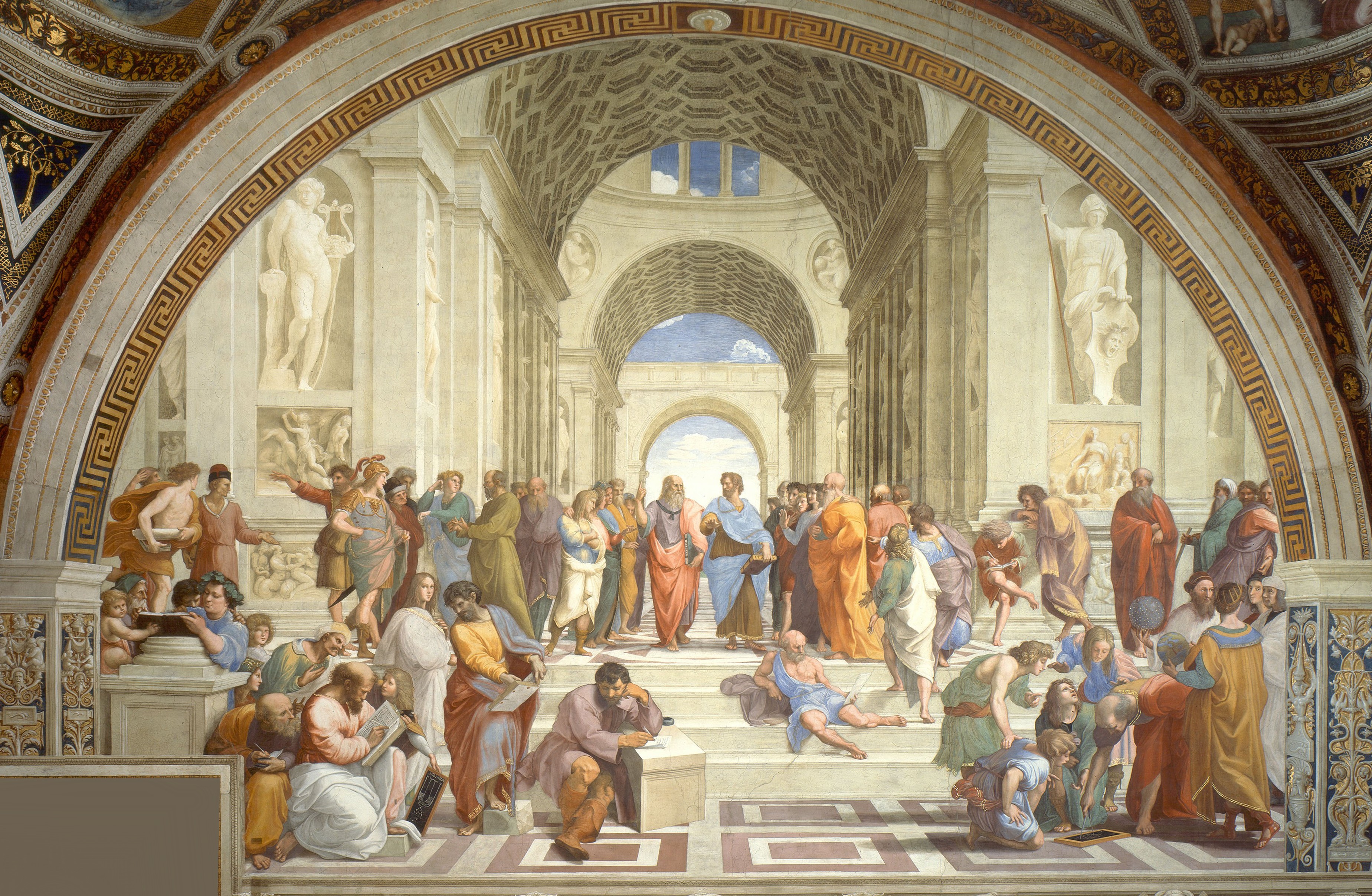
Thursday, June 3, 2010
Instant Replay and the Human Element
I'm fairly certain that almost anything that could be written about yesterday's not-quite-perfect game has already been written. Outrage, certainly, has been commonplace, as has, on the contrary, a respect for the class and dignity with which Jim Joyce and Armando Galarraga have handled the situation.
For any of my readers who are unaware, Armando Galarraga - an unheralded pitcher for the Detroit Tigers - was perfect through 8 2/3 innings last night, falling one out short of a perfect game. The kicker is that, on the 27th hitter, first base umpire Jim Joyce missed a call, awarding a hit to a batter who was - as replays have shown quite conclusively - out. Galarraga retired the next hitter, but the damage was done. Instead of a perfect game, or even a no-hitter, Galarraga had a complete game, one-hit shutout. Impressive, but not historic.
Amidst the backlash has been a swell in the ranks of baseball fans and, perhaps more importantly, journalists who support instant replay in baseball. The argument is simple and clear: replay cost Galarraga a perfect game, only the 21st in baseball history (and this would have been the first time ever that 3 had occurred in a single season). Just as high-profile missed calls on home runs a few years ago helped to usher in the review of so-called "boundary plays" in baseball, this missed call will likely hasten the already inevitable introduction of replay on safe or out calls at the bases.
For my own part, I have no qualms about the introduction of replay to baseball.* The major arguments against it, as far as I can tell, are that it would 1) cause the game to be longer, 2) cost a lot of umpires their jobs, and 3) eliminate the "human element" from the game. The last of these is the most slippery, and also, not surprisingly, the most frequently heard defense of traditional umpiring.
* Indeed, I'm an advocate of a computer-called strike zone. To me, this is an even clearer case than replay at the bases. Anyone who has watched an NFL game knows that replay is no guarantee that the call will be made correctly. All too often it simply cannot be determined whether a player makes a catch, for example. In baseball, this is equally true. In all of the baseball games I have watched, I have seen countless plays where, even in slow motion, I can't tell whether the runner made it to the bag first, whether the outfielder really got his glove under the ball, or whether that chopped down the line was in fair or foul territory when the third baseman touched it. Frankly, replay is imperfect, and that's before you get into questions about how to handle situations like a ball called foul that should have been fair.
Balls and strikes, on the other hand, are much simpler. Every team in the league, and every MLB television broadcast to boot, is using Pitch-FX data to map the exact location of each pitch. Bloggers and analysts across the Interweb are using that data to build actual vs. rule-book zones, to track how pitchers approach different hitters, and how umpires call the ball differently depending on the count (the zone, for instance, is much much much smaller on 0-2, and much much much larger on 3-0). If we can do all of that complex and interesting stuff, why can't we just let the Pitch-FX computer take over calling balls and strikes? Who loses in that setup? Sure, it would violate some umpire union contract - which probably is the biggest barrier - but it would help batters and pitchers by ensuring a more consistent zone, it would speed up the game by eliminating entirely arguments about balls and strikes, and it would reduce the incredulous cries of "WHAT!" from fans after blown calls behind the plate.
Hey, maybe we fans would miss complaining about poor umpiring behind the plate... But I suspect not. I'll take the correct call over the opportunity to complain when a Aaron Cook sinker gets miscalled any day.
Length of Game
I'm not convinced that replay would significantly lengthen the game. I hardly think that baseball should go to an NFL-style challenge system because there are plenty of ways to do replay that are more efficient. Tennis, for example, has a much faster challenge system, thanks in part to the obvious yes-or-no quality of the calls to be made. But the lesson is the same: don't make replay a big deal and it won't take long. There are a number of good proposals already floating in the blogosphere about instant replay that would specifically mitigate this concern, so if you're unconvinced, I encourage you to look around.
More than that, however, replay eliminates argument. Baseball games would be shorter if managers did not argue so many close calls. In the time it takes Jim Tracy to amble from the dugout to second base and back every time Dexter Fowler is caught stealing, some replay official could check the play, determine the accuracy of the call on the field, and relay that call to the umpires. And then have time to make a coffee and read an article from the New York Times. The point being, efficient replay would probably speed up the game, not slow it down.
Umpire Contracts
In reality, the second of the concerns above is the most problematic. MLB umpires are, in essence, like Supreme Court justices: once appointed, they retain the position for life or until they choose to retire. Whereas MLB players have to continually prove themselves or else face unceremonious release, umpires are essentially given a free pass, thanks to a strong union and, frankly, the comparative simplicity of what they do (compared, that is, to what players do).
If it is impossible to fire umpires anyway, how likely is it that umpires will be willing to accept assistance from technology that takes the hardest, most controversial, and probably most interesting part of their jobs away from them? Umpires are people, too, and they like making difficult decisions about who's safe and who's out at pivotal moments in a game, or else they wouldn't do what they do. Trying to take away a big part of what someone does, even when there's a better way, is hard. Look at how much trouble traditional newspaper journalists have had accepting blogs and Internet reporting and you get the idea.
Moreover, whereas NFL officials have a lot of judgment calls to make, even with replay, MLB officials are mainly enforcers of a fairly straightforward rulebook. There are not that many judgment calls in baseball, especially when you slow the game down on camera. What I mean is, rarely do you get into a situation where a call, after all available evidence has been considered, is still debatable. Oh sure, we have our own perceptions; Rockies fans will always think that Holiday touched the plate, Padres fans not so much, but such situations are the exception and not the rule. And, really, the point is that there still should be an answer to the question: was he safe?
Not so with a charging foul versus a blocking foul in basketball. Not so with a holding penalty or a pass interference in the NFL. The only thing that is comparable in baseball is the check swing, which is defined as, essentially, a judgment on the part of the umpire as to whether the batter tried to swing at the pitch. Everything else is clear-cut, or should be.
I think this is why, in the end, the union will resist replay. NFL officials have embraced replay because it is an aid, not a replacement. In MLB, replay is a replacement. Technology can not only help the people involved do better, it can actually do almost the whole job better. There's a difference, to extend the analogy, between using a calculator to help you solve equations in applied physics and using a calculator to divide fractions for you. In the first case the tool is aiding a bigger goal; in the second, it's replacing a less-capable human. In the first case, the tool feels necessary, in the second case - and especially if we're really good at dividing fractions without a calculator - we see the tool as helpful in ensuring accuracy and speeding up the process, but we can live without it. MLB umpires, undoubtedly, are really really good at their particular kind of division problem, but that doesn't mean the calculator isn't faster and more accurate. The problem is, because the calculator is not needed, per se, it's hard to sell a powerful union on the obsolescence of its members.
Hell, we still demand that kids learn how to divide fractions without calculators.
The Human Element
I've already started to address the third and most nebulous of the arguments against instant replay in the previous section, but I haven't really clarified what I think people mean when they say they want the "human element" to stay in the officiating of the game.
I confess, actually, that this impulse is confusing to me. Almost everyone who wants the "human element," I think, is really saying they want umpires to make bad calls in the favor of their own team. Or at least they want the possibility that such will happen. Having been to a number of baseball games, and having watched some large, barely-finite number more on the TV and computer, I think I can safely say that most fans don't really like it when umpires make bad calls that hinder their own team. I have, not once, heard an announcer or nearby fan say, after a missed call at first or a strike three six inches outside against the cleanup hitter: "Well, I don't like that call, but thank God for the human element." Mostly, there are cries of "BOO!" and "Kill the Umpire!" Indeed, the latter is immortalized in Casey At Bat, baseball's most famous poem.
Nor do I believe that people want to complain about bad calls. As I said in the posterisk above, while complaining is cathartic, the correct call will always be preferable. No, I really do think the human element means the slight chance that my team will be able to do better than it should have, thanks to that variation in consistency in the umpire's strike zone, and the off chance that he'll call Holiday safe, even if he didn't touch the plate.
The ironic thing is, most of the people who virulently support the need for the human element in umpiring and officiating are the most likely to complain about inconsistency among the umpires. Former pitchers - who often find their way to the broadcast booth - rail on consistency. "I don't care where the strike zone is, as long as it's consistent." This quotation, all by itself, is steeped in irony. They do care. They want the strike zone to be consistent. They want it to be where, in the end, it is supposed to be. They may like the game-to-game variation between umpire who calls pitches on the corners strikes versus the umpire who calls high pitches strikes and so on (something we could easily work into a computer, if we really like it that much, but I doubt we would, which goes to show), but the call for consistency, when taken to its logical conclusion, is a call for standardizing balls and strikes, both within games and between games.
And why not? In baseball, we can. I am hesitant, as you readers probably know, to take the human element out of things like teaching and learning, because those are far too complicated for a computer to manage effectively. But baseball is a much simpler thing, a much more quantifiable thing. And it does no injustice to the players or the fans if you get calls right. More than anything, I think replay and a computerized strike zone would add to the human element by allowing the truly remarkable humans who play the game to do it better.
A final thought: if, as is often said, umpires have done best when no one remembers them, then what is so human about the job to begin with? Don't we humans want to do things that are memorable? When we talk about the human element, don't we mean that we want to be able to talk about the glorious successes and the tragic failures and epic struggles that occur when man confronts man, or man confronts self, or man confronts some nebulous force? Perhaps, from that perspective, there's a wonderful human story in Jim Joyce's missed call. Perhaps. But if your best day on the job is the one where you go unrecognized, and if your worst day - the day for which you will always be remembered - is the day that you cost a no-name pitcher from Venezuela what is almost certainly his only shot at a perfect game, isn't time to think about what kind of human element we have in officiating baseball, and whether it is really worth such adamant defense?
For any of my readers who are unaware, Armando Galarraga - an unheralded pitcher for the Detroit Tigers - was perfect through 8 2/3 innings last night, falling one out short of a perfect game. The kicker is that, on the 27th hitter, first base umpire Jim Joyce missed a call, awarding a hit to a batter who was - as replays have shown quite conclusively - out. Galarraga retired the next hitter, but the damage was done. Instead of a perfect game, or even a no-hitter, Galarraga had a complete game, one-hit shutout. Impressive, but not historic.
Amidst the backlash has been a swell in the ranks of baseball fans and, perhaps more importantly, journalists who support instant replay in baseball. The argument is simple and clear: replay cost Galarraga a perfect game, only the 21st in baseball history (and this would have been the first time ever that 3 had occurred in a single season). Just as high-profile missed calls on home runs a few years ago helped to usher in the review of so-called "boundary plays" in baseball, this missed call will likely hasten the already inevitable introduction of replay on safe or out calls at the bases.
For my own part, I have no qualms about the introduction of replay to baseball.* The major arguments against it, as far as I can tell, are that it would 1) cause the game to be longer, 2) cost a lot of umpires their jobs, and 3) eliminate the "human element" from the game. The last of these is the most slippery, and also, not surprisingly, the most frequently heard defense of traditional umpiring.
* Indeed, I'm an advocate of a computer-called strike zone. To me, this is an even clearer case than replay at the bases. Anyone who has watched an NFL game knows that replay is no guarantee that the call will be made correctly. All too often it simply cannot be determined whether a player makes a catch, for example. In baseball, this is equally true. In all of the baseball games I have watched, I have seen countless plays where, even in slow motion, I can't tell whether the runner made it to the bag first, whether the outfielder really got his glove under the ball, or whether that chopped down the line was in fair or foul territory when the third baseman touched it. Frankly, replay is imperfect, and that's before you get into questions about how to handle situations like a ball called foul that should have been fair.
Balls and strikes, on the other hand, are much simpler. Every team in the league, and every MLB television broadcast to boot, is using Pitch-FX data to map the exact location of each pitch. Bloggers and analysts across the Interweb are using that data to build actual vs. rule-book zones, to track how pitchers approach different hitters, and how umpires call the ball differently depending on the count (the zone, for instance, is much much much smaller on 0-2, and much much much larger on 3-0). If we can do all of that complex and interesting stuff, why can't we just let the Pitch-FX computer take over calling balls and strikes? Who loses in that setup? Sure, it would violate some umpire union contract - which probably is the biggest barrier - but it would help batters and pitchers by ensuring a more consistent zone, it would speed up the game by eliminating entirely arguments about balls and strikes, and it would reduce the incredulous cries of "WHAT!" from fans after blown calls behind the plate.
Hey, maybe we fans would miss complaining about poor umpiring behind the plate... But I suspect not. I'll take the correct call over the opportunity to complain when a Aaron Cook sinker gets miscalled any day.
Length of Game
I'm not convinced that replay would significantly lengthen the game. I hardly think that baseball should go to an NFL-style challenge system because there are plenty of ways to do replay that are more efficient. Tennis, for example, has a much faster challenge system, thanks in part to the obvious yes-or-no quality of the calls to be made. But the lesson is the same: don't make replay a big deal and it won't take long. There are a number of good proposals already floating in the blogosphere about instant replay that would specifically mitigate this concern, so if you're unconvinced, I encourage you to look around.
More than that, however, replay eliminates argument. Baseball games would be shorter if managers did not argue so many close calls. In the time it takes Jim Tracy to amble from the dugout to second base and back every time Dexter Fowler is caught stealing, some replay official could check the play, determine the accuracy of the call on the field, and relay that call to the umpires. And then have time to make a coffee and read an article from the New York Times. The point being, efficient replay would probably speed up the game, not slow it down.
Umpire Contracts
In reality, the second of the concerns above is the most problematic. MLB umpires are, in essence, like Supreme Court justices: once appointed, they retain the position for life or until they choose to retire. Whereas MLB players have to continually prove themselves or else face unceremonious release, umpires are essentially given a free pass, thanks to a strong union and, frankly, the comparative simplicity of what they do (compared, that is, to what players do).
If it is impossible to fire umpires anyway, how likely is it that umpires will be willing to accept assistance from technology that takes the hardest, most controversial, and probably most interesting part of their jobs away from them? Umpires are people, too, and they like making difficult decisions about who's safe and who's out at pivotal moments in a game, or else they wouldn't do what they do. Trying to take away a big part of what someone does, even when there's a better way, is hard. Look at how much trouble traditional newspaper journalists have had accepting blogs and Internet reporting and you get the idea.
Moreover, whereas NFL officials have a lot of judgment calls to make, even with replay, MLB officials are mainly enforcers of a fairly straightforward rulebook. There are not that many judgment calls in baseball, especially when you slow the game down on camera. What I mean is, rarely do you get into a situation where a call, after all available evidence has been considered, is still debatable. Oh sure, we have our own perceptions; Rockies fans will always think that Holiday touched the plate, Padres fans not so much, but such situations are the exception and not the rule. And, really, the point is that there still should be an answer to the question: was he safe?
Not so with a charging foul versus a blocking foul in basketball. Not so with a holding penalty or a pass interference in the NFL. The only thing that is comparable in baseball is the check swing, which is defined as, essentially, a judgment on the part of the umpire as to whether the batter tried to swing at the pitch. Everything else is clear-cut, or should be.
I think this is why, in the end, the union will resist replay. NFL officials have embraced replay because it is an aid, not a replacement. In MLB, replay is a replacement. Technology can not only help the people involved do better, it can actually do almost the whole job better. There's a difference, to extend the analogy, between using a calculator to help you solve equations in applied physics and using a calculator to divide fractions for you. In the first case the tool is aiding a bigger goal; in the second, it's replacing a less-capable human. In the first case, the tool feels necessary, in the second case - and especially if we're really good at dividing fractions without a calculator - we see the tool as helpful in ensuring accuracy and speeding up the process, but we can live without it. MLB umpires, undoubtedly, are really really good at their particular kind of division problem, but that doesn't mean the calculator isn't faster and more accurate. The problem is, because the calculator is not needed, per se, it's hard to sell a powerful union on the obsolescence of its members.
Hell, we still demand that kids learn how to divide fractions without calculators.
The Human Element
I've already started to address the third and most nebulous of the arguments against instant replay in the previous section, but I haven't really clarified what I think people mean when they say they want the "human element" to stay in the officiating of the game.
I confess, actually, that this impulse is confusing to me. Almost everyone who wants the "human element," I think, is really saying they want umpires to make bad calls in the favor of their own team. Or at least they want the possibility that such will happen. Having been to a number of baseball games, and having watched some large, barely-finite number more on the TV and computer, I think I can safely say that most fans don't really like it when umpires make bad calls that hinder their own team. I have, not once, heard an announcer or nearby fan say, after a missed call at first or a strike three six inches outside against the cleanup hitter: "Well, I don't like that call, but thank God for the human element." Mostly, there are cries of "BOO!" and "Kill the Umpire!" Indeed, the latter is immortalized in Casey At Bat, baseball's most famous poem.
Nor do I believe that people want to complain about bad calls. As I said in the posterisk above, while complaining is cathartic, the correct call will always be preferable. No, I really do think the human element means the slight chance that my team will be able to do better than it should have, thanks to that variation in consistency in the umpire's strike zone, and the off chance that he'll call Holiday safe, even if he didn't touch the plate.
The ironic thing is, most of the people who virulently support the need for the human element in umpiring and officiating are the most likely to complain about inconsistency among the umpires. Former pitchers - who often find their way to the broadcast booth - rail on consistency. "I don't care where the strike zone is, as long as it's consistent." This quotation, all by itself, is steeped in irony. They do care. They want the strike zone to be consistent. They want it to be where, in the end, it is supposed to be. They may like the game-to-game variation between umpire who calls pitches on the corners strikes versus the umpire who calls high pitches strikes and so on (something we could easily work into a computer, if we really like it that much, but I doubt we would, which goes to show), but the call for consistency, when taken to its logical conclusion, is a call for standardizing balls and strikes, both within games and between games.
And why not? In baseball, we can. I am hesitant, as you readers probably know, to take the human element out of things like teaching and learning, because those are far too complicated for a computer to manage effectively. But baseball is a much simpler thing, a much more quantifiable thing. And it does no injustice to the players or the fans if you get calls right. More than anything, I think replay and a computerized strike zone would add to the human element by allowing the truly remarkable humans who play the game to do it better.
A final thought: if, as is often said, umpires have done best when no one remembers them, then what is so human about the job to begin with? Don't we humans want to do things that are memorable? When we talk about the human element, don't we mean that we want to be able to talk about the glorious successes and the tragic failures and epic struggles that occur when man confronts man, or man confronts self, or man confronts some nebulous force? Perhaps, from that perspective, there's a wonderful human story in Jim Joyce's missed call. Perhaps. But if your best day on the job is the one where you go unrecognized, and if your worst day - the day for which you will always be remembered - is the day that you cost a no-name pitcher from Venezuela what is almost certainly his only shot at a perfect game, isn't time to think about what kind of human element we have in officiating baseball, and whether it is really worth such adamant defense?
Saturday, February 13, 2010
The Meaning of Grades
One of the biggest assumptions of our education system is the need for graded assessment, or evaluation. For many colleges, grades and SAT scores make up the entire admissions process. For policy makers, the debate centers around how to improve those scores, taking for granted that they are good measures of learning.
I would argue that the main thing grades assess is a student's ability to get a good grade, and the main thing a standardized test score assesses is a student's skill in taking standardized tests. How many students generate strategies for getting a good grade that have nothing to do with learning? I know I was one, even though I was never as grade-motivated as many of my peers. Likewise, how many people take test-prep courses or work with tutors not so they can learn better the content of tests like the SAT or GRE, but so they can develop test-taking strategies?
The problem with placing evaluation of students above assessment - and then making those evaluations determining factors in student's lives - is that doing so obfuscates the purpose of education for students, and therefore undermines their desire to actually learn. Considering the competitive nature of most evaluation (in order for some to succeed, many more must fail), it is no wonder that students begin to play their appointed roles as "drop-outs" and "failures." How many brilliant minds do we lose to frustration, both among said "failures" and among the "achievers?" How much creativity and critical thinking is stomped out because, in the end, those things are hard to evaluate?
I do not believe that assessment should be abolished, by any stretch. Teachers, whether wittingly or not, are constantly assessing their students. Even a lecture hall with 100 undergraduates and a single Professor has some level of assessment built in ("ah, look who's asleep in the back again"). Most teachers will tell you that they know - usually early in the course - who in their classes gets it, who doesn't, who needs extra help, who is a trouble-maker, who's passing notes to who, and who they can trust to run down to their office to pick up a forgotten hand-out. Most teachers are excellent assessors of their students.
The problem is, those dozens of qualities and skills that teachers assess constantly are narrowed into a single evaluative measure. A to F. What's more, most of those qualities are cut out of the evaluation process. What matters, come grade time, is not a student's work-ethic, or his trustworthiness, or his interest in the material, or his sense of humor.* What matters is how well he 'gets' the material, and how well he is able to navigate the structure of the evaluation the teacher chooses.
* I choose these in particular because of Valentine's Day. We "assess" our lovers largely on these criteria - as well as a few others like attractiveness. In our culture, it seems perfectly natural that the criteria we place at the heart of love - which we tend to say is one of the most important activities in our lives - are ignored by our education system. Indeed, a culture that designed things like sense of humor and trustworthiness and appreciation of beauty into their education systems would seem unsophisticated and barbaric to us. It seems just the opposite to me.
Because we need to be able to communicate student abilities across vast distances of time and space, we transform the myriad assessments a teacher makes of her students into a single letter. The necessity for this is a social one: we need to know how good the student is doing, and we don't have time to listen to the full report. A state senator or school board member especially can't sift through thousands of pages of teacher write-ups, nor do teachers have time to write reports about each of their hundred or more students. The system is what it is because, on some level, it has to be just that.
Education reform is uncommon. Our system is very similar to what it was one hundred years ago, and despite the noise made by just about every presidential candidate, it is likely to resemble its current form for decades to come. Digital technology is a disruptive force, to be sure, just like the television was. The pervasiveness of the Internet and mobile phones might effect the delivery of educational materials more than TV ever could have, but the content and the evaluations are likely to remain much the same. Indeed, if anything the downsizing of the role of the teacher - the transformation from teacher to computer - necessitates an even more rigorous protocol of traditional multiple-choice and true-or-false tests.
I believe that digital technology can have the opposite effect, but only if educators strive to use it in a more progressive way. On the way to doing that, however, there are a great many steps. One is developing technologies - or implementations of technologies that exist, at least - which undercut the need for an evaluation-driven system. I don't believe that means that computers will do the assessments that teachers once did; rather, computers can deliver content and learning environments in a way that students don't see as evaluative or, strictly speaking, educational. How many students of my generation have learned a significant amount of history though computer games, for example?
Another important step is transforming attitudes about education. Education and teaching, as words, should give way to learning (indeed, not all cultures differentiate the three: imagine if we believed teaching and learning to be the same thing). The role of formal education should be questioned, not on the assumption that it will be abandoned, but rather with an eye towards its purpose, and whether technology can help it better fulfill that purpose.
Ultimately, I believe the highly-structured system of homework, test (or essay), grade that we've developed needs to change, and that modern technology makes possible - but not necessary - that change. Education researchers have been fighting that fight for a century (with a remarkable lack of success), as have many teachers and - unwittingly - a great many students. Politicians, businesses, and parents, however, tend to resist change (painting in exceptionally broad strokes), not for any good reason, but because either it's too politically risky, because they like discrete and scalable evaluations, or because that's the way they did it when I was a kid. After all, you gotta learn to buckle down and do your homework so you can get an A so you can get a job so you can have money so you can send your kids to 'good' schools so...
Alas, perhaps challenging the assumptions of education involves challenging the assumptions of a whole culture, an even bigger task.
I would argue that the main thing grades assess is a student's ability to get a good grade, and the main thing a standardized test score assesses is a student's skill in taking standardized tests. How many students generate strategies for getting a good grade that have nothing to do with learning? I know I was one, even though I was never as grade-motivated as many of my peers. Likewise, how many people take test-prep courses or work with tutors not so they can learn better the content of tests like the SAT or GRE, but so they can develop test-taking strategies?
The problem with placing evaluation of students above assessment - and then making those evaluations determining factors in student's lives - is that doing so obfuscates the purpose of education for students, and therefore undermines their desire to actually learn. Considering the competitive nature of most evaluation (in order for some to succeed, many more must fail), it is no wonder that students begin to play their appointed roles as "drop-outs" and "failures." How many brilliant minds do we lose to frustration, both among said "failures" and among the "achievers?" How much creativity and critical thinking is stomped out because, in the end, those things are hard to evaluate?
I do not believe that assessment should be abolished, by any stretch. Teachers, whether wittingly or not, are constantly assessing their students. Even a lecture hall with 100 undergraduates and a single Professor has some level of assessment built in ("ah, look who's asleep in the back again"). Most teachers will tell you that they know - usually early in the course - who in their classes gets it, who doesn't, who needs extra help, who is a trouble-maker, who's passing notes to who, and who they can trust to run down to their office to pick up a forgotten hand-out. Most teachers are excellent assessors of their students.
The problem is, those dozens of qualities and skills that teachers assess constantly are narrowed into a single evaluative measure. A to F. What's more, most of those qualities are cut out of the evaluation process. What matters, come grade time, is not a student's work-ethic, or his trustworthiness, or his interest in the material, or his sense of humor.* What matters is how well he 'gets' the material, and how well he is able to navigate the structure of the evaluation the teacher chooses.
* I choose these in particular because of Valentine's Day. We "assess" our lovers largely on these criteria - as well as a few others like attractiveness. In our culture, it seems perfectly natural that the criteria we place at the heart of love - which we tend to say is one of the most important activities in our lives - are ignored by our education system. Indeed, a culture that designed things like sense of humor and trustworthiness and appreciation of beauty into their education systems would seem unsophisticated and barbaric to us. It seems just the opposite to me.
Because we need to be able to communicate student abilities across vast distances of time and space, we transform the myriad assessments a teacher makes of her students into a single letter. The necessity for this is a social one: we need to know how good the student is doing, and we don't have time to listen to the full report. A state senator or school board member especially can't sift through thousands of pages of teacher write-ups, nor do teachers have time to write reports about each of their hundred or more students. The system is what it is because, on some level, it has to be just that.
Education reform is uncommon. Our system is very similar to what it was one hundred years ago, and despite the noise made by just about every presidential candidate, it is likely to resemble its current form for decades to come. Digital technology is a disruptive force, to be sure, just like the television was. The pervasiveness of the Internet and mobile phones might effect the delivery of educational materials more than TV ever could have, but the content and the evaluations are likely to remain much the same. Indeed, if anything the downsizing of the role of the teacher - the transformation from teacher to computer - necessitates an even more rigorous protocol of traditional multiple-choice and true-or-false tests.
I believe that digital technology can have the opposite effect, but only if educators strive to use it in a more progressive way. On the way to doing that, however, there are a great many steps. One is developing technologies - or implementations of technologies that exist, at least - which undercut the need for an evaluation-driven system. I don't believe that means that computers will do the assessments that teachers once did; rather, computers can deliver content and learning environments in a way that students don't see as evaluative or, strictly speaking, educational. How many students of my generation have learned a significant amount of history though computer games, for example?
Another important step is transforming attitudes about education. Education and teaching, as words, should give way to learning (indeed, not all cultures differentiate the three: imagine if we believed teaching and learning to be the same thing). The role of formal education should be questioned, not on the assumption that it will be abandoned, but rather with an eye towards its purpose, and whether technology can help it better fulfill that purpose.
Ultimately, I believe the highly-structured system of homework, test (or essay), grade that we've developed needs to change, and that modern technology makes possible - but not necessary - that change. Education researchers have been fighting that fight for a century (with a remarkable lack of success), as have many teachers and - unwittingly - a great many students. Politicians, businesses, and parents, however, tend to resist change (painting in exceptionally broad strokes), not for any good reason, but because either it's too politically risky, because they like discrete and scalable evaluations, or because that's the way they did it when I was a kid. After all, you gotta learn to buckle down and do your homework so you can get an A so you can get a job so you can have money so you can send your kids to 'good' schools so...
Alas, perhaps challenging the assumptions of education involves challenging the assumptions of a whole culture, an even bigger task.
Subscribe to:
Posts (Atom)

 Posts
Posts


