I am not a science teacher by trade, but I have found myself teaching science more than any other subject area. Perhaps this is in part a result of my upbringing - my mother is a science teacher - and perhaps a result of pure chance. Regardless of why science has found me and I have found science, my background as a graduate of St. John's has followed close at hand, with the result that I think about science a little differently than many people do, a fact that has helped me to understand science myself, but has not always been to my advantage.
What do I mean by that? Well, one of the most fundamental but unarticulated problems in science education is a failure among the important people in the process to agree on what science really is. That's not to say they should agree, or that agreement is even possible, but rather to say that the lack of a clear definition of science has led to a hodge-podge of curricular methodologies and pedagogies that are non-complementary, and which do more to alienate and confuse students than to empower or interest them.
Scientists, ironically, are probably the most to blame for this situation. There is great lamentation in scientific world about how poorly students do in science. The solution, it seems to these people, is to make science more "real" for students. That is, to align science classes closer to their own experiences as scientists. The problem is, they perceive science to be, generally, a fairly static thing. The average scientists definition of science (and I don't have research to back this up, just my own experiences) seems to be something like this: Science is a set of well-established theories and facts about the natural world arrived by employing a fixed methodology to places where our knowledge is lacking, in order to expand our understanding.
Now there's nothing particularly wrong with this, except it's extremely boring and a waste of student's time. The idea that science is, at its heart, about theories and facts, and an easy-to-use scientific method, to me trivializes the real efforts of science. No, science is not just collecting data and analyzing ad infinitum, the real power of science to affect people's lives lies in something more fundamental to it. To me, science is about a process that is dynamic and contextual. Scientific knowledge is conditional and flexible. Being a scientist is about creativity, critical thinking, and learning.
How much more interesting is this perspective to students? Frankly, they probably don't care how we define science. More important is the result of this perspective on curriculum, on pedagogy, on what happens in the classroom. In the former, the scientist's classroom, students sit and listen to lectures, they engage in laboratory sessions with known answers, they are asked multiple choice questions, they fill in worksheets with word banks. Basically, they're miserable. Even a field trip, in the traditional science classroom, generally leads to little more than the dissemination of information, the collection of useless and meaningless data, or the acquisition of some boring science "skill" that is irrelevant to a student's life.
On the other hand, the latter classroom is organized around the concept of science as inquiry, meaning students are encouraged to develop a more sophisticated understanding of how science really works. That is, by giving students enough structure to keep them on task, but enough freedom to let them develop their own observations, questions, hypotheses, and even experiments and conclusions, students get to learn the real pitfalls of scientific work. What's more, they still learn the content. Perhaps not as much as if they were just lectured at for an hour straight, but what they do learn, they learn better. More importantly, memorizing facts, equations, theories, and methods is a waste of time in our modern world; better to learn how to synthesize, how to analyze, and how to ask good questions.
To illustrate: How many of you readers out there remember anything about how to calculate the effect of friction on a moving body from your high school physics class? For those of you who don't remember, how long do you think it would take you to look it up? I'll give you hint, type in "friction" in Google, and click on the Wikipedia page. There's your equation, plus explanations of how to use it. Good thing your science teachers wanted you to memorize all that.
Beyond acquiring facts, which is manifestly a waste of time, the other biggest problem with traditional science education is that it is built around collecting data. I certainly acknowledge that good data collection is important, but I will also say that data in itself is worthless unless there's some kind of analysis on the other end, not to mention some kind of purpose for collecting it on the front end. It's easy, in pre-made experiments, to point to the supposed "purpose" of certain data, but the whole point of good science education, to my mind, is to get students to make those decisions themselves. What data should they collect? Why? How will they use it?
Now an experienced educator will respond by saying that they need to see that process in action before they can do it themselves, and so we should provide them with situations where they are not designing experiments, where they are working with fake data, where they are performing analysis without doing the legwork to get there. That's fair, but only if we call attention to why we're doing that. Many teachers emphasize the importance of data analysis for its own sake, not as a part of a broader scientific process, and certainly not as a pathway towards meaning.
Ah, there's an interesting word. I suppose, if I had to summarize the two approaches to science education I've discussed here, I would say that the first is about information and the second is about meaning. The problem is, looking for meaning in science is not encouraged by scientists for reasons that are difficult to fathom (though the Freudian in me wants to suggest mean things about scientists being afraid of meaning because of the spiritual, emotional, and social emptiness of their own pursuit of information). The cries that students do poorly in science, to me, reverses the reality: science does poorly for students. Make science real, make it authentic, make is about ideas and not facts, make it about processes and not methods, make it about discussions and not dictation, and then you'll see students do well.
Science is a liberal art, in the root sense of the term. The study of science can help free you from other people's conclusions, from propaganda, from drug commercials that say "studies show..." Science, however, can also bind you and blind you. Unfortunately, the classroom (and, more importantly, the legislator's table and the teacher training program) is, in this discipline as in many others, a battlefield. A battlefield where the "fluffy," holistic, more authentic side is losing, not because it is actually worse, but because it's harder to do well, harder to assess, harder to standardize. Those are fair criticisms, but it might be that part of what's wrong in education, broadly, is that we shy away from what's better but harder too often.
Showing posts with label nature of science. Show all posts
Showing posts with label nature of science. Show all posts
Friday, October 29, 2010


Saturday, July 31, 2010
Timaeus at the LDT Expo
Yesterday was the glorious final exhibition of my and my cohort's final Master's Projects. That means that we're all but done, but for the piecing together of a final paper and the assembly of a portfolio of the work we've done over the year (plus, for me anyway, moving out of my apartment in preparation for a return to Hawaii). The Expo was, I must say, a fitting ending to an intense, but rewarding year at Stanford. Fitting because it was intense but rewarding in much the same way.
LDT stands for Learning, Design, and Technology, and as my project partner Coram and I ruminated, our final project was equal parts all three. We were hardly alone in that, as our cohort's projects were much the same, despite ranging in content from nutrition apps for adults to math games for kids. Each project incorporated the three main aspects of the program well, despite - as far as I know - much work to explicitly make sure it happened that way. It's a testament to LDT that the kinds of problems we wanted to tackle were the kind that required a little L, a little D, and a little T.
I'm getting ahead of myself, however, because I haven't described my own project yet. Timaeus, as we happened to call it*, is a web-based visualization tool designed to support dialogue around the scientific process and the nature of science. That's a bit of a mouthful, but I'll do my best to convey the essence of the project here, before I ruminate about the Expo experience.
* Yes, I can't help it, and no, I'm not sorry.**
** That's for my college roommate Joe. Timaeus is a very St. John's thing to call my Master's Project, even if it did happen by accident. Because we Johnnies have a hard time getting away from our eminent Johnny-ness (some might call it "pretension," but that's not quite it, even if it's close), we have to develop a mechanism for acknowledging that sometimes we end up dropping Platonic dialogue names in casual conversation, much to the chagrin to everyone else in the room. The best response, Joe has found (and I think I agree), is in the posterisk before this one.
---------------------------------------------------------
Coram and I, at the outset of working on our project, decided that we wanted to do something around dialogue. We did not know what subject area we would design around, or how we would incorporate technology into a design for dialogic pedagogy, but we both agreed that good conversations in the classroom is the best way to facilitate learning.* The design problem, here, is that technology doesn't really support dialogue in the sense we wanted to support it. Sure, there are Internet forums and there's Twitter and stuff like that, but that's not really dialogue so much as, as one of Coram's Professors described it, "Shouting in a crowded room."
* Yes, I can't help it, and no, I'm not sorry.
One of the tricks to good dialogue is that it can't just be a group of people talking about their opinions. "I think this" followed by "Well, I think that" is all well and good for political "discussion" shows and all (especially when accompanied with a good deal of shouting and thumping), but no one really learns anything without trying out new ideas and really listening to each other. The problem is, without a good shared basis of understanding, most people find there's not really a lot to talk about except life stories, geography, and meteorology. When was the last time you and a stranger started randomly talking about philosophy?
For my part, the last time that happened was with Coram; we were talking about Kant before we knew each other's wives names. The reason, though, was not that we're huge nerds,* but rather that we had both read Kant, so we had a shared text about which we could have a conversation. When our Professors brought up modern educational philosophies based on Hegelian phenomenology, we could step outside the classroom and critique the adaptation of Hegel's method to modern education because we were mutually familiar with what Hegel's method was, and how he talked about it. The point is, it's tough to have those conversations without a shared text.
* We probably are, but that's not the point.
Knowing we wanted to support dialogue, and knowing that the best place for technology was not in dialogue in itself, but in the precursor (some kind of shared language, text, cultural artifact, or what-not), we looked for a subject area. Coram has a background in - among other things - Art History, so we bandied about that, especially because of my dabbling in Music History. We both love literature and poetry, so that came up as well. But the thing is, teachers of literature, art, and music usually do a pretty good job of facilitating dialogue. It's easy, really, because you just have to look at a piece of art, study it for a few minutes, and sit down with someone else who has done the same thing to have a rich conversation. Sure, some artistic theory and historical context can help, but it's not necessary. Likewise with literature, where high schoolers across the country have conversations about Romeo, Odysseus, and Tom Sawyer every year. Those may not be the best dialogues in the world, but for the most part they do happen.
Not so in science classes. Rare indeed is the science class that uses dialogue at all, let alone as the dominant pedagogical model. Science teachers will tell you it's because they have to meet so many standards that they have to just convey information. But those same teachers, if you talk to them outside of class, will lament how they have to spend three weeks on stuff that should take two days because they have to repeat it over and over and over again. I would argue that that might have something to do with how people learn: while there are some people who can pay attention and diligently take notes through an hour long lecture, learning everything, that's not the case for most of us. Rather, we learn better in more dynamic environments, having conversations with friends, visualizing concepts, performing actions. A dialogic classroom, potentially, hits all of those things by opening up not only the content, but the very learning process to the learners involved. Students know how they learn best, so let them lead the learning.
Anyway, the systematic problem of didactic science education isn't really a Master's project, because it's simply too big. Instead, we focused on a narrower goal: providing a technological tool that would give students and teachers access to the rich dialogues in science. Biology teachers know that ethical questions are often fascinating and dynamic areas for student involvement in meaningful science debates, so we wanted to leverage that spirit in a way that spans disciplines. Rather than focusing on fringe issues like current events in the ethics of scientific practice (and, after all, it's hard to have a robust debate about the ethics of particle accelerators), we wanted to cut to the heart of the issue: what is science, anyway?
It is remarkable that, despite the general agreement in the scientific community about so many scientific theories, there is almost no agreement as to the nature of science itself. In the following diagram (from our presentation), you can see one of any number of axes along which eminent scientists and philosophers might be arranged.

That a number of well-known and accepted theories and ideas come from scientists across the spectrum speaks to the value of the very debate about what science is. Consider the same graph, but with some famous scientists (and philosophers) on it:

We could argue about whether each of those luminaries is in the right place, but that's exactly the point. Why oh why would we deny students access to this debate? Is there any reason to shut off such a rich source of dialogue? Does it really help to present to students the idea that science is just a set of steadfast rules and methods, practiced exactly the same way by all scientists, in order that they might discover the Truth? Granted, some scientists do think that, too, but that not everyone does - that Newton operated in a way very different from how Heisenberg did - speaks once more to the value of opening up the conversation to high schoolers, especially because, in the course of the debate, they will naturally have to learn content in order to justify and understand their own positions.
---------------------------------------------------------
So what is Timaeus, then? It's a tool to help students visualize the scientific process, not as a static set of five fixed steps, but as a dynamic, evolving, and iterative set of decisions which may not, it turns out, be easy to classify. We give students a set of five colored shapes that represent the traditions steps of the process, and let them build maps of scientific texts, videos, and accounts of experiments. The results look something like this:
 In case you can't read it, the circle stands for "Observation," the square for "Question," the upwards triangle for "Hypothesis," the downwards triangle for "Experiment," and the diamond for "Claim" or "Conclusion." This example in particular charts the process of John Snow in his effort to uncover the causes of the Broad Street Cholera Outbreak of 1854, as described in this Wikipedia article. This is essentially the same map as you may have seen on this blog a few months back, but this was made using our actual tool (which is still in beta, but can do this much as it stands) and not photoshop.
Reading an account of a text closely enough to make analytical and categorical decisions about what is happening at each point is valuable enough, but where Timaeus really shines is in the ability to move from a single student's work to a class's with the search function:
 This image shows the work of six different LDT students mapping Marie Curie's discovery of Radium. From the exact same speech, the there are a wide range of understandings of what, exactly is happening. From a teacher's perspective, this not only lets you see how students are understanding science, but also provides the entry point to a rich conversation around what is happening in a given scientific experiment. When we ran through this exercise, for example, with a group of young Baha'is in the area, they jumped from the map creation to questions about how radium is isolated, where it comes from, and, ultimately, what elements are and how the periodic table is constructed. As a teacher, it's hard to get students interested in learning about the periodic table, so how cool is it when they actually want you to pull it out and explain it?
---------------------------------------------------------
I could go on about the tool a bit more, but I want to talk about Expo as well. Coram and I presented our project in the morning for a panel of five reviewers. Because our project spans across ideas, our reviewers were hardly a homogeneous group. Of the three Stanford Professors in attendance, one was a curriculum specialist, another a science education specialist (whose own work has been in visualization and scaffolding inquiry), one a human-computer interaction specialist from the Computer Sciences department. Our other reviews came from outside of Stanford, one a IT specialist and administrator, and the other a National Board Certified AP Statistics teacher (whose class we had done a user study with, incidentally). Presenting to an audience with such a varied background meant that we had to be sure to address - in our 20 minutes - everything from learning theory to technology design decisions, but I feel we put together a strong presentation and we seemed to be well-received (with the exception of one somewhat tangential question from a non-reviewer in attendance about the "gender" of our project).
In the afternoon we had a three hour long poster session which was packed. In previous years LDT Expos have been held in a smaller space, elsewhere on campus. This year we were in Wallenburg, which opens to the oval and Palm Drive at the front of the school, and we took up the entire lobby and main floor. And there was a time, early in the session, when you could barely move. This may seem unremarkable, but apparently there were about 3 times as many people at this Expo as there have ever been, which means both that our Expo Committee (and our Program Coordinator Karin) did an excellent job getting the word out, and that LDT is gaining some notoriety around the Bay Area and hopefully beyond.
The really value here, though, is that it makes the capstone project of a year's work feel really worth it. It may be exhausting to talk for three hours straight to a continuous string of people wanting to know about your project, but it's awesome that people actually want to know about your project. Even better, for Coram and I, was the feeling we got that people really thought that what we are trying to do is worthwhile. We would believe in it either way, I think, but that doesn't mean that it doesn't help to hear that other people do too.
This project, though, isn't just about feeling good. Because I'll be teaching science back in Hawaii next year with Nalu Studies, I truly do feel that Timaeus is something that can and should be used in the classroom. The kids Nalu is designed for - at-risk and high-risk teens - can benefit as much as anyone from really exploring the nature of scientific work, because it helps them to unlock a whole new way of making and evaluating decisions. For kids who have often already made some bad decisions, there's nothing more empowering than learning how to make better ones in the future, and moreover how to tell the difference ahead of time, how to pick each other up, and how to fail gracefully instead of tragically.
---------------------------------------------------------
As a conclusion, I want to talk a little about the name Timaeus. To be honest, Coram and I struggled to decide on a name for our tool for a long time, finally settling on Timaeus on the day when we had to submit our final name for the LDT Expo poster. As we've thought more about it, however, we're increasingly of the opinion that it fits. In case you don't know, Timaeus is a dialogue by Plato about the nature of the universe. It's a precursor to Aristotle's Physics and his Metaphysics, in that it attempts to layout how the cosmos is arranged, what the soul is, and how we understand and talk about the material and metaphysical world. In short, it's the first foray into describing the nature of science, despite the absence of that term, and the highly logical (instead of empirical) nature of the process.
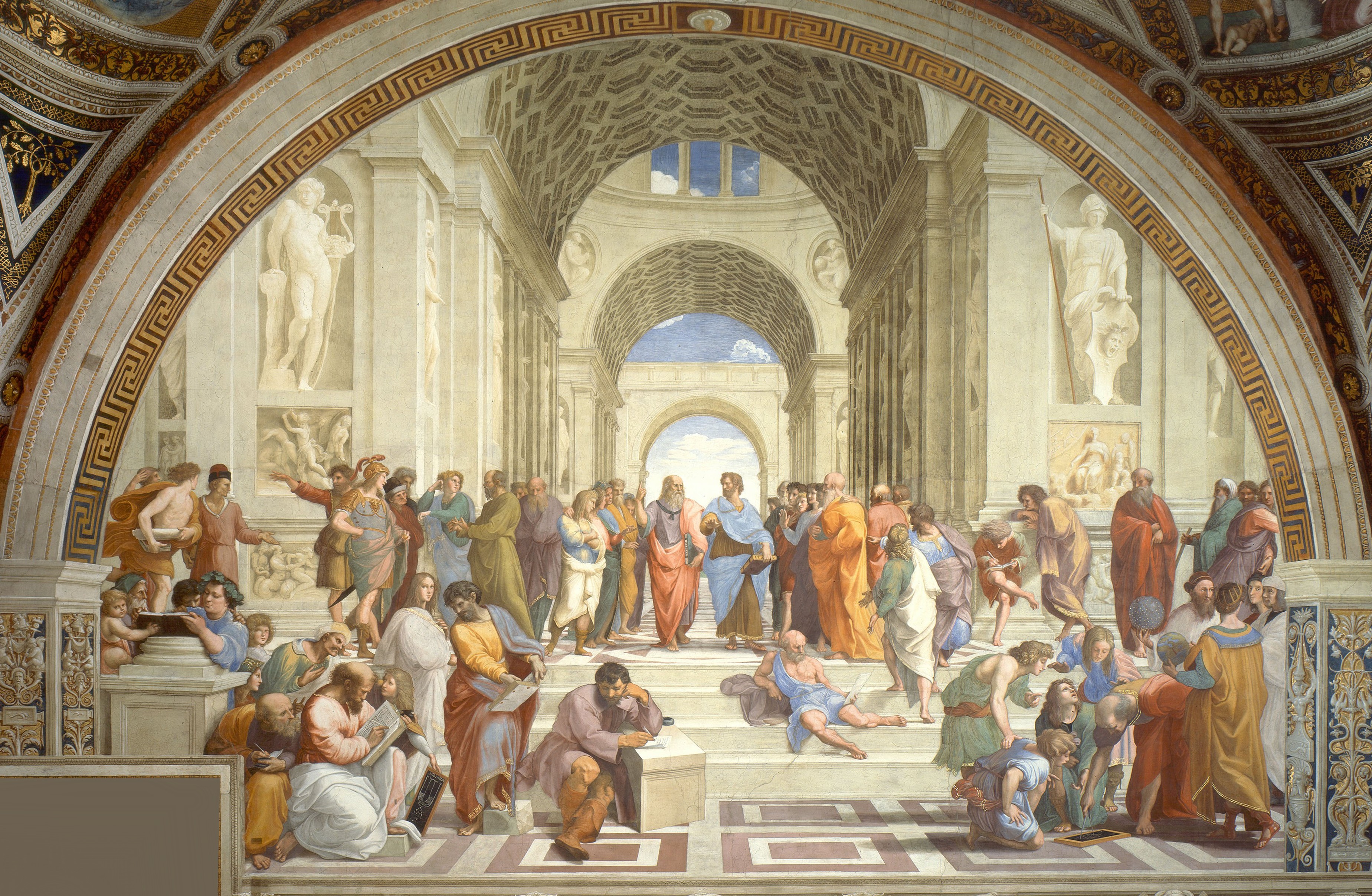
If you know of Raphael's famous School of Athens you may know that Plato and Aristotle are the figures at the center of the work. Coram - as an Art History minor - and I both love the painting, and had discussed it prior to selecting our name. After we came to Timaeus, however we returned to the painting because, as I knew (but Coram did not), the dialogue that is under Plato's arm is the Timaeus. There's something fitting about that, because just as Plato and his academy were one of the first forays into forming a scientific community - and just as Raphael's own artistic and scientific community was a rekindling of that same spirit of inquiry - we believe that modern science education should shift to include more students in the debate around the nature of science, the world, and the pursuit of knowledge. Regardless of what happens with our particular technological and curricular tools, that aim is one we both will share with, we hope, an ever-increasing number of educators for the rest of our lives.

LDT stands for Learning, Design, and Technology, and as my project partner Coram and I ruminated, our final project was equal parts all three. We were hardly alone in that, as our cohort's projects were much the same, despite ranging in content from nutrition apps for adults to math games for kids. Each project incorporated the three main aspects of the program well, despite - as far as I know - much work to explicitly make sure it happened that way. It's a testament to LDT that the kinds of problems we wanted to tackle were the kind that required a little L, a little D, and a little T.
I'm getting ahead of myself, however, because I haven't described my own project yet. Timaeus, as we happened to call it*, is a web-based visualization tool designed to support dialogue around the scientific process and the nature of science. That's a bit of a mouthful, but I'll do my best to convey the essence of the project here, before I ruminate about the Expo experience.
* Yes, I can't help it, and no, I'm not sorry.**
** That's for my college roommate Joe. Timaeus is a very St. John's thing to call my Master's Project, even if it did happen by accident. Because we Johnnies have a hard time getting away from our eminent Johnny-ness (some might call it "pretension," but that's not quite it, even if it's close), we have to develop a mechanism for acknowledging that sometimes we end up dropping Platonic dialogue names in casual conversation, much to the chagrin to everyone else in the room. The best response, Joe has found (and I think I agree), is in the posterisk before this one.
---------------------------------------------------------
Coram and I, at the outset of working on our project, decided that we wanted to do something around dialogue. We did not know what subject area we would design around, or how we would incorporate technology into a design for dialogic pedagogy, but we both agreed that good conversations in the classroom is the best way to facilitate learning.* The design problem, here, is that technology doesn't really support dialogue in the sense we wanted to support it. Sure, there are Internet forums and there's Twitter and stuff like that, but that's not really dialogue so much as, as one of Coram's Professors described it, "Shouting in a crowded room."
* Yes, I can't help it, and no, I'm not sorry.
One of the tricks to good dialogue is that it can't just be a group of people talking about their opinions. "I think this" followed by "Well, I think that" is all well and good for political "discussion" shows and all (especially when accompanied with a good deal of shouting and thumping), but no one really learns anything without trying out new ideas and really listening to each other. The problem is, without a good shared basis of understanding, most people find there's not really a lot to talk about except life stories, geography, and meteorology. When was the last time you and a stranger started randomly talking about philosophy?
For my part, the last time that happened was with Coram; we were talking about Kant before we knew each other's wives names. The reason, though, was not that we're huge nerds,* but rather that we had both read Kant, so we had a shared text about which we could have a conversation. When our Professors brought up modern educational philosophies based on Hegelian phenomenology, we could step outside the classroom and critique the adaptation of Hegel's method to modern education because we were mutually familiar with what Hegel's method was, and how he talked about it. The point is, it's tough to have those conversations without a shared text.
* We probably are, but that's not the point.
Knowing we wanted to support dialogue, and knowing that the best place for technology was not in dialogue in itself, but in the precursor (some kind of shared language, text, cultural artifact, or what-not), we looked for a subject area. Coram has a background in - among other things - Art History, so we bandied about that, especially because of my dabbling in Music History. We both love literature and poetry, so that came up as well. But the thing is, teachers of literature, art, and music usually do a pretty good job of facilitating dialogue. It's easy, really, because you just have to look at a piece of art, study it for a few minutes, and sit down with someone else who has done the same thing to have a rich conversation. Sure, some artistic theory and historical context can help, but it's not necessary. Likewise with literature, where high schoolers across the country have conversations about Romeo, Odysseus, and Tom Sawyer every year. Those may not be the best dialogues in the world, but for the most part they do happen.
Not so in science classes. Rare indeed is the science class that uses dialogue at all, let alone as the dominant pedagogical model. Science teachers will tell you it's because they have to meet so many standards that they have to just convey information. But those same teachers, if you talk to them outside of class, will lament how they have to spend three weeks on stuff that should take two days because they have to repeat it over and over and over again. I would argue that that might have something to do with how people learn: while there are some people who can pay attention and diligently take notes through an hour long lecture, learning everything, that's not the case for most of us. Rather, we learn better in more dynamic environments, having conversations with friends, visualizing concepts, performing actions. A dialogic classroom, potentially, hits all of those things by opening up not only the content, but the very learning process to the learners involved. Students know how they learn best, so let them lead the learning.
Anyway, the systematic problem of didactic science education isn't really a Master's project, because it's simply too big. Instead, we focused on a narrower goal: providing a technological tool that would give students and teachers access to the rich dialogues in science. Biology teachers know that ethical questions are often fascinating and dynamic areas for student involvement in meaningful science debates, so we wanted to leverage that spirit in a way that spans disciplines. Rather than focusing on fringe issues like current events in the ethics of scientific practice (and, after all, it's hard to have a robust debate about the ethics of particle accelerators), we wanted to cut to the heart of the issue: what is science, anyway?
It is remarkable that, despite the general agreement in the scientific community about so many scientific theories, there is almost no agreement as to the nature of science itself. In the following diagram (from our presentation), you can see one of any number of axes along which eminent scientists and philosophers might be arranged.

That a number of well-known and accepted theories and ideas come from scientists across the spectrum speaks to the value of the very debate about what science is. Consider the same graph, but with some famous scientists (and philosophers) on it:

We could argue about whether each of those luminaries is in the right place, but that's exactly the point. Why oh why would we deny students access to this debate? Is there any reason to shut off such a rich source of dialogue? Does it really help to present to students the idea that science is just a set of steadfast rules and methods, practiced exactly the same way by all scientists, in order that they might discover the Truth? Granted, some scientists do think that, too, but that not everyone does - that Newton operated in a way very different from how Heisenberg did - speaks once more to the value of opening up the conversation to high schoolers, especially because, in the course of the debate, they will naturally have to learn content in order to justify and understand their own positions.
---------------------------------------------------------
So what is Timaeus, then? It's a tool to help students visualize the scientific process, not as a static set of five fixed steps, but as a dynamic, evolving, and iterative set of decisions which may not, it turns out, be easy to classify. We give students a set of five colored shapes that represent the traditions steps of the process, and let them build maps of scientific texts, videos, and accounts of experiments. The results look something like this:
 In case you can't read it, the circle stands for "Observation," the square for "Question," the upwards triangle for "Hypothesis," the downwards triangle for "Experiment," and the diamond for "Claim" or "Conclusion." This example in particular charts the process of John Snow in his effort to uncover the causes of the Broad Street Cholera Outbreak of 1854, as described in this Wikipedia article. This is essentially the same map as you may have seen on this blog a few months back, but this was made using our actual tool (which is still in beta, but can do this much as it stands) and not photoshop.
Reading an account of a text closely enough to make analytical and categorical decisions about what is happening at each point is valuable enough, but where Timaeus really shines is in the ability to move from a single student's work to a class's with the search function:
 This image shows the work of six different LDT students mapping Marie Curie's discovery of Radium. From the exact same speech, the there are a wide range of understandings of what, exactly is happening. From a teacher's perspective, this not only lets you see how students are understanding science, but also provides the entry point to a rich conversation around what is happening in a given scientific experiment. When we ran through this exercise, for example, with a group of young Baha'is in the area, they jumped from the map creation to questions about how radium is isolated, where it comes from, and, ultimately, what elements are and how the periodic table is constructed. As a teacher, it's hard to get students interested in learning about the periodic table, so how cool is it when they actually want you to pull it out and explain it?
---------------------------------------------------------
I could go on about the tool a bit more, but I want to talk about Expo as well. Coram and I presented our project in the morning for a panel of five reviewers. Because our project spans across ideas, our reviewers were hardly a homogeneous group. Of the three Stanford Professors in attendance, one was a curriculum specialist, another a science education specialist (whose own work has been in visualization and scaffolding inquiry), one a human-computer interaction specialist from the Computer Sciences department. Our other reviews came from outside of Stanford, one a IT specialist and administrator, and the other a National Board Certified AP Statistics teacher (whose class we had done a user study with, incidentally). Presenting to an audience with such a varied background meant that we had to be sure to address - in our 20 minutes - everything from learning theory to technology design decisions, but I feel we put together a strong presentation and we seemed to be well-received (with the exception of one somewhat tangential question from a non-reviewer in attendance about the "gender" of our project).
In the afternoon we had a three hour long poster session which was packed. In previous years LDT Expos have been held in a smaller space, elsewhere on campus. This year we were in Wallenburg, which opens to the oval and Palm Drive at the front of the school, and we took up the entire lobby and main floor. And there was a time, early in the session, when you could barely move. This may seem unremarkable, but apparently there were about 3 times as many people at this Expo as there have ever been, which means both that our Expo Committee (and our Program Coordinator Karin) did an excellent job getting the word out, and that LDT is gaining some notoriety around the Bay Area and hopefully beyond.
The really value here, though, is that it makes the capstone project of a year's work feel really worth it. It may be exhausting to talk for three hours straight to a continuous string of people wanting to know about your project, but it's awesome that people actually want to know about your project. Even better, for Coram and I, was the feeling we got that people really thought that what we are trying to do is worthwhile. We would believe in it either way, I think, but that doesn't mean that it doesn't help to hear that other people do too.
This project, though, isn't just about feeling good. Because I'll be teaching science back in Hawaii next year with Nalu Studies, I truly do feel that Timaeus is something that can and should be used in the classroom. The kids Nalu is designed for - at-risk and high-risk teens - can benefit as much as anyone from really exploring the nature of scientific work, because it helps them to unlock a whole new way of making and evaluating decisions. For kids who have often already made some bad decisions, there's nothing more empowering than learning how to make better ones in the future, and moreover how to tell the difference ahead of time, how to pick each other up, and how to fail gracefully instead of tragically.
---------------------------------------------------------
As a conclusion, I want to talk a little about the name Timaeus. To be honest, Coram and I struggled to decide on a name for our tool for a long time, finally settling on Timaeus on the day when we had to submit our final name for the LDT Expo poster. As we've thought more about it, however, we're increasingly of the opinion that it fits. In case you don't know, Timaeus is a dialogue by Plato about the nature of the universe. It's a precursor to Aristotle's Physics and his Metaphysics, in that it attempts to layout how the cosmos is arranged, what the soul is, and how we understand and talk about the material and metaphysical world. In short, it's the first foray into describing the nature of science, despite the absence of that term, and the highly logical (instead of empirical) nature of the process.
If you know of Raphael's famous School of Athens you may know that Plato and Aristotle are the figures at the center of the work. Coram - as an Art History minor - and I both love the painting, and had discussed it prior to selecting our name. After we came to Timaeus, however we returned to the painting because, as I knew (but Coram did not), the dialogue that is under Plato's arm is the Timaeus. There's something fitting about that, because just as Plato and his academy were one of the first forays into forming a scientific community - and just as Raphael's own artistic and scientific community was a rekindling of that same spirit of inquiry - we believe that modern science education should shift to include more students in the debate around the nature of science, the world, and the pursuit of knowledge. Regardless of what happens with our particular technological and curricular tools, that aim is one we both will share with, we hope, an ever-increasing number of educators for the rest of our lives.
Subscribe to:
Posts (Atom)

 Posts
Posts


